For parents like me whose kids are heading off to college in a few weeks, August is a time to shop for dorm supplies and brace ourselves for our soon-to-be emptier nests. Given the turmoil on college campuses over the past few years, it’s also a time for concern: What kind of ideological battleground are our kids about to enter?
To answer that question I’ve spent the past two years interviewing more than 100 undergraduates and recent alumni across the country and analyzing survey data on thousands more. What I found is reassuring in some ways and deeply troubling in others.
The good news is that most young people going to college today will find like-minded peers to connect with and will take engaging courses that speak to their interests and values. Relatively few will spend their college years browbeaten by arrogant professors or militant students whose political views are antithetical to their own.
The bad news is that this mostly congenial experience is made possible by a pervasive insularity. To a striking degree, young people now pick their college based in part on the school’s political reputation, make friends with and date other kids with similar political views, choose majors that reinforce their outlook on the world and generally gravitate toward what is ideologically familiar.
This self-sorting not only undercuts the development of the critical thinking skills that a college education is supposed to foster; it also deepens the polarization that is imperiling our country.
Social scientists distinguish between two kinds of polarization, ideological and affective. Ideological polarization occurs when people move further apart in their political beliefs and preferences. But affective polarization, which is the true scourge, takes place when your politics become a core feature of your identity, leading you to have negative feelings toward those who disagree with you.
Studies suggest that over the past few decades, affective polarization in the United States has grown faster than ideological polarization, and that the negative feelings some Americans have toward their ideological opponents increasingly involve hostility or disdain, rooted in a sense that the other side is immoral. That kind of clannishness, I found, is reshaping the college experience.
Consider the college search process. In a national survey of undergraduates I ran in the summer of 2024, I asked students how important their college or university’s political reputation had been for them when they were applying. Four out of five had been aware of that reputation. And of those who had been aware, nearly half said it had played a role in their decision to attend.
One story, typical of what I heard, came from a young man at a selective nondenominational Christian college known for its conservatism. He had gone to a high school where students tended to be liberal or left-wing, and he often butted heads with them. Though he chose his college primarily for its academic rigor, in his eyes it was a major bonus that he would be surrounded by students who shared his basic worldview.
I heard similar stories from students on the left. And less politically minded students — a significant share of the undergraduate population — rattled off the schools they hadn’t applied to because they thought politics would be impossible to avoid.
Millions of young people acting on preferences like these have changed the higher education landscape. The economists Riley Acton, Emily Cook and Paola Ugalde have confirmed this: In research released last year, they showed that between 1982 and 2019, though the average first-year college student nationwide became somewhat more progressive, the student body at some schools moved markedly left while at other schools it shifted to the right. In other words, students on the left and right were congregating in different institutions.
A large majority of students remain in-state for college, primarily for financial reasons, so one driver of this change is likely growing regional polarization. That would help explain why, for example, so many students at the University of Massachusetts, Amherst, are liberal while the student body at Auburn University in Alabama is more conservative. But the researchers found that a significant additional factor was the students’ preference for attending college with politically similar peers — and their even stronger desire not to go to school with people on the other side of the political divide.
This trend has come at considerable cost to the college experience. For one thing, when students perceive their college as being “for” the left or the right, they are more likely to take part in bouts of cancel culture, casting dissenters to campus orthodoxies as interlopers. By the same token, if faculty members assume that the typical student at their school shares their political beliefs, they can be tempted to editorialize in the classroom in ways that go beyond the scope of their expertise. (Public impressions that college teaching has become politicized have made higher education a potent symbol for the populist right, incentivizing the Trump administration’s damaging moves against colleges.)
Perhaps the biggest cost of this self-sorting is the dampening effect on debate and critical thinking. Even at the most progressive universities the student body isn’t truly politically homogeneous: Yale may have about nine solidly liberal students for every one conservative, judging from data collected in 2025 by the Foundation for Individual Rights and Expression, but over a quarter of Yale students characterize their politics as more middle of the road. Those disagreements could, in theory, become the basis for productive conversations that sharpen minds and cultivate political tolerance.
But my interviewees told me that for the most part they’ll get into meaningful political exchanges only with people they consider good friends — and the friend groups that students are forming today tend to be politically segregated.
One student at a top-tier university explained that he felt the most comfortable discussing political matters when “you’re just sitting around with your boys, playing beer pong and smoking weed and you talk politics from 2 to 4 a.m. because there’s trust, it’s personal and it’s real.” Outside of their close friend groups, students reported, they worry they’ll inadvertently say something that others will deem offensive or that will make them sound ignorant or dumb.
At the same time, eight out of 10 students I surveyed on the left and seven out of 10 on the right agreed or strongly agreed with the statement “most of my close friends today share my political views.” That means that the trust necessary for robust political conversations is most commonly found among students who, while perhaps disagreeing on some things, are in roughly the same political orbit and can push one another only so far.
Along similar lines, undergraduates value political agreement in dating. According to a 2025 survey conducted by Harvard’s Institute of Politics, 58 percent of college students say that political agreement is important in romantic relationships, while only 13 percent say it is unimportant.
Political sorting also happens in clubs and extracurricular activities. Fraternities and sororities, campus faith-based organizations, pre-professional clubs and even a cappella groups can all become gathering points for students with broadly similar political outlooks. So can sports teams: Data collected by the political scientists James Druckman and Elizabeth Sharrow show that college athletes skew moderate relative to the average student.
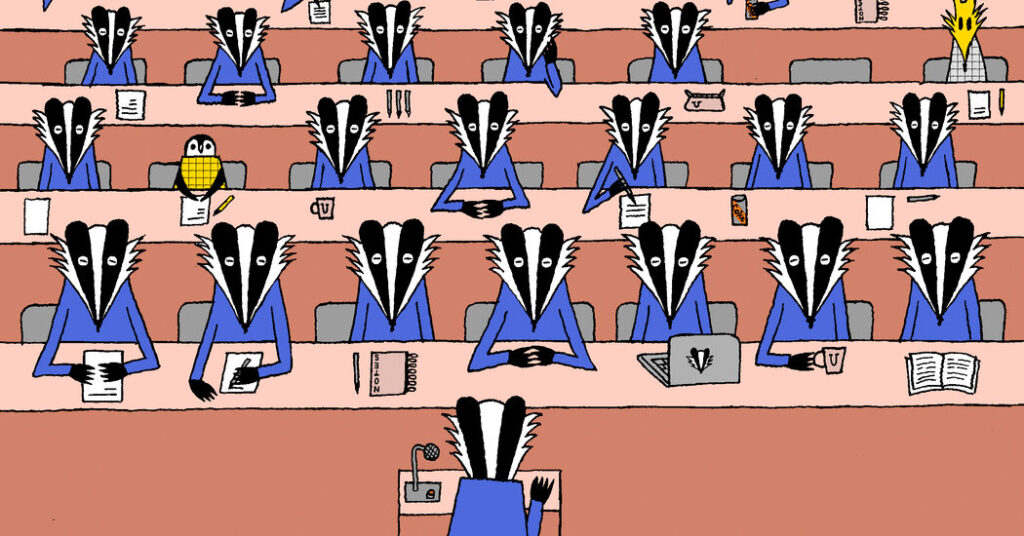
Classes in fields like political science and sociology, which can be relevant to current events, ought to give students an opportunity to encounter and consider a range of opinions and viewpoints. Yet there’s a shortage of vigorous political debate in many such courses, not only because students worry about offending a classmate or their professor (or because of how the course is designed), but also because they are self-sorting politically by college major.
Nationally, around 60 percent to 69 percent of students who major in political science, psychology, anthropology, sociology and international relations are liberal, according to data from the Foundation for Individual Rights and Expression. Among students who major in theater, English, film and media studies, fine arts, music and environmental studies, about 73 percent to 83 percent fall into the liberal camp and 9 percent or less are conservative.
At elite colleges, where students tend to be the most politically engaged and progressive, these numbers are higher still. The upshot is that in upper-level classes where it might be appropriate to discuss controversial issues, there often isn’t enough strong disagreement among classmates for debates to gain traction.
For years critics on the right have contended that universities are leftist indoctrination machines. Defenders have denied the charge, arguing that smart, educated people are drawn to progressivism as a matter of course. My research suggests that both camps are missing the bigger picture. The critics are correct that politics suffuses the college experience, but wrong to think that its main form is coercive or confrontational. The defenders of universities are correct that most students do not experience college as an indoctrination, but wrong to think that that’s the end of the story.
The truth is that because of polarization and self-sorting, the college experience has become more political than ever, albeit in more subtle and ultimately more insidious ways.
Neil Gross is a professor of sociology at Colby College, a researcher at the Harvard Radcliffe Institute and the author of the forthcoming book “What Happened to College? How Politics Broke Higher Education and What We Can Do to Fix It,” from which this essay is adapted.
The Times is committed to publishing a diversity of letters to the editor. We’d like to hear what you think about this or any of our articles. Here are some tips. And here’s our email: [email protected].
Follow the New York Times Opinion section on Facebook, Instagram, TikTok, Bluesky, WhatsApp and Threads.
The post College Is More Political Than Ever. But in a New, Insidious Way. appeared first on New York Times.