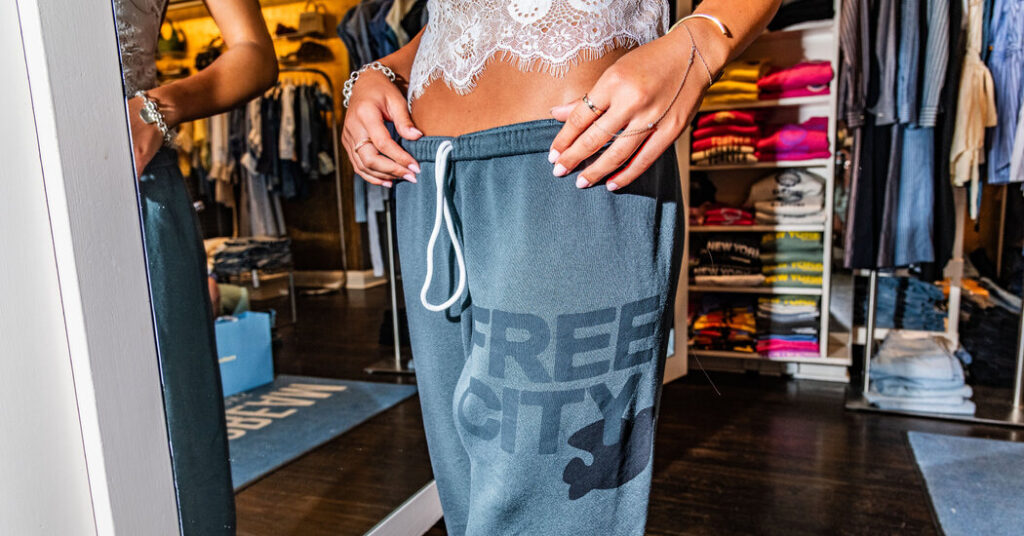
If a Hamptons uniform exists, it’s a discreet blue-and-white striped “shent” — shirt/tent style — as popularized by Ina Garten. In the historic Long Island seaside villages, the quietest and most timeless looks persist. Think beige cashmere pullovers, bleached white jeans, more-expensive-than-they-appear leather sandals. It’s rare to spot anything that wouldn’t blend into the background of a Nancy Meyers film. So the latest East End status symbol, a pair of $168 indie sleaze-era sweatpants with a garish logo, stands out.
Free City sweatpants, which first had their moment in the early to mid-2000s, are quickly replacing subtler bottoms on the beaches and in the villages of the Hamptons. Instantly recognizable, the soft, classic-style sweats are emblazoned with a dove and the all-caps Free City logo. The long and short cutoff versions are rampant in the area’s boutique fitness scene, where I’ve spotted them in classes at New York Pilates, Forward Space and Tremble at the Barn, the Bridgehampton workout mecca. At chichi East Hampton cafes like Sant Ambroeus and Tutto Caffé, post-Pilates trendsetters wear them slung low, revealing a slice of toned midriff.
The first time around, Free City sweats were part of the louche, slightly trashy look worn by celebrities who were hounded by paparazzi at the beginning of the century. When Madonna, Gwyneth Paltrow or Miley Cyrus wore them in the early 2000s, they seemed to say, “I will not dress up for you.”
“The sweatpants took off, then they took off again, then they took off again,” said Nina Garduno, Free City’s hippie-chic founder. Garduno said she still owned 100 percent of the brand she founded in Los Angeles in 2001 when she was a buyer for the West Coast fashion institutions Ron Herman and Fred Segal, championing intellectual designers like Dries Van Noten and Comme des Garçons. She seems stunned by Free City’s resurgence, which she said began to surge in sales again during the coronavirus pandemic when her “website blew up.”
Free City’s resurgence isn’t limited to the Hamptons, but, like iced matcha prices and brand activations, it’s turbocharged there. Part of the popularity can be chalked up to the trend pipeline of savvy Substack-reading women from Los Angeles and New York City summering and lounging out east. The pants have also been sold at the Row boutique in Amagansett, where they stand out amid Mary-Kate and Ashley Olsen’s racks of subdued staples.
Some of the appeal is nostalgic. “Everyone keeps saying 2016 is back — apparently, so are the sweatpants,” said Alie Mitchell, the owner of Social Life Magazine and Polo Hamptons who recently wore a pair of her slouchy Free City sweats to a “wellness morning” at the Shou Sugi Ban House spa in Water Mill. Mitchell first bought them when she was a self-professed SoulCycle fanatic 10 years ago. The workout behemoth sold them then, and still does today.
“We’re pulling out all the things that we loved in our 20s and realizing that they were actually really good,” said Meredith Shumway, a fitness instructor who has noticed a sea of Free City sweatpants at the Formula x Meredith, her perpetually sold-out cardio classes in Bridgehampton. “I joke that the Formula has become a little time capsule, between the 2000s playlists, trucker hats and all the Free City sweats in the room.”
Garduno was inspired to start Free City after a trip to Freetown Christiania, the anarchist community in Copenhagen. When she was there, she had an epiphany, which she described as an impulse toward “pure freedom” and creativity. Free City’s early, experimental stores in Malibu, Calif., and Hollywood, which are now closed, included whimsical features like fresh-squeezed juices, custom-painted bicycles and giant crystals.
Garduno still keeps it scrappy. She eschews bigger collaborations in favor of ones that feel heartfelt, such as one in 2025 with the fellow Los Angeles label Madhappy. The double-logo collection sold out pretty much immediately. She no longer has stores, but Free City’s direct-to-consumer and wholesale businesses are thriving.
“You can imagine how many times people wanted to buy Free City,” Garduno said. “They’re like, ‘I could make billions of dollars on this sweatpant, sell it all over the world,’” she recounts, saying she always turns down potential buyers for not understanding the brand’s ethos.
“I said ‘no’ way more than I said ‘yes,’” Garduno said. “The ‘no’ has kept me here.”
The “no” strategy is working out pretty well for Free City. “They’re definitely the cool-girl sweatpants of the moment,” said David Thielebeule, the fashion director of Bloomingdale’s, which he said was the only department store that carries the brand. “They’re our No. 1 sweatpants, and we can’t keep them in stock.”
Some die-hard fans never stopped wearing their original sweatpants. The jewelry designer Lisa Eisner has an entire section of her closet dedicated to the brand and compares them to Linus’s security blanket.
Garduno explains Free City’s continued success with the philosophical verve of a lecture at Burning Man. “What’s important about it is that it’s just pure connection,” she said.
“I’ve kept enough room for everybody to be able to make it their own,” she said.
The post Why Are These Retro Sweatpants All Over the Hamptons? appeared first on New York Times.