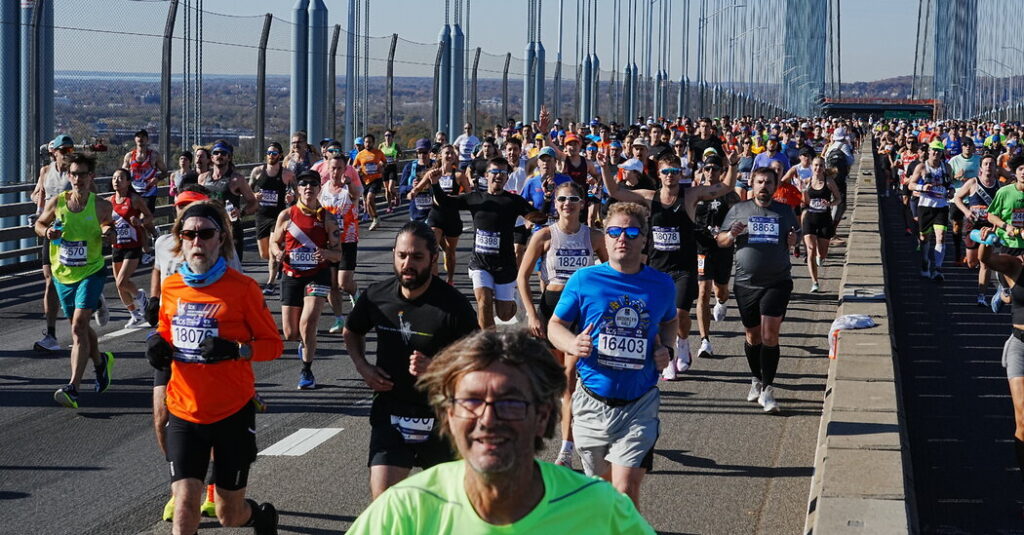
The organization behind the annual New York City Marathon, one of the largest races of its kind, announced on Thursday that it would revamp its popular 9+1 program for guaranteed entry into its 2028 competition.
For the first time, participation in the program, which requires runners to complete nine races and one volunteer opportunity, will be based on a drawing, according to New York Road Runners, the organizer that stages the marathon and dozens of other races across the city each year.
Rob Simmelkjaer, the chief executive of New York Road Runners, said the popularity of the 9+1 system had led to long waits online to sign up for races and stiff competition to get into local races.
“This was the solution that we thought was most equitable, that was most manageable and that continued to keep the tradition of 9+1, which is a great tradition, alive,” he said in an interview on Thursday.
The 9+1 program, popular among New York City’s growing running population, has been around since the early 2000s, according to New York Road Runners. Over 200,000 runners have used it to gain entry to the marathon since the program’s inception. Until Thursday, simply completing the program ensured entry.
Now, the program has been limited to roughly 15,000 participants who will be chosen through a yearly drawing. It will also require a formal registration process that includes paying a $99 fee, if selected, to become a “9+1 passholder,” which provides participants with help from New York Road Runners in matching with qualifying races.
The 9+1 program has always and will continue to be limited to New York Road Runners members, which requires a $64 fee.
Matthew Forys, the vice president of strategy for New York Road Runners, said in an interview that the number of people completing the 9+1 program has increased by 29 percent since 2019. He estimates the new program will lead to a 15 to 20 percent reduction in the amount of 9+1 participants.
The program creates the largest pool of runners out of all other qualifying methods, of which there are about a dozen, including signing up through charities, an annual drawing, time qualifiers and international tour operators.
The change comes as marathons and other races around the world have struggled to meet the seemingly ever-increasing demand from a post-Covid running boom. In June, the London Marathon, another world marathon major, announced that it would split the 2027 men’s and women’s races over two weekend days.
Juan Esteban Baus, 29, who works in clinical research at NYU Langone Health and lives on the Upper East Side, participated in the 9+1 program in 2024, which qualified him to run the 2025 New York City Marathon. He said that he did not experience issues registering for the required races or his volunteer spot.
“It was a great experience — I think it got me to different parts of the city, different boroughs that I otherwise wouldn’t have been to,” Mr. Baus said. “It really created a sense of community through running in New York City.”
But for others, the program’s popularity meant long wait times to register for races — akin to a Ticketmaster line for those looking to snag tickets to watch Harry Styles or Taylor Swift — only to find that the race they wanted to run was sold out.
Drea Smith, 44, a personal trainer who lives in the Bronx, ran the New York City Marathon in 2025 after securing a spot through the annual lottery for guaranteed entry. To run in this year’s marathon, she completed the 9+1 program.
To prepare for race registration, she said, she set an alarm, made sure she was logged in to her Road Runners profile and devoted an hour to waiting in line. She said she was not sure the new system would help.
“It’s absolutely absurd,” Ms. Smith said. “And then to add this layer on top of an already ridiculous process — I don’t know that this was the answer.”
In addition to the changes to the 9+1 program, New York Road Runners said it was getting rid of its Member Plus tier, which granted advance registration to those who paid an additional fee, usually about $60. The races themselves cost money to register for, with fees around $25 for a 5K, $105 for a half marathon and over $250 for the marathon itself for members.
Both Mr. Baus and Ms. Smith expressed concern that the new program would make 9+1 less accessible to people who might not be able to afford the $99 fee to participate. Ms. Smith also raised worries about “back-of-the-pack” runners who would not be able to meet the qualifying time and who depended on the 9+1 program for a chance to participate in the marathon.
“It was amazing — the energy from New York City is 10 out of 10,” Ms. Smith said of her experience running the marathon. “There are thousands and thousands of people out there screaming and cheering and handing you slices of oranges and tissues and beer if you want it. It really is a magical time.”
The post Want to Run the N.Y.C. Marathon? You May Have to Enter Another Lottery appeared first on New York Times.