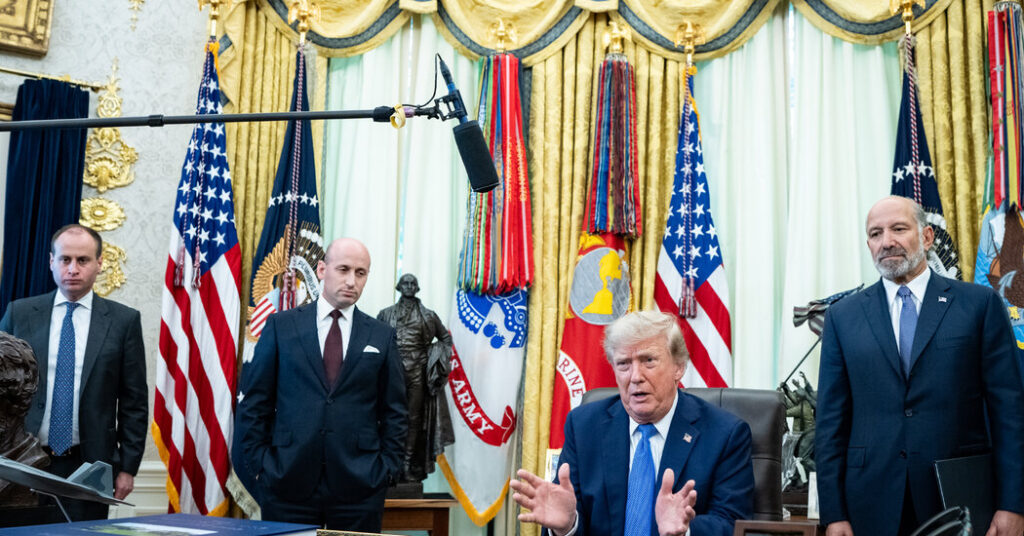
President Trump signed two executive orders on Thursday aimed at limiting the number of people who are eligible for birthright citizenship and cracking down on “birth tourism,” in which women give birth in the United States to get automatic citizenship for their newborns.
The new orders came weeks after the U.S. Supreme Court, in a 6-3 ruling, rejected the president’s previous efforts to end birthright citizenship for undocumented citizens through executive orders.
During an Oval Office event, Mr. Trump told reporters that the June 30 Supreme Court ruling was a “very, very unfortunate decision.”
“This was done right after the Civil War,” Mr. Trump said of the constitutional amendment granting automatic citizenship to infants born in the United States. “This was for the babies of slaves, and what’s happening now? People are building businesses around it.”.
It was not immediately clear how the twin orders could realistically be enforced. They would restrict those who could qualify for birthright citizenship, to exclude children of staff working for foreign governments but serving in the United States, and the babies of mothers who lie about their intentions for visiting the country while pregnant. There is a third category, for babies born in U.S. territories, but that would first require congressional action.
And then there are children whose parents are tagged by the government as being part of known terrorist groups or who are “alien enemies.”
Mr. Trump has criticized birthright citizenship for years, using it as a political tool as he has repeatedly tried to restrict legal immigration. He has talked about trying to end it since his first presidency. And in unusual move, he attended oral arguments in the birthright citizenship case at the Supreme Court, a presidential first.
Stephen Miller, Mr. Trump’s top domestic policy adviser and the architect of much of his immigration platform, and Will Scharf, the White House staff secretary, described the orders as important correctives to the current system.
“As the president mentioned, the 14th Amendment was passed exclusively in the aftermath of the Civil War, so to ensure that the children of slaves would be citizens,” Mr. Miller said. “It had no other meaning and purpose outside of that, and that’s been clear, obviously, since the day that it was passed.”
Mr. Scharf described “birth tourism” as “something that used to happen incidentally, where somebody who happened to be on vacation here went to labor early and had a baby,” a relatively narrow subset that has grown into “organized rings, at times criminal rings, setting up a system whereby” tens of thousands of people come to the country solely for that purpose.
Mr. Scharf said among the actions being considered would be denying visas to visitors they suspect are coming to the country solely for delivering a child in the United States.
“There’s absolutely nothing in here that runs afoul of any of the Supreme Court’s opinions on the subject,” Mr. Scharf said.
Mr. Miller said that Section 215A of the Immigration and Nationality Act gives the president the authority to engage in these new restrictions, when asked how the administration will determine the difference between “tourism” and “birth tourism.”
When a reporter noted that the president’s own solicitor general had been unable to tell the Supreme Court precisely how many people were benefiting from birthright citizenship, Mr. Trump replied, “I’ll tell you right now, hundreds of thousands, OK? Hundreds of thousands.” (Pennsylvania State University scholars released a study about the time of the Supreme Court ruling that found that fewer than 0.3 percent of all births in the United States were to tourists, in any year.)
But Mr. Trump pressed on, “You have one man came in with a family head said he had 56 children. Another one came in. They said they had 98 children. This was not what it was for. This was meant for the babies of slaves. It was, it was right after one week or two weeks after the Civil War ended.” In fact, birthright citizenship was ratified as part of the 14th Amendment more than three years after the war ended.
Any renewed effort to prevent new classes of people from having babies in the United States who are automatically citizens would invite fresh rounds of litigation. There would likely be challenges, for instance, to who counts as “alien enemies” and invading armies — categories that lower court judges have already rejected in separate cases involving the Trump administration’s aggressive immigration policies.
Federal immigration law gives the government broad power over entry into the United States, but the law also forbids discrimination in the issuing of immigrant visas. Limits on the entry of certain pregnant women from other countries, as the president’s order envisions, could also give rise to claims of discrimination.
In its final opinion of the Supreme Court’s term, the justices rejected Mr. Trump’s attempt to prevent babies born on U.S. soil to undocumented immigrants and temporary foreign residents from being given citizenship automatically.
The decision was a major blow to Mr. Trump’s longstanding effort to limit the guarantee of birthright citizenship and the president wrongly suggested after the ruling that he could get around the court’s decision through legislation.
Five justices — a majority — found that birthright citizenship was guaranteed in the Constitution, meaning the president would likely need an amendment to change the long-held principle that nearly all children born in the United States are American citizens.
A sixth justice, Brett M. Kavanaugh, said he would have struck down the president’s order based on federal law, not the Constitution.
Soon after the court announced its decision on June 30, Mr. Trump said he would ask the justices to reconsider their decision, a long-shot request since the Supreme Court has not agreed to revisit an argued case in decades.
The deadline for such a filing passed last week without the president asking for a rehearing.
In response to the president’s orders on Thursday, Cody Wofsy, deputy director of the ACLU’s Immigrants’ Rights Project, said in a statement, “The Supreme Court already decided this issue: Birthright citizenship is guaranteed by the Constitution. No additional executive order can change the meaning of the Constitution. Any executive order that tries to rewrite birthright citizenship will meet the same fate as the last one.”
The post Trump Signs Executive Orders Targeting Birthright Citizenship appeared first on New York Times.