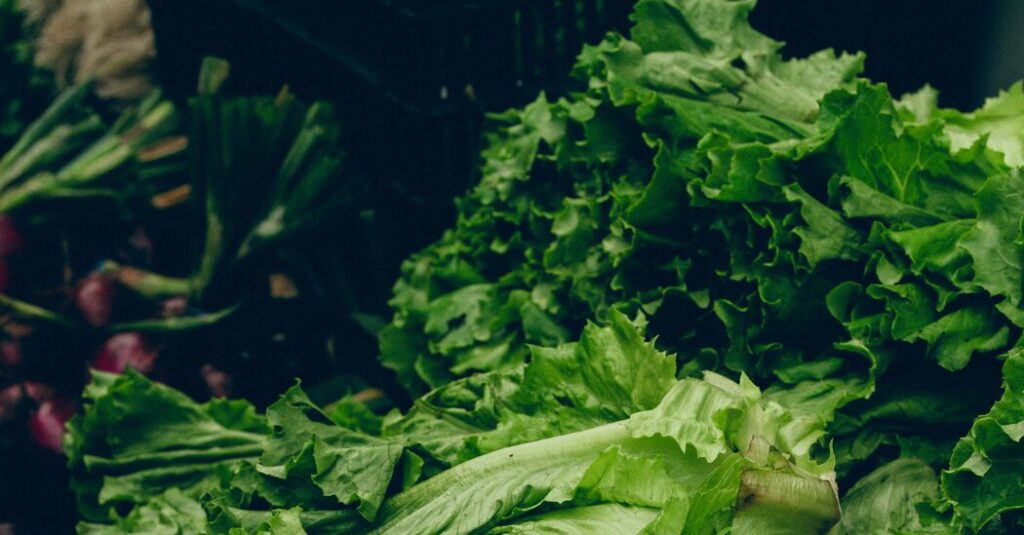
Oliver’s Produce, a small family-owned farm and market in upstate New York, sold 700 heads of lettuce last July. This July, as an outbreak of cyclosporiasis scared people off from leafy greens at chain restaurants and grocery stores, sales more than doubled, to 1,500 heads.
“We actually sold out last Friday, ahead of the weekend,” said Sawyer Oliver, part of the husband-and-wife team that owns the farm.
Sales of prepackaged salads in grocery and other retailers dropped more than 20 percent in mid-July from a month earlier, according to Nielsen IQ, a consumer research firm. Instead, more consumers are turning to local produce stands, farmers’ markets and even greenhouse-grown produce in the belief that romaine, spinach and butter lettuce are safer than produce grown in large industrial farms.
Ms. Oliver was managing the sudden surge in demand this week, dealing with calls from customers disappointed they couldn’t get their hands on leafy greens and local restaurants frantic for new sources for lettuce.
“We have people hounding us, wondering when we’ll have more,” she said.
Oliver’s Produce is one of many small farmers benefiting from the swirl of uncertainty around leafy greens as the country remains in the grips of a record outbreak of cyclosporiasis, an illness that strikes people with stomach cramps and severe diarrhea. As of Wednesday, the Centers for Disease Control and Prevention has confirmed or is investigating more than 22,000 cases in 47 states, and has reported 517 hospitalizations. Two deaths in Michigan have been linked to the illness.
Federal health officials have linked more than 6,300 of those illnesses to iceberg lettuce grown in Mexico or served at some Taco Bell locations and elsewhere. Taylor Farms, a supplier of Taco Bell and the country’s largest produce supplier to grocery retailers and restaurants, voluntarily recalled iceberg lettuce shipped to 27 states.
But despite repeated assurances from Taylor Farms, which said in a statement that “all implicated product is no longer in the market,” many consumers are shunning the bags and plastic containers of arugula and spinach they bought just a few weeks ago.
Some of the distrust from consumers stems from the lack of visibility into where lettuce comes from. Taylor Farms, a vegetable behemoth with more than $7 billion in annual sales, sells salad kits under its own name, but much of its sales to grocery retailers and restaurants are a mystery to consumers. The company — like other food producers — does not disclose which stores or restaurants use its leafy greens or other vegetables, which has fueled speculation across social media as consumers debate whether Taylor Farms is the source of their favorite leafy greens.
A’shia Sun, a florist in Charlotte, N.C., used to buy her containers of mixed greens from Walmart, largely because they were cheaper there. But when the cyclosporiasis outbreak happened, she stopped buying lettuce altogether.
“I went two weeks without buying any produce before I said, ‘There has to be a lettuce that is safe to eat,’” Ms. Sun said. She saw posts on social media about people switching to indoor greenhouse-grown produce. On her next trip to Walmart, she picked up a package of greenhouse-grown lettuce from Little Leaf Farms.
“I don’t think I’ll go back to the other lettuce brand,” Ms. Sun said. “I don’t feel very confident in the information we’re getting from the government right now. Even if they came out and said, ‘Yup, everything is safe,’ I’m not sure I would trust that.”
The distrust among consumers of Big Lettuce has been good business for smaller, local producers — even newer businesses like John Warner’s 520 Greens, which uses hydroponics, or soil free, methods to raise unusual varieties of lettuce, like Muir and Tropicana. Mr. Warner does all of this out of a 1,200-square-foot greenhouse in his backyard.
“Normally, I’ll sell roughly 90 percent of my lettuce and some herbs, like cilantro, in about four hours” at two farmer’s markets in Tucson, Ariz., he said, but “last weekend, I had a continuous line and sold out in 90 minutes.”
Mr. Warner quit his job as a manager for a commercial laundry equipment distributor more than two years ago. This week, he is putting the finishing touches on a new greenhouse, and in about four weeks, he hopes to start selling lettuce to local restaurants.
“I have been planning it for a while, then, all of the sudden, the outbreak happened,” Mr. Warner said. “I wish I had started it four weeks ago.”
Some companies, trying to distance themselves from traditional lettuce production used by Taylor Farms and other big growers, are reaching out to consumers to ease their concerns. Little Leaf Farms, whose leafy greens are grown in two indoor greenhouses on the East Coast, saw sales of its packaged greens at big retailers dip in mid-July as the confirmed cases of cyclospora grew, said Paul Sellew, its founder and chief executive.
So the company took to social media, posting pictures of its controlled facilities and noting it had never had an outbreak of cyclospora.
“There was a lack of clarity and the public is rightly concerned,” Mr. Sellew said. “It was time to let the people know that our lettuce is grown differently and there is no way we could be impacted by this type of pathogen.”
The public outreach helped, and by late July, sales had rebounded, he said.
Tami Purdue, the founder of Triangle United Growers, an organization of local produce, meat and dairy farmers in North Carolina, said more consumers had been asking about the organization’s growing practices and its food-safety procedures. She’s been fielding those calls, and sales at local farmers’ markets for the growers’ group rose 30 percent in July with subscriptions for its delivered boxes of produce up 20 percent, she said.
The big question remaining for local growers seeing big demand for their produce is whether consumers will stick around after the cyclosporiasis outbreak fades.
“We’re not going to keep everybody — some people will go back to prior habits,” Mr. Sellew said, noting the company is getting ready to open a site in Tennessee, its third in the country. But, he said, the company will benefit from consumers trying the brand and “looking for alternatives for product that is not going to get them sick.”
There are already discussions at Oliver’s Produce around ramping up the planting of lettuce next year, Ms. Oliver said.
She said she thought consumer purchasing habits would change long term because of the cyclospora outbreak. She said that when the pandemic began in 2020 and consumers were scared to go to grocery stores, sales at the produce market doubled and held in the next few years.
“Obviously, the grocery store is more convenient than us,” Ms. Oliver said. “But we hope that once consumers see how much better quality they get from the lettuce they bought from us, they’ll feel it is worth it to go out of their way and shop here.”
The post Scared of Cyclospora, Consumers Turn to Local Lettuce appeared first on New York Times.