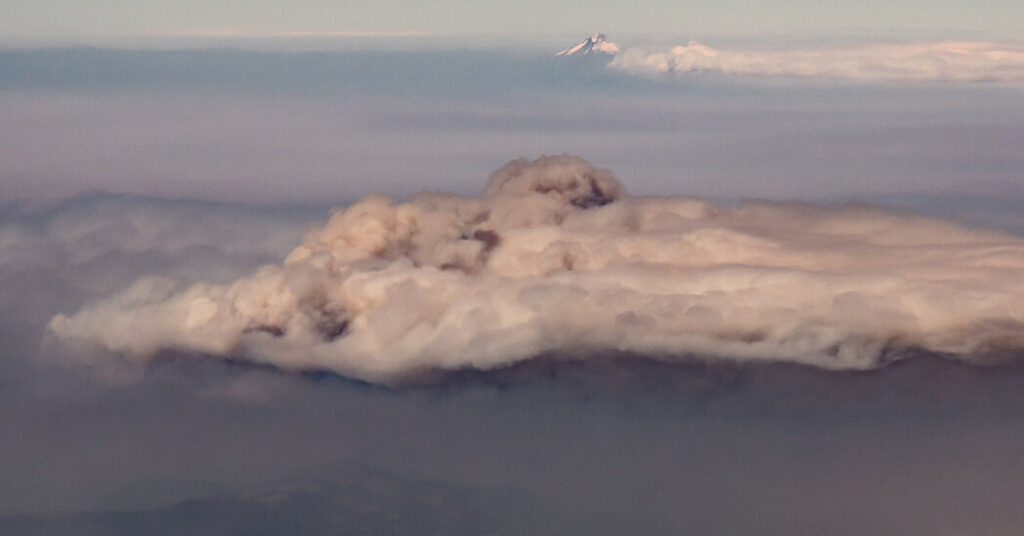
Toxic air from dozens of wildfires burning in the Pacific Northwest gave skies over the region an orange hue in recent days and made going outside a miserable and potentially dangerous experience. Across Oregon and Washington, people closed their windows tightly to prevent wildfire smoke from entering their homes, donned masks for exercise and yardwork and hit refresh on air quality apps.
“This is a good reminder that our summers are changing,” said Nadège Dubuisson, a public health program supervisor with Multnomah County, Ore. “This is probably going to be our new reality, and we need to kind of be helping everybody get smoke-ready and wildfire-prepared.”
On Thursday morning, air quality alerts were in effect across much of Oregon, Washington and neighboring Idaho. Yet there was hope that conditions would improve in coming days.
The smoke was starting to drift out of Oregon and Washington and, with a shift to breezier weather, was expected to clear gradually through the weekend, forecasters said. But the winds are a double-edged sword. They could also aggravate the fires, leading them to produce more smoke. And since the winds are expected to blow from the west, they are likely to cause air quality problems to the east, from the northern Rockies to the Midwest.
“The issue is that we have incredibly dry vegetation, and with no precipitation on site, these fires are going to continue burning on the landscape,” said Nathan Santo Domingo, an air resource specialist at the Washington State Department of Natural Resources.
Air pollution levels are measured with the Air Quality Index, which soared above 300 this week at some locations in eastern Oregon and Washington, where most of the fires were burning. That level is considered hazardous — levels of 50 or below represent good air quality — and is generally the highest the region has recorded since 2022.
On Wednesday, Larry O’Neill, the state climatologist of Oregon, was in Eugene, where skies were hazy and the A.Q.I. hovered between 200 and 250.
“The smoke is definitely thick out there,” Dr. O’Neill said. “You can’t see very far. We’re in a mini heat wave as well. Temperatures are close to 90. It’s pretty bad outside.”
This summer has been particularly busy with wildfires, and the situation intensified last Saturday as wind-whipped wildfires raged across the parched, drought-ridden landscape in eastern Oregon and Washington, pumping out huge plumes of wildfire smoke.
In the following days, the winds eased and shifted direction, nudging the smoke to the west, degrading air quality levels in Seattle and Portland, Ore. A high-pressure system developed over the region and acted as a lid that trapped the smoke, engulfing almost all of the Pacific Northwest in acrid air.
“It does take a toll on your mental health,” said Kelli Hawkins, a spokeswoman for the Spokane Regional Health District in Washington. She added that even if you can go outside, “you still don’t feel good. The sky is darker. You don’t have that nice summer weather that we only get three months of.”
Public health officials now encourage people to be “smoke-ready” by having access to filtered air.
Wildfire smoke is becoming a summer norm in the Northwest. That’s changing how families think about where to vacation, how landscape and construction crews schedule their shifts, how summer camps plan start times and how groups that serve homeless people think about the future.
“We’ve been talking about what would it be like to be open all day long, not just when our cafe is open, to be able to bring people inside when it’s 20 degrees or 100 degrees,” said Steve Cook, executive director of Blanchet House, a social services nonprofit in Portland that provides meals.
“You’re talking about people who often have nowhere to go,” he said. “They’re just migrating from place to place, trapped in this dangerous air.”
While meteorologists said on Thursday that the smoke conditions were likely to improve in coming days, it remained unknown what the dozens of wildfires across the region would do next. Smoke is also notoriously tricky to forecast, and where it drifts next can change with the slightest gusts.
The air quality in Spokane, where fires destroyed more than 700 homes and businesses over the weekend, fluctuated wildly this week: On Wednesday the A.Q.I. was down to 110. A day later, it was back to 164.
“It all comes down to the weather and the wind, right?” Ms. Hawkins said. “We all know how to pay attention to that stuff now.”
The post ‘Our New Reality’: Wildfire Smoke Fills Skies Over the Pacific Northwest appeared first on New York Times.