It was a warm Sunday July afternoon in the rolling landscape of southern Germany and the faithful were processing up a steep hill and purifying themselves as if before Mass. They had come for the Bayreuth Festival, an annual celebration of the music dramas of Richard Wagner, which was opening its 150th anniversary edition with “Rienzi,” one of the composer’s early works.
The politicians and celebrities would arrive later, and the mood was relaxed. Casually dressed tourists gawked at the Festspielhaus, the event’s storied theater, and mingled with people dressed in white tie and evening gowns. To everyone’s relief, the outdoor temperature was a sensible 78 degrees (the theater has no air-conditioning).
A group of aficionados stooped outside — friends who found their way to Wagner as teenagers and met as young men in Bayreuth. Now, they travel across Europe to see performances of the composer’s operas. “It’s an addiction,” said one, Daniil Starikov. “You can’t live without it anymore. Our drug is Wagner.”
“It’s a religion,” said Barbara Stüwe, sitting nearby at a card table where she rents opera glasses to patrons. “They come to Bayreuth like pilgrims.”
Stüwe started working at the festival nearly 30 years ago, and was granted her binocular rental concession by the family of the composer. Back then, she had a stand in the lobby; she’s been outside since 2009. “Katharina,” she said dryly, “decided the glasses weren’t needed anymore.”
Katharina, now 48, is the composer’s great-granddaughter, and inherited the family business from her father, Wolfgang Wagner, when he died. It was telling that Stüwe used her first name. While they may not actually be on first-name terms, the audiences who flock to this annual celebration of Wagner’s music dramas — and people like the innkeepers in town who tend to their needs — are acutely aware of Katharina Wagner’s presence and preferences. They feel a sense of collective ownership over the event and a closeness to the family that runs it.
It started in the years leading up to 1876, when the composer Richard Wagner was seeking an appropriate venue for the performance of his monumental, four-opera “Ring” cycle.
Think about the first scene of the film “The Age of Innocence,” set in the early 1870s — how Newland Archer, played by Daniel Day-Lewis, wanders into a New York opera house and takes his seat in a box partway through an act. The audience is lit almost as brightly as the stage. He can pay attention to one or two arias while still flirting shamelessly with a countess in the box opposite. The theater is a social setting to see and be seen, where the goings-on onstage are only a part of the experience.
Wagner was opposed to this. He wanted to create “music drama” that was audience’s sole focus.
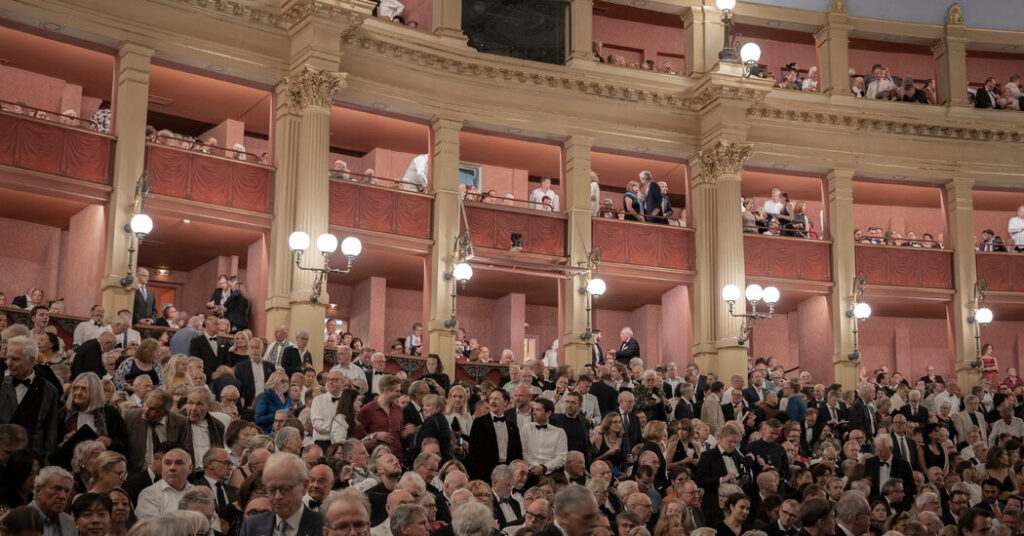
The Festspielhaus has no boxes. Its seats rise in an amphitheater-shaped fan, its walls and proscenium focus attention on the stage. The pit is covered, so the orchestra’s sound rises as if from the building itself. The cover also ensures that no light leaks out of the pit to remind audiences that they’re watching a staged show.
It was designed as a singular place to interpret and contemplate Wagner’s works: more religious temple than standard-issue opera house. As Wagner wrote, the theater aimed to transport viewers into an “ecstatic state of clairvoyance in which the scenic image” becomes “a true reflection of life itself.”
The theater, which has seats made of back-numbing plywood and no ventilation, cooks in the afternoon sun before each performance. But it is worth it, said Annemarie Silberbauer, who has attended annually since 1993, for the “goose bumps” you get if it all goes well.
Wagner thought about building the Festspielhaus in Zurich or Munich before settling on Bayreuth. He had temporarily fallen out with King Ludwig II of Bavaria, who was in thrall to the composer and had paid his bills and extensive debts while he wrote some of his most important works.
After a meeting with Chancellor Otto von Bismarck to secure state funding was unfruitful, Wagner sought to make the festival self-supporting. He helped invent modern arts fund-raising, creating a system in which wealthy private patrons invested and reserved blocks of tickets.
A network of “Wagner Societies” formed around the globe and invested in the shares. For decades, these societies controlled access to many tickets, leading to long waiting lists.
Yoshi Onodera lives in Toyko and fell for Wagner as a teenager. “Wagner’s music does something to my soul,” he said. He first became a member of the Richard Wagner Society Japan in 2000, in his mid-20s; in 2005, he first got a ticket to hear the “Ring” in Bayreuth, and has attended annually ever since.
Despite the elegance of its audiences and the price of its drinks and tickets, the Festspielhaus has a rustic vibe. The grounds are dotted with portable toilets. There are barely any indoor lobbies; before the performance and during the luxurious, hourlong intervals, audience members stroll across plazas and parks outside and munch on sausages.
The end of the intermissions (Wagner operas usually have two) are announced not by bells but by brass fanfares, arranged by the composer himself from the music of the upcoming act, which ring out from a balcony at the front of the theater.
Gabrielle Schellert is a familiar sight at opera premieres in Berlin. There’s lots of Wagner performed there, too, but Bayreuth, she said, is special: “It’s the emotion in the music and its performance.”
Wagner was a master technician of emotions. He also expressed antisemitic views and understood his work as part of the creation of a German national and racial community. The Wagner family enthusiastically supported the Nazis before and after they took power. Adolf Hitler visited regularly and used the festival for Nazi propaganda purposes.
The 2026 opener, “Rienzi,” is a youthful Wagner effort about a populist Roman leader. Hitler loved it so much that he owned Wagner’s original score, which is now lost and presumed to have been in Hitler’s bunker when it was destroyed after the dictator’s suicide. That makes it particularly difficult to separate the music from the politics. The new production, by the directorial team of Alexandra Szemerédy and Magdolna Parditka, explicitly thematizes the dangerous power of mob rule.
This summer’s other debut production, a “Ring” cycle not directed but “curated” by Marcus Lobbes, in which singers perform behind a screen featuring images generated by artificial intelligence, has caused something of a scandal. One music scholar wrote that it was greeted by “booing with a fury and unanimity I have never previously encountered” and was “a rebuke not only to Wagner, not only to Bayreuth, but to any conception of art.”
Re-evaluating Wagner’s works became part of the festival’s DNA as it rebuilt after the war. (American bombs destroyed the city of Bayreuth and Wagner’s villa, but spared the Festspielhaus.) Wieland and Wolfgang, who took over the festival in 1951, adopted as their motto the phrase “Art is what matters here.” They began introducing spare, nonrepresentational productions, a radical shift from the romantic clutter of prewar Bayreuth. International audiences flocked to the performances.
In 1976, for the festival’s 100th anniversary, the family debuted its biggest change yet: a production of the “Ring” cycle conducted by Pierre Boulez (the French avant-garde composer who once suggested that Europe’s opera houses should be blown up) and directed by Patrice Chéreau as an allegory of capitalism and its discontents.
Joachim Thiery, a professor of medicine who was at the “Rienzi,” was also there for the premiere of the Chéreau “Ring.” The audience was so affronted, he recalled, that people “actually brought in whistles to try to interrupt the performance.” Nevertheless, after being filmed and released on videocassette, the Chéreau “Ring” became a generational classic and a point of reference for so-called director’s theater, in which opera productions comment on works rather than simply presenting them.
Not everyone in the audience for “Rienzi” was interested in these interventions. Jan and Sue Stanek live in Britain and Spain, and have attended Bayreuth for the past five years. Wagner, Jan said, was “obviously an acquired taste. It’s not for everyone. There are many associations which are unpleasant that some people perceive. We are interested in music. We’re not interested in politics.”
The festival remains politically contested. Since the early 1970s, it has been organized as a foundation that receives funding from the state of Bavaria and the German federal government. Even though Germany’s national culture budget is set to shrink as the economy stutters, the culture minister, Wolfram Weimer, recently presented a draft budget with increased funding for the festival.
Germans across the political spectrum are attuned to the ways that the Bayreuth Festival, which symbolizes so much about the country’s aesthetic and political contradictions, presents itself and handles its own history. That’s why Hannes Langer, who makes socially conscious, experimental theater in eastern Germany, had come — not as a pilgrim, but, as he said, “above all, to observe.”
The decision to program a freighted work like “Rienzi” was courageous, he said. “Music is powerful,” he said, “and when you hear this music, it’s no wonder the National Socialists liked it so much.”
Another patron, Marcus Erlenbauer, who has been attending the festival for many years, was relaxed about the association — especially if Wagner’s work was performed critically. “Many politicians and dictators have had a passion for something or another,” he said.
The patrons’ opinions varied as widely as their dress. There were some in the traditional Bavarian deerskin formal wear known as “Tracht,” while others wore runway fashions or sensible, heat-friendly outfits in cotton and linen.
Stüwe, who lends out the opera glasses, said she had noticed a change in the outfits over the years. “Since corona,” she said mournfully, “people come in sneakers and jeans. There’s no dress code anymore.”
But she needn’t have worried about some of the youngest attendees. Sophie Merzrath, elegantly dressed in a peach dress and white sweater, was attending Bayreuth for the second time: The first time, she was still in the womb. She might only be 10, but she’s a regular operagoer in Berlin. “I’m not sure if it’s my first Wagner opera,” she said. “But I think it’s really cool.”
The post ‘Our Drug Is Wagner’: This Festival Draws the Composer’s Fiercest Fans appeared first on New York Times.