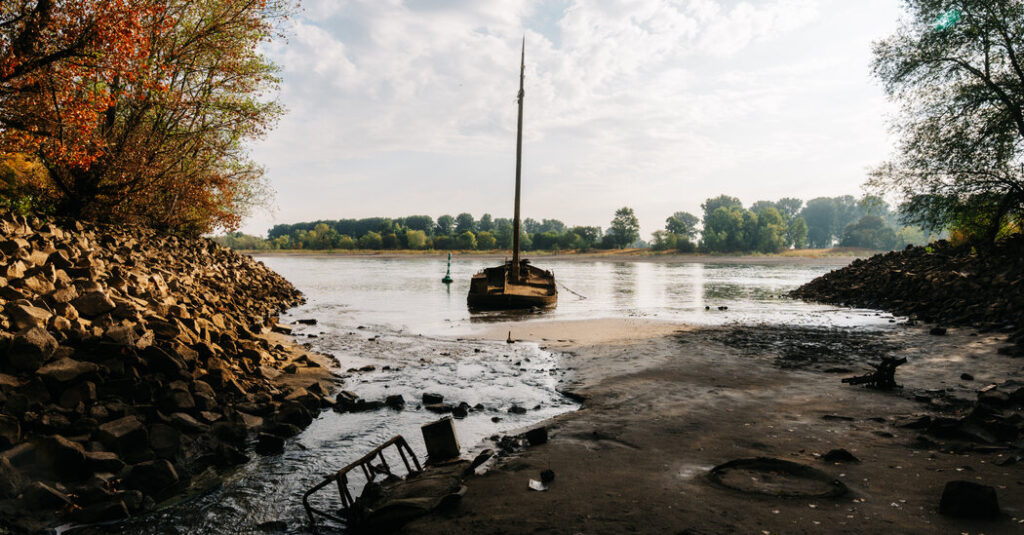
Ferocious heat waves, wildfires and freakish storms have pulverized Europe this summer. Now a series of droughts, magnified by climate change, have crippled some of the continent’s key waterways, bringing further economic pressure on a region struggling with stagnating growth and fierce global competition.
One center of the crisis is the “wide and winding Rhine” river, as Lord Byron put it, which stretches nearly 800 miles through six countries as it journeys from the Swiss Alps to the North Sea.
This vital economic artery conveys thousands of vessels and millions of tons of cargo a year that stoke trade and industry throughout the continent.
“It’s one of the most important heart chambers of the German economy,” said Carsten Brzeski, global head of macro research at ING, as well as a devoted rower.
This week, water levels hit their lowest point since 1880, when official measurements were first recorded, disrupting supply chains, raising shipping costs and possibly forcing companies to scale back on production.
The wave of extreme weather is also affecting the Danube, the second longest river in Europe, where record low water levels are exposing the previously hidden hulks of warships sunk during World War II.
That water crisis is forcing a scramble to keep electricity flowing in Hungary and Romania, which use water from the Danube to cool nuclear power reactors. Governments in both countries have appealed to households and businesses to reduce their power use.
The ripple effects of low water levels on the economy can be seen in Duisburg, Germany, where goods were being moved from bigger ships onto smaller ships, rail cars or trucks. Other boats have unloaded as much as two-thirds of their cargo so they can safely navigate the river, which at some points has a depth of little more than four feet of water.
“Now you see who is a good captain and who is a bad captain,” said Wilma van Ingen, part of a Dutch husband-and-wife team that brought the 564-foot push freighter, W. De Beijer Sr, up from Rotterdam carrying iron ore.
Her ship, which can normally carry 5,000 tons, has been reduced to carrying just 1,200 tons.
Fewer loads mean heavier traffic.
“We are working at our limit,” said Markus Bangen, the chief executive of Duisburg harbor, which processes some 100 million tons of a cargo a year and handles more than 20,000 ships a year.
The Rhine shaped the geography of Germany’s industrial might as companies built their factories and trading routes along its shores. Titans of German manufacturing — BASF, Mercedes-Benz, Bayer and ThyssenKrupp — are along the route.
Nearly 300 million tons of cargo are carried by its waters each year. The Rhine connects the North Sea port of Rotterdam to three of Germany’s largest industrial clusters, linking oil refineries, steel and chemical factories, coal-fired power plants and more along the way.
It would require as many as 100 trucks or an entire freight train to transport the cargo from a single river barge, Mr. Brzeski of ING said. But even substitutions are complicated. “The railways are a disaster as well,” he added. And at the moment, construction work means one of the routes that runs along the river is not available.
A punishing drought in 2018 shuttered factories and ended up shaving 0.3 percent off Germany’s overall output at the time, according to analysts.
The experience, though, prompted industry and officials to be more nimble, said Jens Schwanen, the director of the Federal Association of German Inland Navigation, an industry group.
“We cannot make water magically appear,” he said.
Instead, companies have adapted. They have gotten better planning for times when water levels run low. They have built more storage space in deep water ports, so goods can continue to be delivered even when waterways run dry. This has been a strategy of Siemens Energy, whose 300-ton turbines are so bulky they cannot be transported by rail or road.
There has also been a move to build ships that travel higher in the water, using different materials and wider designs.
Big propellers, though more efficient, stop working in shallow water. So some new designs feature multiple smaller propellers or special encasements that protect propellers from riverbeds.
“It’s good to see that the measures are working,” said Mr. Bangen, the Duisburg harbor chief. “We’re in a much better position than we were eight years ago.”
But the upgrades are slow. Of the nearly 8,000 cargo ships plying the Rhine, only about a dozen have been designed to handle low water levels.
And slower traffic, lighter loads and alternate routes cost more. Consumers in Germany whose petrol is shipped on the river are paying as much as 11 cents more per liter, according to the German cartel office.
An analysis by the Kiel Institute for the World Economy, a German research center, concluded: “Low water levels lead to severe disruptions in inland water transportation and cause a significant and economically meaningful decrease of economic activity.”
After a month of low water, “industrial production in Germany declines by about 1 percent,” Kiel found.
That’s quite a lot in a country that “for a prolonged period of time has been stagnating rather than growing in any significant way,” said Stefan Kooths, a research director at Kiel.
Shipping crises outside of Europe’s borders have also battered the region’s economies. The war in Iran and disruption of trade and energy deliveries through the Strait of Hormuz and Bab al-Mandab Strait have pushed up oil prices and fed inflation.
Concerns about rising prices caused by the conflict prompted the European Central Bank to raise interest rates in June.
At the same time, Europe is essentially fighting two trade wars: one with China, over a flood of cheap goods, and a second with the United States over a range of tariffs.
The forces of geopolitics and geography are both taking their toll, with more to come. Less snowfall in the alps during the winter months caused lower river levels this summer. The drought now means there is less rain flowing into the river. The heat has made things worse, causing surface water to evaporate and lowering water levels at a very early point in the season.
And more baking weather without rain is expected in the coming weeks.
The post Drought Threatens a Vital Economic Artery in the Heart of Europe appeared first on New York Times.