The color of the cherry blossom hovers between pink and white. The blooms peak briefly. It’s hard to explain why Japanese love the sakura. But they do, deeply.
Robots do not appreciate the soft evanescence of the sakura. Nor do they understand why a snowbound town in northern Japan has dedicated itself to the cultivation of a winter variety.
But the residents of Nishikawa have discovered — at least they thought they had discovered — that they need robots for their sakura. There are not enough workers in town. The average age of a Nishikawa farmer is 73. Who else will work in the most depopulated town in one of the most depopulated prefectures in one of the most depopulated nations on earth, if not for an amalgamation of aluminum, steel and hard plastic?
“We had to do something,” said Mitsuya Kaneko, the head of the Nishikawa cherry blossom farmers’ union, whose parents, aged 75 and 84, still plod through the snow to prune and package winter sakura in a largely unheated shed. “We cannot just die out.”
Mr. Kaneko, at 53 years old, is tech savvy. He pushes his glasses down his nose to peer at his iPhone from which he can check the temperature and humidity of his sakura orchards, as well as catch a livestream of cherry trees being cherry trees. After watching his hometown shrink and its farmers stoop ever steeper with age, Mr. Kaneko worked with the local government to bring technology to Nishikawa.
Agricultural officials installed sensors detecting minute temperature variations to determine the best time for harvesting the winter sakura. (That turns out to be after 500 hours of temperatures below 8 degrees Celsius, or 46 degrees Fahrenheit.) They deployed grass-mowing robots. And as their triumphal act, they ordered a robot that would allow the farmers to more easily transport and load bundles of cherry blossoms onto trucks. Pochi, as the robot was named, was to arrive last November.
Then the farmers of Nishikawa waited. November came and went. In a nation that has made punctuality a high art form, the delay was embarrassing. Pochi finally arrived on Christmas Day, a cheery yellow container on wheels that looks less like a sophisticated robot and more like an oversized Lego construction. The price tag was about $15,000.
Since then, well, that’s the story. For all the buildup and excitement from robot boosters and local politicians from Yamagata Prefecture eager to uncork central government funds for rural revitalization, Pochi has mostly slumbered unloved in a corner of a greenhouse. The prevailing attitude toward the robot, which can negotiate mountain terrain and carry 600 pounds, was encapsulated by Hideki Shida, 84, another Nishikawa farmer. Even as Mr. Kaneko showed off how Pochi, with the slightest flick of a wrist, followed him like an obedient dog, Mr. Shida trundled past conspicuously, pushing stacks of cherry blossoms on a metal cart, his body angled with effort.
“I do things the old way,” he said, casting a dismissive look at Pochi.
Not one of Mr. Shida’s three children is a farmer. He is widowed. He lives alone and farms alone, hiking up to his mountain fields to shovel the sakura out of the snow.
Snow Country
Not so long ago, Nishikawa slumbered in the snow. Mr. Kaneko’s parents remember how the family farmhouse in the mountains above the town was inaccessible for months at a time, even into the early 1970s. The only way to get anywhere was by sled.
By the 1980s, Nishikawa, like much of the rest of Japan, had grown fast. Families moved to the snowy backcountry, eager to cultivate farmland. Japan’s agricultural ministry helped to protect them from overseas competition. Throughout rural Japan, cement mixers churned to make roads, tunnels and bridges. Yamagata Prefecture — Yamagata means “mountain shape” — dedicated itself to growing luxury crops, like La France pears and perfect cherries. Japan’s boom times were symbolized by the $100 melon, a literal fruit of postwar prosperity.
Japan’s economic bubble burst in 1992, the same year that the bullet train finally arrived in Yamagata. Discount shops offering goods for 100 yen, about 80 U.S. cents back then, popped up alongside the vendors of expensive fruit. Japan’s farming population, which had already dwindled because of industrialization and economic development, shrunk further, just as Japan’s demographics fell off a cliff.
Nishikawa lost its high school in 1991. The last supermarket closed about 20 years ago. Factories for camera lenses and cellphone parts both closed. The country’s birthrate hit a record low in 2025, and the Japanese population, now 123.8 million, is projected to fall below 100 million by 2060.
Across Yamagata, local officials have tried out various robot — and robot-aspiring — solutions to the precipitous demographic decline. The 48-year-old mayor of Nishikawa, Daishi Kanno, secured $40,000 in funding for Pochi and other “smart agriculture” innovations. Like other prefectural leaders, he has chosen technology over another potential fix to the nation’s labor shortage: welcoming more foreign workers. The Japanese government is cracking down on visas. In all of Yamagata, there are only 145 foreign farm laborers.
“Finding people who can take over for the next generation is difficult,” Mr. Kanno said.
Mr. Kaneko’s parents said their son was the only one in their community who has continued farming. Abandoned houses are proliferating in town. Nationwide, the number of independent farmers has plummeted below 1 million, from about 2.4 million at the turn of the century. Last year saw the largest-ever decline in farming households in Japanese history.
Mr. Kaneko pushed his father to get a drone operating license. He did. But an octogenarian is not the ideal drone operator.
“It’s not a habit I’ve formed,” said Keiichiro Kaneko, Mr. Kaneko’s father. “They’re all these rules for what to do.”
Every day during winter sakura season, Mitsuya Kaneko’s parents leave their wooden farmhouse, with its thin walls and chilled interior, and shuffle past snowbanks nearly double their height.
“In the winter, in our mountains, only bears can walk around,” Mr. Kaneko’s father said. “I don’t think it’s very easy for robots.”
The couple work in an icy greenhouse swaddled in layers of clothes, occasionally warming their hands at a stove fed by scraps of wood. While Japan’s agricultural ministry is famous for its generous subsidies, the reality on the ground remains hardscrabble.
“When we were younger, we could make a living, but it’s getting harder to survive,” Mr. Kaneko’s father said.
His son has managed to coax a few outsiders to Nishikawa, pitching his hometown as an antidote to tough city living. The first to arrive were the Nakagawas, a couple from the outskirts of Tokyo. They now farm a patch in the mountains above town, the sakura blossoms soft against the cold, hard earth. It is lonely work, and dangerous, too. They farm with bells attached to ward off bears.
This winter sakura season, another newcomer, Shizue Moriya, began renting space at a government greenhouse where Nishikawa farmers bundle and pack their flower branches. In a male-dominated field, Ms. Moriya, 48, is staking out her niche. She sells sakura blossoms to be used as nail art for fancy manicures, and also encases the petals in resin for jewelry.
As she schleps and hoists and packs her branches, Ms. Moriya occasionally looks longingly at Pochi sitting idle in the greenhouse. Although Mr. Kaneko and other veteran farmers have told her she is free to use the machine, an ingrained sense of social hierarchy prevents her. She is an outsider, a woman and the most junior sakura farmer of them all.
“There’s no way a new worker could use it,” Ms. Moriya said, enumerating Pochi’s attributes, from its quiet confidence to its powerful heft.
She smiled at the robot, but it did not smile back.
Mechanical Wolves
In May, a 78-year-old man went foraging for wild plants in the mountains of Yamagata. He never returned. He was the third person in Japan to have been fatally mauled by a bear within a month’s span. As Japan’s human population declines, its bears have enjoyed a demographic boom. Increasingly brazen in forests and fallow farmland, they have attacked in depopulating towns and cities.
Masako and Kazuo Sakurai’s cabbage and broccoli farm, perched on steep hillsides a 45-minute drive from Nishikawa, has been inundated with bears, wild boars and the occasional serow, a shaggy Japanese bovine that looks like a cross between a goat, an antelope and a Wookiee from “Star Wars.” Last year, after seeing bear tracks through their cabbage field, Mrs. Sakurai spotted bear cubs. Aggressive mama bears are a perennial fear.
The Sakurais are in their 70s. Mr. Sakurai walks with a deep stoop, his back bent from years of farming. Little is mechanized. He makes divots for seeds by running a bicycle tire studded with wooden pegs over the ground. He pushes a rusty wheelbarrow over frozen earth. What used to be seven farms in the area is now only two. Nature is reclaiming the mountains.
“Yes, it’s lonely,” Mrs. Sakurai, 74, said.
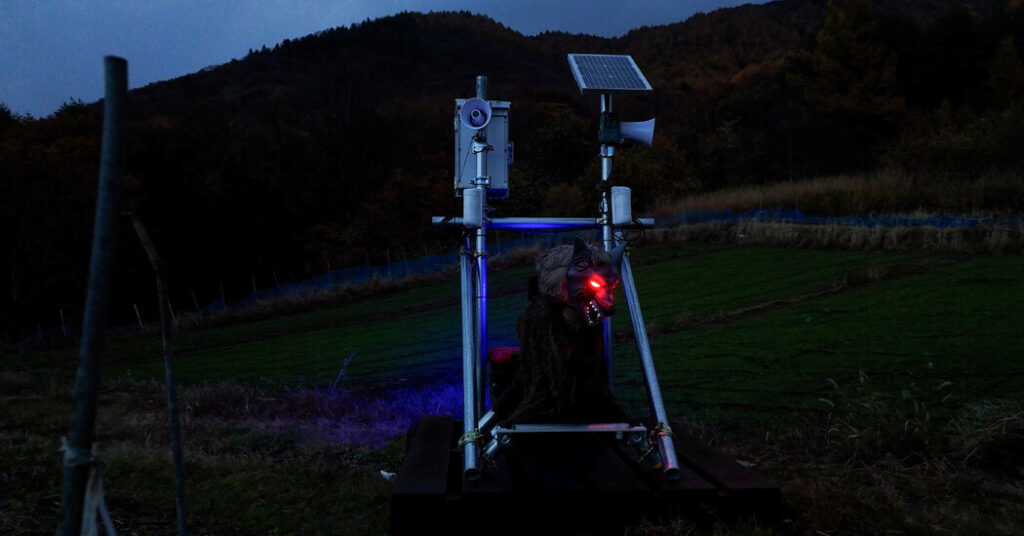
Enter Monster Wolf, a made-in-Japan, fur-sheathed contraption with flashing red eyes and a piercing vocal range. As the couple’s cabbages grew sweet and crisp last season, Monster Wolf reported for duty courtesy of the Yamagata city government, emitting an assortment of sounds every half-hour that fluctuated between vastly annoying and genuinely terrifying. Motion also sets off the machine’s cacophony. The Sakurais were able to work without fear of an attack.
Still, Monster Wolf is, by robot standards, tame. The mechanical wolf is affixed to a platform, and only its head moves. Besides, the Yamagata government only has one scare-wolf on its payroll. Monster Wolf has now moved on from the Sakurais’ fields. They want it back. Monster Wolf’s Japanese developers say that orders have tripled this year.
Cherry Picking
The promise of robots has excited Yamagata researchers for years. The prefecture produces about 70 percent of Japan’s cherries, and there is a chronic shortage of harvesting labor. Searching for solutions, a local fruit magnate contacted Yuichi Tsumaki, a professor of robotics and mechatronics at Yamagata University, about designing a cherry-picking robot. The government kicked in with funding.
“I said I was not confident, but we would try,” Professor Tsumaki said.
He explained the delicate mechanics of cherry picking: Without the stem, the harvested fruit spoils quickly, yet picking it with the stalk depends on the gentle rotational pressure of a human hand.
In anticipation, Zenyu Saito, the fruit magnate, had trained his cherry trees to grow on trellises, like grapevines, so that a robot could more easily access the fruit. Mr. Saito’s farm is now filled with flat-topped cherry trees that dangle fruit at a pleasing, consistent height. All that is missing is the cherry-picking robot. He had given Professor Tsumaki four years to develop the robot. It has now been 10.
One morning in his laboratory, the professor looked decidedly nervous. After a delay of several months, he and his student researchers were about to show what a decade of robot innovation could do for Yamagata. One graduate student donned a face mask, black gloves and a hard hat. He bumped his head on metal scaffolding then carefully attached five magnetized fake cherries to a fake tree. A robotic arm slid forward and plucked the ersatz cherries with their stems. Professor Tsumaki gave a small bow.
On the second attempt, the robot stalled with a cherry suspended in midair. On the third, the robot got stuck in a fruitless spiral, plucking the air with nothing in its gripper. The fourth effort failed, too. On the fifth, five fake cherries were again harvested.
Mikito Misawa, one of the graduate students, said he was not very hopeful that robots would save Yamagata’s agriculture. Ever since his family invested in his robotics studies, his father, a cherry farmer, has advised him to leave the prefecture for better job opportunities.
“He says there’s nothing good about here,” Mr. Misawa said, of his father’s perspective.
Mr. Saito, the fruit magnate, is now 80. He is weak and on kidney dialysis. Helped by his grandson, he hobbled out to his flat-topped cherry trees and surveyed his fruit empire, 16 generations strong. His son, who is taking over the business, isn’t interested in robots.
Last year, at a global cherry summit in Yamagata, Chinese researchers showed interest in Mr. Saito’s flat-topped cherry orchards. They had heard about the cherry-picking robot and wanted to see it in action.
“I saw on TV the other day that China’s robots are incredibly advanced, right?” Mr. Saito said. “I heard that, so I didn’t show them Yamagata University’s harvesting robot because I thought they might use that technology.”
Japan may have once led the world in robotics, creating the first humanoid robot in 1973, but it has fallen far behind China, with its soccer-playing, somersault-flipping machines. In March, a robot developed by Nanjing Agricultural University trundled through strawberry fields in China, picking fruit with 84 percent accuracy, using A.I. models built on the rotational movements of sea anemones, at least according to Chinese state news media, which tends to report on domestic innovations in glowing terms. The researchers are tweaking the robot’s cloud data platform for tomatoes and cherries next. Chinese robots already harvest lychees and goji berries.
Even Pochi, the supposed savior of Nishikawa’s cherry blossom farmers, harbors an embarrassing origin story: The robot was made in South Korea.
The Next Generation
Pochi isn’t the only unloved robot in Nishikawa. A grass-cutting robot meant to trim the sakura orchards keeps getting foiled by weeds. Local authorities say they are experimenting with a deployment of pesticide-spraying drones, but things haven’t progressed far. And an earlier, clunkier version of Pochi — a machine that doesn’t even merit a name — is even less respected than its cousin is.
Still, one local farmer likes Pochi very much. Osamu Shida, 74, named the robot after the Shiba dog he once owned. He, practically alone among the workers, stacks his cherry branches on the machine and marvels at how easy it is to transport his sakura.
“I feel like Pochi’s papa,” Mr. Shida said. “I like to have Pochi follow me around.”
Late one afternoon, Mr. Shida was out in his fields with his snow blower, clearing a field for future planting. The snow hung high above him, more than 30 feet tall in places. As the sun set, Mr. Shida returned to his family farmhouse. The air was cozy from a wood-burning stove and the toasty aroma of sweet potatoes being roasted by his wife, Kimie, an ethnic Korean originally from China whom he met through a matchmaker 25 years ago. Her granddaughters, also born in China, sprawled on the couch, scrolling on their phones, like preteens anywhere.
The girls, who now speak fluent Japanese, squabbled as they packed up for their karate lesson. Their grandmother sent them off with rice balls and roasted sweet potatoes for a snack.
“There aren’t many children left in Nishikawa anymore,” Mr. Shida said.
In fact, his step-grandchildren don’t live in Nishikawa, either. They have moved with their parents to an apartment in a nearby city.
“We are old already,” Mrs. Shida said. She has had surgeries on her knees and her hands. Everything aches.
Unlike most others in Nishikawa, though, the couple hopes they can pass on the farm to the younger generation. Perhaps they’ll export winter sakura across Asia. They are certainly less wary of robots.
“Maybe we should just retire and live a peaceful life and look out at the snow,” Mrs. Shida said.
Mr. Shida grunted.
“Not yet,” he said. “We still have work to do.”
The post Can Robots Save an Aging Japan? appeared first on New York Times.