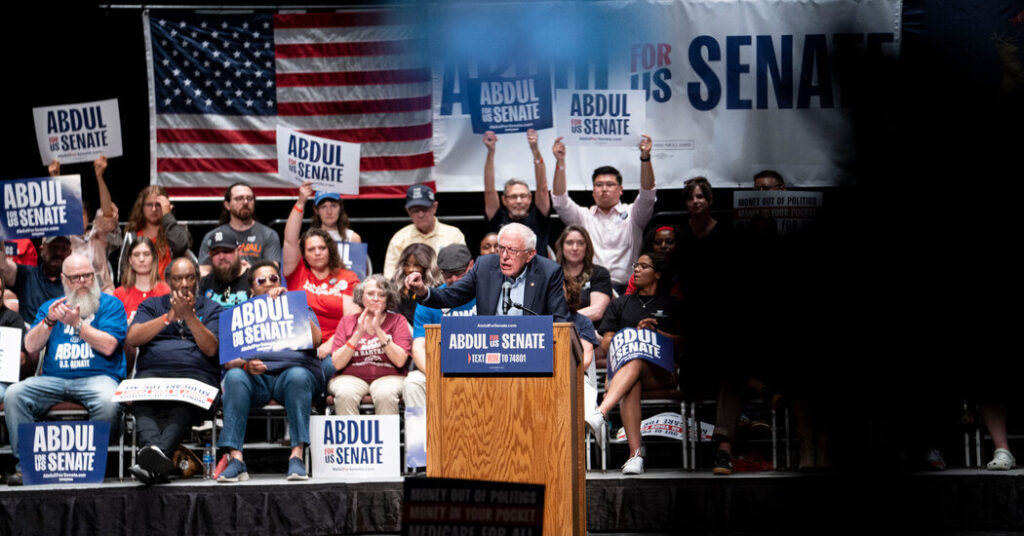
The primary win in the Michigan Democratic Senate race by Dr. Abdul El-Sayed, a progressive former public health official, marks the latest, and perhaps most surprising, instance of the insurgent left’s electoral success at beating establishment incumbents or candidates. It is another episode in the political story of the summer — the sense that something like a left-wing Tea Party is afoot.
These candidates are running for a very progressive policy program. In primaries, they have also run against something: the Democratic establishment. They have stressed the perceived political failings of the establishment — above all, its inability to defeat Donald Trump. The prominent figure at the center of this critique is Bernie Sanders, the Vermont independent.
Primaries are the place to have party fights about issues and hash out those disagreements. But victories like Dr. El-Sayed’s call for greater scrutiny of the political judgments of Mr. Sanders and his movement, forcing us to reckon with exactly what their project is all about. Their focus on factional organizing, while narrowly effective, has sometimes left them at odds with the Democratic Party. And some candidates — particularly those in the Democratic Socialists of America — are articulating a vision that could make it more difficult for Democrats to expand their appeal across America.
The Sanders presidential primary campaigns of 2016 and 2020 set the foundation for the ascendance of the progressive left. Mr. Sanders responded to his losses in those primaries by working tirelessly to promote the political careers of people who supported him. When Sanders-backed candidates have won offices — figures like Alexandria Ocasio-Cortez and Zohran Mamdani — they have gone on to pay it forward.
The insurgent left has shown an impressive display of organizing. But they are building this organization in part out of misleading narratives about the Democratic Party.
Take the 2024 election. For all the effort to hang that defeat on the flawed judgments of the establishment, in the critical weeks after Joe Biden’s debate fiasco, it was often moderate Democrats who led the charge to replace him. By contrast, Mr. Sanders endorsed Mr. Biden, standing by him long after the debate and urging Democrats to stop trying to get him out of the race.
Had Democrats listened to his advice, Mr. Biden would almost certainly have lost in a landslide. Successful Democratic Senate candidates in Michigan, Arizona, Wisconsin and Nevada would likely have floundered, and House seats in Virginia, New Mexico and Minnesota would have been at risk. Mr. Trump would have been able to inflict far more damage with huge congressional majorities at his back.
In the wake of Ms. Harris’s loss, Mr. Sanders proclaimed that “it should come as no great surprise that a Democratic Party which has abandoned working class people would find that the working class has abandoned them.” Yet earlier that summer he explained that he was standing by Mr. Biden precisely because he so strongly endorsed the Biden economic agenda.
The influence of Sanders-aligned advisers in the Biden administration was enormous. And it continues. Lina Khan, the former Federal Trade Commission chair, and a top aide Sam Levine — are leading economic policy in Mr. Mamdani’s administration.
The progressive left has been savvy about obscuring their influence on Bidenomics by shifting the center of the intraparty debate to Israel, where they have the upper hand among Democratic Party primary voters. But the Middle East is a low priority for most Americans (as foreign policy issues typically are).
The party is already suffering from dismal favorability ratings. And broadly speaking, a leftward tilt of the Democratic Party is not what voters want. A June New York Times/Siena poll of voters in the Senate battleground states found that 53 percent of likely voters think Democrats are too far to the left. That — the party brand, and not a difficult map — is the most basic, high-level reason that Republicans are favored to retain control of the Senate, and the Sanders faction has no answer to the problem.
It’s true that, in Michigan, Democratic Party primary voters nominated Dr. El-Sayed and were happy to blow off warnings not only from national party leaders but also their own governor. Still, history suggests a leftist politician like Dr. El-Sayed will be expected to run somewhat weaker than a conventional Democrat — meaning he would likely lose a swing state like Michigan in a neutral political environment. Current polling indicates that the national mood favors Democrats by six or seven points. You would expect an effective politician like Senator Elissa Slotkin of Michigan — who won narrowly in 2024 — to coast to an eight-point victory this year. So Dr. El-Sayed has room to run four to five points weaker than her and still win — which a scrupulous person would characterize as a disappointment, but Mr. Sanders and his followers would hail as a triumph.
Many rank-and-file Democrats respect the progressive left’s zeal for punching back hard at the Trump administration, which is easier to do from the safety of Vermont or New York City than from the electoral front lines. What they have not been as good at is winning in places that aren’t deep blue. In House races, for example, members of the centrist Blue Dog and New Democrat caucuses perform better than the average Democrat, while members of the Congressional Progressive Caucus perform worse. Elevating Sanders supporters can also lead to vetting failures, as we saw with Graham Platner in Maine and with Nate Blouin, a House candidate in Utah with an unfortunate track record of posts mocking sexual assault and Mormons.
The very top electoral performers among Democrats — lawmakers who have a record of results in districts most liberals would lose, like Vicente Gonzalez of Texas, Marie Gluesenkamp Perez of Washington State, Tom Suozzi of New York and Don Davis of North Carolina — are independent thinkers who are critical of Democratic Party leaders and the establishment. The difference is that rather than positioning themselves even further left than a party that most Americans think is too left-wing, they pick issues and rhetoric that are heterodox and often more restrained.
The insurgents benefit — or suffer, depending on your point of view — from a sort of political conflict of interest. If their wild rhetoric or fanciful position-taking hurts Democrats’ national image, that doesn’t hurt their members in safe seats. Instead, moderate Democrats in competitive seats end up losing. This in turn intensifies grass-roots anger at party leaders’ failure to win, and benefits the insurgents.
Given Mr. Trump’s unpopularity and Democrats’ generic ballot lead, Dr. El-Sayed could carry Michigan in November. A useful way to de-escalate factional tensions would be for people like Mr. Sanders to acknowledge that the bar for proving their case that leftists can teach Democrats how to win is higher than narrowly winning in a favorable cycle. Can he beat Ms. Slotkin’s performance by the eight points suggested by the national swing? Can he outperform Roy Cooper and Mary Peltola by amounts that account for Michigan’s bluer partisan lean than North Carolina or Alaska? It’s fair to have a debate about the best direction of the party, but that debate should be conduced on honest terms.
Matthew Yglesias (@mattyglesias), a contributing Opinion writer, is the author of “One Billion Americans: The Case for Thinking Bigger” and writes at the newsletter Slow Boring.
The Times is committed to publishing a diversity of letters to the editor. We’d like to hear what you think about this or any of our articles. Here are some tips. And here’s our email: [email protected].
Follow the New York Times Opinion section on Facebook, Instagram, TikTok, Bluesky, WhatsApp and Threads.
The post Bernie Sanders Is Not Doing the Democrats Any Favors appeared first on New York Times.