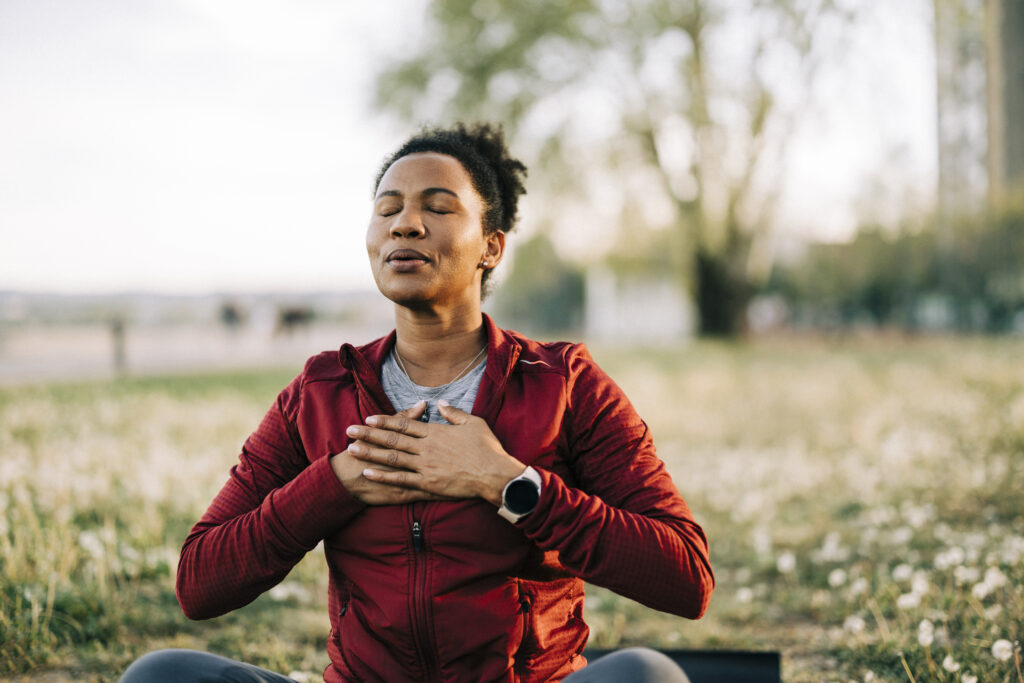
Taking a deep breath to calm down feels too simple of a tactic to actually work. Yet there’s a reason every mental health professional recommends trying this: It’s effective. When you’re feeling stressed and anxious, controlling your breathing through breath work practices might actually help you feel a bit calmer — and there’s science to back that up.
Psychological stress activates the sympathetic nervous system, which controls the body’s fight-or-flight response. As a result, when you’re feeling anxious, scared, overwhelmed or otherwise stressed, you might notice physical changes such as faster breathing, an increase in your heart rate, feeling on edge and muscle tension.
Focusing on controlling your breathing — particularly slowing it down — kicks the parasympathetic nervous system into gear, said Kristin Szuhany, a clinical psychologist at NYU Langone. Often referred to as the body’s “rest and digest” state, the parasympathetic nervous system helps relax the body, thereby counteracting the physical effects of the stress response.
“Since it is challenging to control things like our heart rate, our breath is something that is a bit easier for us to focus on and attempt to control,” Szuhany said. Also, when you’re focusing on breathing, you have less capacity for worry or other thoughts that can make you feel more stressed, Szuhany said.
By keeping a few specific breathing exercises in your back pocket, you’ll have tools to turn to when you need a quick way to calm down. Here are five evidence-based techniques that experts recommend.
Box breathing
How to do it:
- Inhale for four counts.
- Hold your breath for four counts.
- Exhale for four counts.
- Hold for four counts.
- Repeat.
- As each step progresses, picture one side of a square box.
Focusing on counting and breathing can be “a healthy distraction from thoughts that may be feeding into increased anxiety,” said Patty Johnson, a clinical psychologist in Oak Park, Illinois, with a focus on integrative behavioral medicine. And research suggests it can have a calming effect: In one randomized controlled trial, people who practiced box breathing before a stress-inducing task had a lower heart rate and less self-reported anxiety afterward compared with people who breathed normally.
4-7-8 breathing
How to do it:
- Inhale through your nose for four counts.
- Hold your breath for seven counts.
- Slowly exhale through your mouth for eight counts.
- Repeat.
Slowing down the exhale, specifically, can really help kick the parasympathetic nervous system into gear and relax the body, Szuhany said. Some research has found that 4-7-8 breathing is effective at reducing heart rate and blood pressure, while studies on yogic breathing (which uses a similar breathing pattern) suggest similar benefits. Another small study found that 4-7-8 breathing was helpful in reducing reported levels of anxiety and improving quality of life in patients who recently had bariatric surgery.
Physiological sigh
How to do it:
- Inhale deeply through your nose, filling your lungs with air and allowing your diaphragm to expand.
- Take a second, shorter inhalation through your nose.
- Exhale slowly and fully through your mouth.
- Repeat.
In a randomized controlled trial out of Stanford University, researchers compared the effectiveness of the physiological sigh — also known as the cyclic sigh — to two other breathing techniques and a control group that did mindfulness meditation. While all four groups experienced a drop in anxiety and better mood, those who did the physiological sigh experienced the largest improvement in mood. The more days in a row that the participants practiced the technique, the greater improvement in mood they experienced. The researchers suggest that slowing down breathing may lower aspects of physiological arousal, such as heart rate, and help regulate mood.
Alternate-nostril breathing
How to do it:
- Gently close your right nostril with the thumb of your right hand and inhale through your left nostril for a count of four.
- Gently close your left nostril with your ring finger, release your thumb, and exhale through your right nostril for a count of four.
- Inhale through your right nostril for a count of four.
- Close your right nostril again and exhale through your left nostril for a count of four.
- Repeat.
Known in Sanskrit as nadi shodhana, alternate-nostril breathing is a traditional yogic breath work practice. One study found that using a modified form of this breathing method for 30 minutes a day, five times per week for 12 weeks reduced participants’ perceived stress levels. They also saw a reduction in heart rate and blood pressure, indicating a shift toward a calmer state and away from a stress response.
Diaphragmatic breathing
How to do it:
- While sitting comfortably or lying down on your back, place one hand on your chest and the other on your stomach, just below your rib cage.
- Inhale slowly through your nose.
- Your stomach should expand outward into your hand while your chest remains still.
- Exhale through pursed lips as your stomach moves back into its original position.
- Repeat.
Also known as belly breathing or abdominal breathing, diaphragmatic breathing engages the diaphragm, which is a large muscle at the base of your lungs. “Diaphragmatic breathing allows the most efficient intake of oxygen, which helps decrease heart rate and, in result, also decrease anxiety effectively,” Johnson said. This can be especially helpful if you’ve fallen into a shallow or rapid breathing pattern due to stress, Szuhany said.
Research suggests that diaphragmatic breathing may also decrease cortisol levels: In one study, participants who practiced diaphragmatic breathing 20 times over a period of eight weeks had significantly lower cortisol levels than people in a control group who didn’t use the breathing technique.
Breath work takes practice — and it may not work for everyone
All of these breathing exercises are most effective if you practice them regularly, especially in times of lower stress, Szuhany said. That doesn’t mean you need to dedicate a ton of time to intentional breathing.
“There is some research indicating that benefits can be seen in as little as five minutes a day, but more research is needed for us to know exactly how long and how frequently we need to practice these techniques to experience the maximum benefits,” said Genna Popovich Hymowitz, a clinical psychologist at Stony Brook Medicine.
For now, Szuhany suggested starting with 5 to 10 minutes per day of consistent, daily practice. Try to do so in a peaceful environment with limited distractions. Not only will those brief sessions bring you a sense of calm throughout your week, they’ll also ensure you’ve got your techniques down and ready to go when you find yourself having a moment and needing to chill out, fast.
Also, Szuhany noted that breath work is just one tool among many for combating stress and anxiety. If you have more persistent mental health concerns, or have been diagnosed with a psychiatric condition such as anxiety or a depressive disorder, you may need more comprehensive treatment, including other mindfulness practices, various types of therapy or medication. A mental health professional can help you figure out the best tactics for keeping your stress and anxiety under control.
“Breath work is a helpful component of therapies but is only just one small element of a full therapy package,” Szuhany said.
The post 5 breathing exercises that actually help you feel calmer appeared first on Washington Post.