Times Insider explains who we are and what we do and delivers behind-the-scenes insights into how our journalism comes together.
If there’s anything to be learned from the nearly 18,000 emails in our inbox at New York Times Games, it’s that people are passionate about language and that the meaning of words can be very subjective. What one player views as problematic might not even register for another.
So it’s our job on the Games team to evaluate and play with the language, to bend and twist letters for fun and for a little daily brain workout.
Every Times game is human-made, which means a lot of room for editor creativity and judgment. But we do have rules across all nine of our word games, and we lean on shared dictionaries to create our base word lists. We primarily use the Oxford English Dictionary and the NASPA Word List, the official dictionary for North American Scrabble Association tournaments. (By contrast, The Times’s newsroom uses Webster’s New World College Dictionary.)
Though the Games team has standards governing usage and taste, editors make choices based on the puzzles they lead. We sort “bad words” into three main categories: vulgarities, slurs and violence. We may accept some of those words as a guess or a hint, but not as a solution.
Here is a game-by-game look at our approach.
Wordle
Wordle is our most popular game. Players must find the five-letter solution in six guesses or fewer. Wordle is powered by two lists: acceptable guesses and possible answers.
The accepted guess list is just that. Solvers can enter five-letter words from the Oxford dictionary, but just because a word is accepted as a guess doesn’t mean it will be a solution. We also do not accept proper nouns that have no other meaning, or -s plurals.
Tracy Bennett, who edits the game, curates the answer list with a personal flair. She has overseen changes to the list since The Times acquired Wordle in 2022. That includes choosing which words to use, when to use them, how often to repeat words and the cadence of harder or easier words.
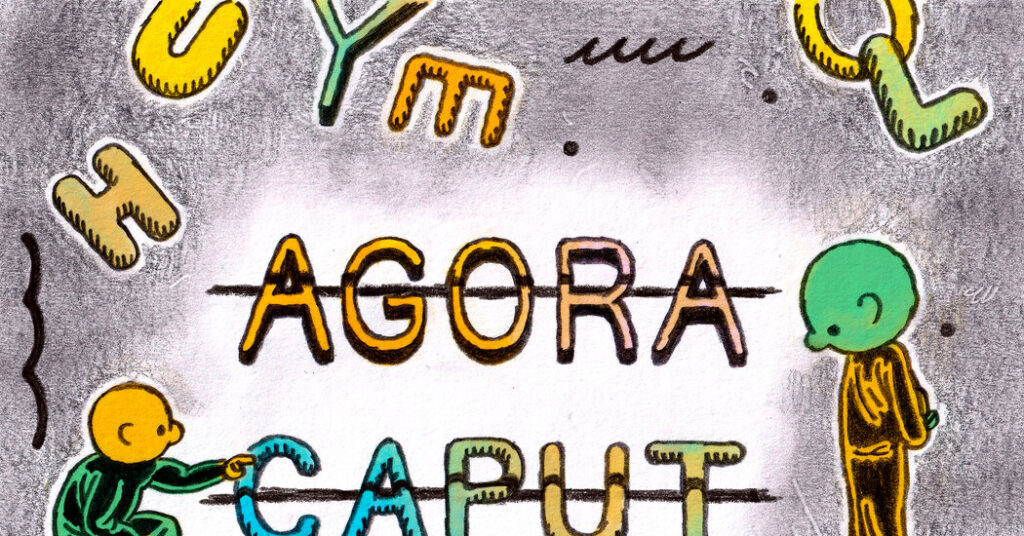
“I want to run words that people use in daily life, though some higher-quality old-fashioned vocabulary and niche terminology is peppered into the mix for variety, surprise and interest,” she said. “I curate the answer list by adding words that I think should have been included in the original list (like KAZOO, PIOUS and SQUID) and downgrading words that I conclude through testing aren’t going to be familiar to many solvers (like AGORA and CAPUT).”
One tip: Don’t try VOMIT; she thinks it’s gross.
Spelling Bee
Spelling Bee is possibly our most contested game, because players frequently express frustration over finding words that don’t count toward solving that day’s puzzle.
The game challenges solvers to find certain words in the puzzle that use the letters in the “hive.” Each word must contain at least four letters and include the center letter, but the puzzle does not include every word that can be found each day.
“If you simply include every theoretical word imaginable in a given puzzle, it will be that much more difficult to get to Amazing, Genius and beyond, and not in a satisfying way,” said Sam Ezersky, the puzzle’s editor.
Spelling Bee uses the Oxford dictionary and is curated by Sam. For each puzzle, as he works on his list of acceptable words within a given letter set, he also reviews several other dictionaries.
He edits for familiarity and avoids a word if its primary definition is considered a slur or a vulgarity, or if it elicits a viscerally negative reaction.
Crossplay
Crossplay is our first two-player game, and the only word puzzle that isn’t directly edited by one of our editors. Players build words off each other in a grid to gain the most points. There are two lists: one for human players and one for the computer players. Both are powered by the NASPA list, but the computer-player list is calibrated for difficulty.
The organization behind the Scrabble tournament list licenses it for a variety of word games, including Crossplay. A committee manages the word list, drawing from a number of prominent dictionaries.
For a word to be excluded from the NASPA list, it must be “at least often offensive and personally applicable in not just one but all senses,” according to the 2020 edition of the list. This means that some people might find some accepted words offensive.
“If you’re a lexicographer, the question of what makes a word offensive is a difficult one,” said John Chew, the chair of the advisory board that rules on the Scrabble list. “They’re in the business of documenting what they see and recommending how people use language and there’s a feedback loop: What lexicographers say impacts what people use.”
The NASPA advisory board most recently reviewed its list of offensive words in 2020, he said. He said the next update is expected in early 2027.
In addition to using the NASPA dictionary, Times Games did other work on the Crossplay dictionary to denote which words could be considered offensive and to share the inoffensive definitions.
Strands
Strands is a word search with a twist: You must find words that fit the day’s theme. But you can get points toward a hint for any word found on the board, even if that word is not part of the solution. Controversy arises when players find a word that isn’t on that day’s list, or when a word they find offensive counts toward the hint.
Bennett, the puzzle’s editor, creates each Strands board from a set of theme words that fit the 48-character count. She uses a tool (a script written by a computer engineer) that finds every possible word and evaluates each for offensive meanings.
“I want the theme words to be varied in letter length and letter variety, in addition to being mostly accessible, familiar dictionary words, with maybe one more unusual word in the mix,” she said.
Letter Boxed
In Letter Boxed, solvers must connect letters around a board to find all the words selected for the puzzle in the fewest number of moves. The puzzle is solved when all the letters are used.
Any word whose primary use is considered a slur or vulgarity is not accepted. “Negative” words are allowed but are not part of the solution. The puzzle’s editor, Ezersky, uses the Oxford dictionary as a guide
“I always build a puzzle around our specified two-word solution, even if I’m not expecting most of our solvers to find it,” he said. “It’s intended as a nifty way to showcase one of hundreds (or thousands!) of possible combinations of words that use all 12 letters around the box. I like to joke that Letter Boxed is almost a Rorschach test of sorts and that the words you gravitate toward are indicative of the way your brain is working.”
The Crosswords
The Daily, the Midi and the Mini crosswords do not have a singular word list for construction or editing, though we follow the same standards around vulgar or offensive language. Constructors must work through restraints, including size, symmetry and black-square rules, to form a grid.
“I don’t have a massive curated word list and never auto fill a grid,” said Ian Livengood, the puzzle editor for the Midi. He said he might use a list as a jumping-off point, where he picks one word and manually builds the crossword from there.
The crossword allows for players to solve from many angles, so we may use harder or less common words because solvers can figure them out by using crossings and word patterns. We also provide more context with the clues, which leaves less room for misinterpretation.
That being said, we have a running “yellow flags” list, which includes words that we regularly receive feedback on or that have gained a new context because of current events, like war in the Middle East. These words are not banned, but they are flagged so we can discuss whether to include them.
Connections
Connections also uses the Oxford dictionary, but it’s mostly powered by the surrealist landscape that is the editor Wyna Liu’s mind. In Connections, solvers are given 16 words, phrases or symbols to sort into four categories before running out of guesses.
Liu generally avoids topics like weapons or disease and is mindful of how words may combine to create new contexts. Every Connections board inspires a daily illustration in the Connections Companion, so the editor takes extra care since images can also create new context.
“It’s fun to mix common words that have multiple meanings, associations or parts of speech with more eye-catching words that evoke specific ideas,” she said. “I also enjoy including unusual vocabulary that connects to other words in the category in unexpected ways. Words are chosen not only for their meanings — both real and potentially misleading — but also for the kinds of wordplay they allow.”
The post Why You Sometimes See Naughty Words in NYT Games appeared first on New York Times.