Patrick Childress is a partner at the law firm Holland & Knight and former assistant general counsel in the U.S. trade representative’s office.
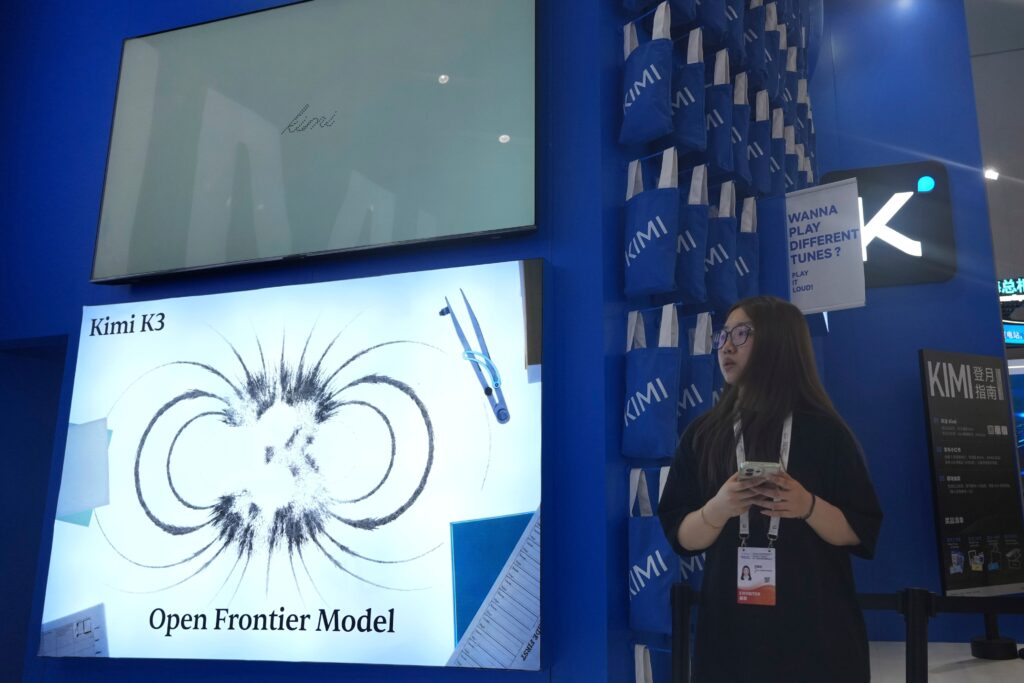
The recent release of the Chinese artificial intelligence model Kimi K3 — the largest open-weight model ever built — was a wake-up call for labs in California and policymakers in Washington. Kimi’s performance still trails the very best American models, but independent evaluators found it competitive with nearly all top-tier U.S. offerings and at a fraction of the cost.
This development has global consequences. In Washington, the White House and lawmakers have focused on whether the United States or China will build the world’s most-advanced AI models. But in Beijing, the focus is clearly on building mass-market AI that most people use.
China has already employed this strategy to great effect in global trade. It doesn’t need to invent or manufacture the best products in the world to dominate trade in key industries. It wins by building “good enough” products at massive scale and exporting those goods around the globe at low prices.
China’s history with electric vehicles is instructive. Beijing did not become an EV powerhouse by building the best cars. Rather, it built an entire industrial ecosystem designed to manufacture EVs that suffice for most people and can be cheaply built for export in large numbers.
First, China locked down upstream EV inputs. The country produces or processes most of the world’s lithium, cobalt and graphite — critical components for batteries — and Chinese companies together control over 80 percent of global battery cell manufacturing. Second, China layered on two decades of subsidies and public procurement preferences that allowed its EV makers to scale production and drive down costs even further. And third, China exported cheap, excess EVs to price-conscious buyers around the world.
The trade data tell the story: China now produces nearly 75 percent of the world’s electric cars, and it has overtaken the European Union as the world’s largest car exporter. In markets outside Europe and the U.S., Chinese brands now supply 55 percent of new EVs. That’s up from less than 5 percent just five years ago.
The U.S. is still winning the AI technology race. U.S. companies develop and bring to market the world’s top frontier AI models, even as Chinese labs close the technical gap faster than many expected. But if history is any guide, China is after market dominance, not technological supremacy.
Here’s what I expect to happen: First, China will control its own AI inputs by building Chinese compute capacity, hoarding training data and walling off a domestic talent pipeline. Second, it will grow its AI companies through massive state subsidies. And third, it will offer cheap prices to cost-sensitive customers as it pushes its “good enough” AI models into global markets. The strategy is already emerging: Chinese firms are focusing on low-cost, open-source models that prioritize broad adoption over technical superiority — most recently with Kimi K3.
There are two reasons this focus on “good enough” products for the masses will work to China’s benefit.
AI models are improving so fast that day-to-day use of the best one is quickly becoming unnecessary. The frontier models of tomorrow will probably be so advanced that using them for mundane tasks like doing your taxes or creating a PowerPoint deck will be overkill. Soon, “good enough” Chinese models will suffice for most general uses.
Then, once all AI models are adequate for most tasks, price becomes the differentiator. And no one competes on price like China. Today’s AI prices are artificially low for different reasons: Chinese AI relies on state subsidies, while U.S. AI is subsidized by patient investors who are comfortable (for now) watching these companies lose massive amounts of money. But eventually investors will want to see profits. When U.S. companies inevitably raise prices in the pursuit of profitability, Chinese companies will lure new customers with satisfactory models at the low prices consumers expect.
The Trump administration favors a tariff-focused trade policy. But that approach won’t work against Chinese AI that enters markets via download rather than shipping containers. Instead, the U.S. government could restrict the use of Chinese-origin AI models in government, defense and critical infrastructure such as power plants, and fund American labs developing efficient, low-cost models for the global mass market.
China doesn’t need to build the best tech to establish global dominance in AI, just as it never needed to produce the best EVs or the highest quality steel to control most trade in those goods. It just needs to make cheap, good enough AI and watch global consumers flock to its models. Washington cannot afford to wait to respond.
The post How China can corner the AI market with inferior technology appeared first on Washington Post.