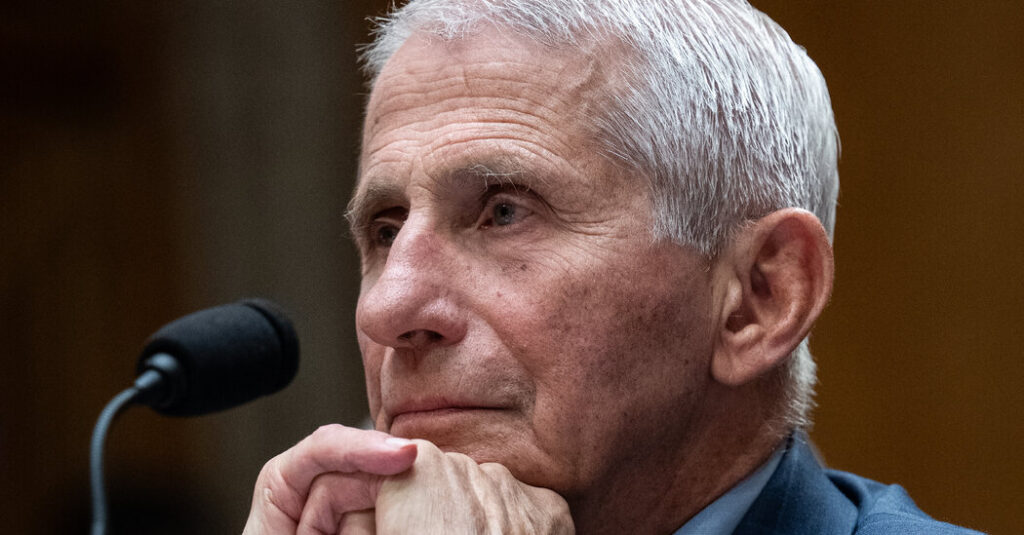
A Senate committee is scheduled to vote Thursday on whether to hold Dr. Anthony S. Fauci, the scientist who led the country’s Covid response, in contempt of Congress for declining to answer questions during a hearing last week.
But if the resolution passes, will the courts uphold it?
Dr. Fauci invoked his constitutional right under the Fifth Amendment to remain silent, refusing to respond to a single question during the three-hour session of the Senate Homeland Security Committee. Republicans on the panel, led by the chairman, Senator Rand Paul of Kentucky, say that he is ineligible for Fifth Amendment protection. The reason, they say, is that President Joseph R. Biden Jr. granted him an unconditional pardon for public service actions during a period that includes the pandemic.
Many people, including Trump administration officials, and even the president himself, have invoked the Fifth Amendment. But the case is unique, legal scholars say, because of the tension between the reach of a presidential pardon and that of the Fifth Amendment.
If Dr. Fauci is ultimately held in contempt, the potential consequences could be grave. Here are some things to know.
Why did Mr. Biden pardon Dr. Fauci?
Almost immediately after President Trump was elected to a second term in 2024, Republicans vowed to pursue several prominent figures, among them Dr. Fauci, the government’s top infectious disease expert, for his management of the pandemic. On his last day in office, Mr. Biden issued Dr. Fauci, and others, an unconditional “pre-emptive pardon” that protects him from federal prosecution for his actions from 2014 through Jan. 19, 2025.
Why did the Senate committee seek his testimony?
There were many pandemic-related issues that senators sought to explore. They accused Dr. Fauci of funding research that led to the creation of the coronavirus and of lying to Congress about it under oath, allegations that Dr. Fauci has long denied. They sought to hold him responsible for school lockdowns, masking and vaccine mandates, and other Covid-era restrictions imposed by states, communities and employers.
Is Dr. Fauci eligible to plead the Fifth?
This is the question at the heart of the legal debate.
Republican senators on the committee contend that because Dr. Fauci had a presidential pardon, he was already protected: By refusing to answer their questions, he had effectively violated their subpoena of him. “You don’t have any rights under the Fifth Amendment because you’ve been pardoned, as you very well know,” Senator Josh Hawley, Republican of Missouri, told Dr. Fauci at the hearing,
Legal scholars say the issue is not that clear.
Jonathan Turley, a constitutional law expert at George Washington University Law School, said that the impact of pardons on a witness’s ability to invoke the Fifth was “murky,” noting that there is little case law on the issue.
“There are good-faith arguments that his pardon would afford him effective immunity,” rendering Dr. Fauci ineligible for the Fifth Amendment protection, Mr. Turley said in an interview. He noted that there were also claims that Dr. Fauci’s opening statement could be construed as waiving his Fifth Amendment privilege, negating the cloak of immunity granted by the pardon itself.
Other scholars maintain that Dr. Fauci’s invocation of the Fifth was proper because he was legally vulnerable. His pardon period ended roughly 18 months before the Senate hearing, from which fresh, contemporaneous charges could have emerged. Mr. Paul has said for years that Dr. Fauci belongs in prison.
Pleading the Fifth Amendment is an acceptable strategy, “given the pretext of the investigation, which is that they are looking for a way to put him in jail, and given the president’s own track record of vindictive prosecutions,” said Kimberly Wehle, a professor at the University of Baltimore School of Law who is an expert on the pardon power.
In his opening statement to the committee, Dr. Fauci essentially said he believed that the purpose of the hearing was to capture evidence against a preselected defendant.
If the committee wanted frank testimony and a full exploration of unresolved pandemic questions, senators could have offered him limited or full immunity covering the testimony, a number of law experts said.
Not doing so “debunks their claim that he’s completely protected by presidential pardon,” said Representative Jamie Raskin, Democrat of Maryland, who is a constitutional law professor. “It’s only because they imagine that he can still be prosecuted that they wouldn’t offer him immunity.”
Are other actions covered by the Fifth Amendment but not the pardon?
Yes. The presidential pardon applies only to federal prosecutions, not those brought by states. The Fifth Amendment applies to both.
Shortly after Dr. Fauci refused to testify last week, officials in Alabama, Louisiana and Florida vowed to commence state investigations against him.
What happens next?
If the committee votes that Dr. Fauci should be held in contempt, the case will go to the full Senate for a vote, or possibly be directly referred to federal prosecutors. They in turn would probablyconvene a grand jury and seek an indictment. If they succeeded, Dr. Fauci would be charged with the misdemeanor of criminal contempt, for which a conviction could result in fines and a prison sentence of up to a year.
AFederal District Court judge in the District of Columbia would decide whether the case should go forward, a ruling likely to address whether Dr. Fauci was entitled to plead the Fifth.
Many scholars predict the case will end there, if not sooner.
Professor Turley, who maintains that the impact of Dr. Fauci’s actions and the many entries in his diary raise questions about his thinking that should have resulted in a robust hearing, believes that courts are more likely to side with Dr. Fauci’s right to invoke the Fifth. But, he said, “having the right to do something does not make it the right thing to do.”
Professor Wehle also thinks Dr. Fauci will prevail, in part because the Fifth Amendment was intended to shield witnesses against overbearing government prosecution.
If a court did say that Dr. Fauci could not claim the Fifth, she said, the precedent would be truly upending.
“That would say you take the Fifth at your own risk of going to jail,” she said. “And that turns the Fifth Amendment upside down.”
Sheryl Gay Stolberg contributed reporting.
The post Fauci Faces Contempt Vote. Here Are the Legal Issues Involved. appeared first on New York Times.