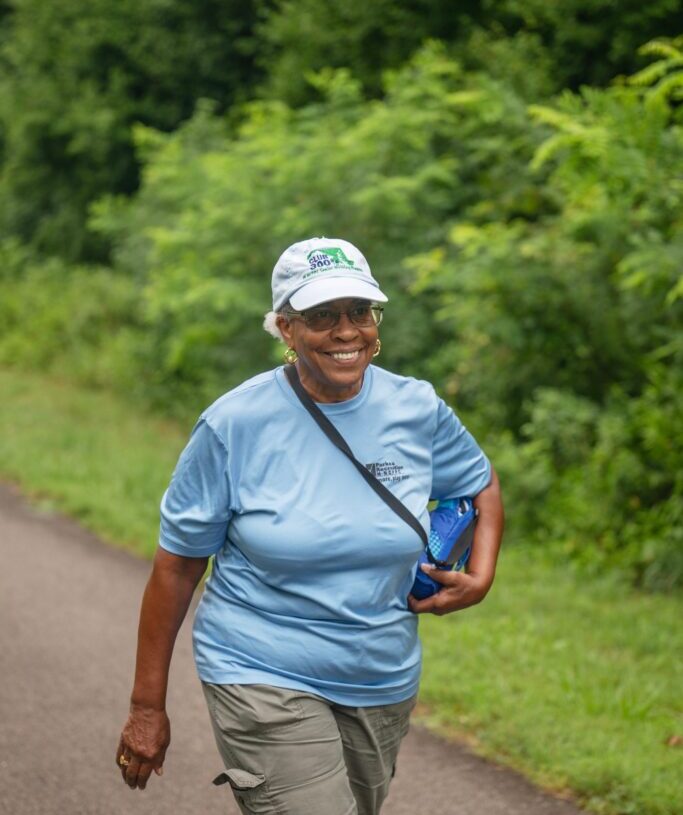
Here’s why you should be a “super mover” when you get older.
Super movers, defined by scientists as someone who is able to walk significantly faster than most of their aging peers, are about half as likely to experience cognitive decline, a new study finds.
Plus, if they develop problems with thinking and memory, the condition often progresses more slowly.
The study, published in July in Neurology, builds on earlier research about super movers, who are men and women age 80 and older whose everyday gait speed resembles that of people in their 50s.
This past research linked super moving to better health, greater longevity and slower rates of aging compared with people whose gait speed was lower.
The new study, which involved nearly 5,000 older men and women, expands those benefits to the brain, finding that super movers’ brains typically work better, for longer, than those of slower movers.
“I think the idea of ‘super movers’” being at relatively low risk for cognitive decline “makes sense,” said Michelle M. Mielke, the chair of the department of epidemiology and prevention at Wake Forest University. She has studied gait speed and health but wasn’t involved with the new study.
The study provides another compelling reason to be or become active as we age. But it also raises questions about whether and how super moving changes older brains and if it’s ever too late — or early — for the rest of us to start paying attention to our gait speed.
Slow walking and declining brain health
Decades ago, scientists first noticed that slow or uncertain gait in older people was disproportionately linked to poor health, short lifespans and dementia.
“We’ve known about this association between abnormal gait and higher risks of cognitive impairment for more than 20 years,” said Joe Verghese, the chair of the neurology department at the Renaissance School of Medicine at Stony Brook University in New York and lead author of the new study.
Slowing gait may even signal future cognitive problems years before noticeable decline begins.
But little research has examined the flip side of impaired walking, Verghese realized. If slow walkers are prone to dementia, would fast older walkers remain clear thinkers as the years pass?
He and his colleagues sought answers in multiple, global health studies and databases focused on older people, pulling records for nearly 5,000 participants 80 and older. All had completed cognitive and gait speed tests and sometimes also brain scans.
The scientists then grouped the men and women by their walking times, noting those who were 1.5 standard deviations above normal, placing them in the top 5 to 8 percent of all the walkers. Most of them strode as fast as people 30 or 40 years their junior.
These were the super movers.
Super movers’ brains are different
The scientists tabulated everyone’s gait speeds and cognition and checked brain scans to see if the super movers’ brains were distinctive.
They were. Most notably, they were more than 48 percent less likely to develop cognitive impairment within about five years of joining one of the health studies than people who moved more slowly, even after researchers controlled for age, sex and some lifestyle factors.
If the super movers did show signs of decline, the condition usually worsened more slowly.
Their brains also differed structurally from those of most of the slower movers, with greater volume in the hippocampus, a key memory center.
These findings hint that something about fast walking may influence older brains, Verghese said. “Walking in the real world is often a divided-attention task,” he said, with the brain rapidly juggling inputs and instructions about motor control, navigation, uneven ground, jostling crowds, traffic and other distractions.
In this scenario, super moving represents a potentially brain-boosting puzzle as we age.
Working muscles also release biochemicals that travel through the blood to the brain, Verghese said, where they are known to jump-start processes that improve the health and function of neurons and other brain cells.
The study’s limitations
A limitation of the study, though, is that researchers couldn’t control for many aspects of people’s health and lifestyles. The super movers might also be unusually healthy, with few diseases, good nutrition, lucky genes, high incomes, robust social support or combinations of those.
Those lifestyle and genetic factors could then be the main drivers of any healthy brain changes, not fast walking. In fact, having healthier brains might be enabling older people to walk exceptionally fast, and not vice versa.
Similarly, the study doesn’t tell us when or how the aging participants became super movers or whether the timing matters.
“I would suspect that those who are super movers are more likely to have a history of being more physically active” when younger, said Alexandra Wennberg, an epidemiologist at the Karolinska Institute, who has studied gait speed and health during aging. She wasn’t involved with the new study.
In other words, we don’t know from this study whether it’s desirable or even possible to become a super mover as an octogenarian or if it’s best to start walking fast years earlier.
How to calculate your gait speed
But even with these limitations, the central message of the super mover research remains unchanged, Verghese said. “Stay active,” he said, whatever your age. Now 61, he exercises almost every day, he said, and has since he turned 40.
Want to know where you stand? You can learn how to assess your own gait speed here and find estimates of typical gait speeds by age here.
“Walking is an easy entry point” to exercise, Verghese added. “Most people can do it within their limits.”
Talk to your doctor if you have medical conditions. Then start gently, but when your regular walks start feeling comfortable, “push yourself a bit,” he said. Pick up the pace, walk a little faster than last week. Those are probably the first steps toward being a super mover.
Do you have a fitness question? Email [email protected] and we may answer your question in a future column.
The post Fast walkers in their 80s have half the risk of cognitive decline appeared first on Washington Post.