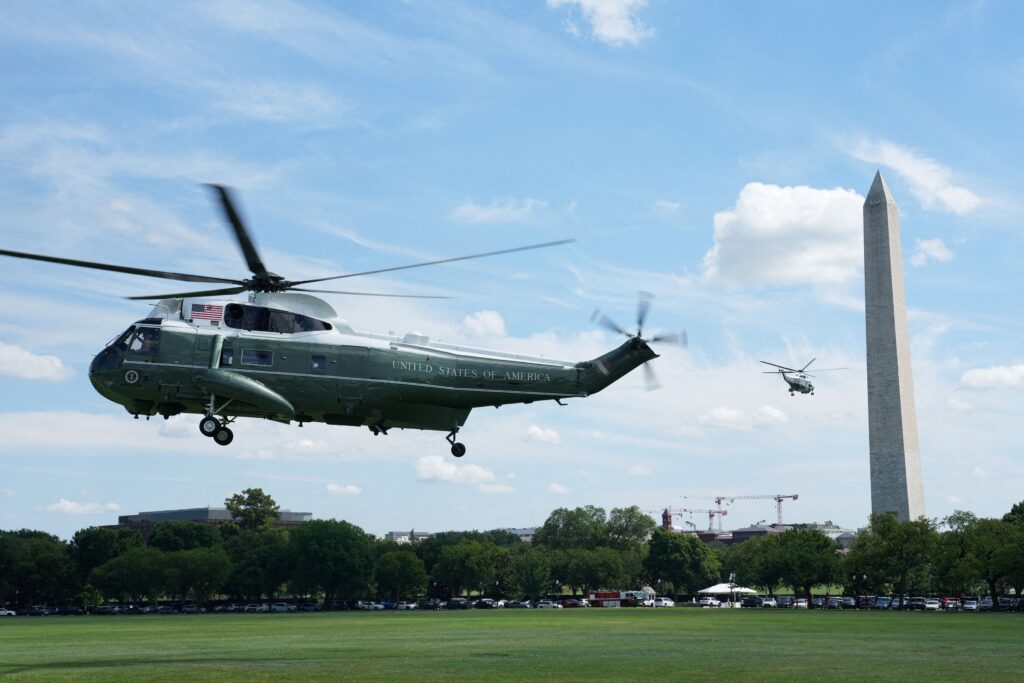
The Federal Aviation Administration is investigating a safety incident involving Marine One and Reagan National Airport, the agency said.
President Donald Trump took off from the White House in Marine One on Tuesday afternoon, but air traffic controllers at National Airport had not stopped commercial flights, according to two people familiar with the matter. They spoke on the condition of anonymity because they were not authorized to comment.
Marine One is supposed to give air traffic controllers at Reagan National a three-minute warning before taking off, which allows the air traffic controllers to clear the airspace and give the helicopters an unimpeded route to Joint Base Andrews in Maryland, the people said.
“Marine One flights are piloted by some of the best aviators in the world, and at no point was the President in harm’s way,” White House spokesman Kush Desai said in a statement.
Based on audio recordings from ATC.com, the Marine One pilot gave a three-minute warning multiple times, but the air traffic controller appears to have had trouble receiving or hearing it.
“Tower, just want to make sure you copy. Marine One, three minutes to lift,” the pilot said shortly after 2:30 p.m. “Tower, do you copy? Marine One, three minutes to lift,” the pilot said seconds later.
“Last calling, that’s broken and unreadable,” the air traffic controller responded.
A few minutes later, the Marine One pilot said: “National tower, Marine One, proceeding as briefed.”
“Uh, Marine One, you said you’re proceeding as briefed?” the air traffic controller replied. The Marine One pilot said that he was. “Okay, no three minutes. Roger, proceed as briefed,” the air traffic controller said.
The air traffic controller then informed Marine One that an Embraer E-170 passenger jet was taking off. It was an American Airlines flight to Pensacola, Florida. The Marine One pilot said the helicopter would take a “momentary delay” before proceeding.
The Wall Street Journal first reported the incident.
A statement from the Marine Corps said the flight was “routine.”
“Washington National Tower did not delay the helicopter crew, ask them to hold, or otherwise alter their flight profile. The [air traffic control] team approved the requested route and provided timely and appropriate traffic information,” the statement said.
Other takeoffs and landings at National were delayed for about 10 minutes, according to flight data.
After a deadly midair collision in 2025 that killed 67 people near the airport, all but the most critical helicopter flights near the airport have been banned, and new rules block helicopters and commercial jets from occupying the same airspace in certain areas near the airport.
Based on the FAA’s preliminary safety review of Tuesday’s incident, there was a “momentary loss of separation,” after which the aircraft continued to move away from each other, an FAA spokesperson said in a statement. Air traffic control procedures are designed to minimize risks by keeping planes and other aircraft safely separated.
“The air traffic controller was in contact with both the commercial pilot and Marine One pilot during the loss of separation,” the FAA statement said. “As the White House has said, the President was never in danger. We are continuing to review the incident and will implement any appropriate corrective actions based on our findings.”
The FAA did not respond to a question about potential communication issues between Marine One and the air traffic controller.
Jeff Guzzetti, a former accident investigator at the FAA and the National Transportation Safety Board, said he was concerned by the apparent communication issues and that the incident marks “a persistent problem in the congested D.C. airspace.”
But overall, Guzzetti said, it wasn’t very serious.
“While it never should have happened in the first place — the loss of separation — it did happen. But the system was able to mitigate the risk,” he said.
Andrew Ba Tran and Dan Lamothe contributed to this report.
The post FAA investigating incident involving Trump’s helicopter and Reagan National appeared first on Washington Post.