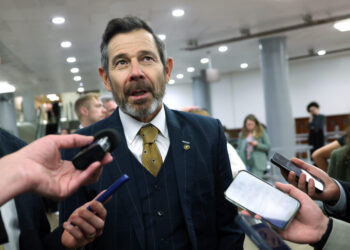
Democratic Party insiders were quick to dismiss the insurgent victories of some left-wing candidates in primary races this summer as little more than a product of deep-blue, big-city politics.
The kind of antiestablishment message that can win in heavily Democratic areas, they said, was not enough to win the battlegrounds where progressives would also have serious Republican opponents in November.
Then came Tuesday’s primary in Michigan.
In races up and down the ballot, Michigan Democratic primary voters rejected the electability argument offered by their mainstream leaders, instead opting for progressive candidates who have pledged to tax billionaires and curb spending on wars overseas.
Abdul El-Sayed, a populist former health official who campaigned largely on getting money out of politics, narrowly won the primary for an open Senate seat key to control of that chamber.
And Michigan voters also nominated William Lawrence, a progressive housing and environmental activist, for a battleground House district and ousted an incumbent House Democrat from the Detroit area in favor of a democratic socialist.
Tuesday night’s results hardly resembled a blowout. El-Sayed was leading by about one percentage point. Lawrence won a plurality of the vote with two moderate candidates splitting the rest.
Yet the narrow wins will force mainstream Democrats to reckon with a groundswell of anti-Washington populism that could shape the party’s identity in a post-President Donald Trump era. The left-wing victors now face a test: Will their message appeal broadly enough to defeat well-funded Republicans in a battleground state far more used to political moderation?
“Abdul will be the tip of the spear in proving an economic fighter can win a swing state,” said Adam Green, co-founder of the Progressive Change Campaign Committee, a political action committee that backed El-Sayed. “Once that happens, the lid can be blown off.”
A power-lifting Rhodes Scholar and former gubernatorial candidate, El-Sayed overcame a spending disadvantage of nearly 9 to 1 against Rep. Haley Stevens (D) for the Senate seat currently held by the retiring Sen. Gary Peters (D).
Groups that backed him, including Justice Democrats and Green’s PCCC, also pooled support behind two House candidates: state lawmaker Donavan McKinney, who unseated Rep. Shri Thanedar (D) for a safe Democratic seat in the Detroit area, and Lawrence, who co-founded the Sunrise Movement climate group and now faces a GOP incumbent in a battleground district based in Lansing.
Since Bernie Sanders’s campaign for president in 2016, progressives have been insisting that a populist economic approach can win in swing districts by appealing to independent and working-class voters who vote for Republicans.
But races such as the one in Michigan, where El-Sayed is set to face former congressman Mike Rogers (R) in the general election, will demonstrate how far that message might resonate in a general-election battle.
“Our side hasn’t had enough races to prove that theory of the case because the establishment has been so focused on snuffing them out,” Green said.
El-Sayed’s victory relied on the same kind of highly educated voters who backed similarly progressive congressional candidates in New York, Washington, Seattle and Denver, according to a Washington Post analysis of election and demographic data.
Yet he also won middle-class voters across all races and posted large-enough margins in the suburbs and state’s rural areas to shut out Stevens.
Richard Czuba, a longtime Michigan pollster, said that El-Sayed’s support for policies such as Medicare-for-all were effective at locking down a base of support from the party’s left wing.
Heading toward November, Czuba said, El-Sayed will need to recast his messaging to court the swing state’s independent voters by focusing on the failure of the country’s political system broadly instead of specific policies.
“He has that opportunity to introduce himself and pivot,” Czuba said.
In a call with reporters Wednesday, Sanders pointed to the victory of Michigan populists as evidence that voters are connecting with a message that America’s economic and political systems are “rigged” and “broken.”
“Abdul talked about that, and people in Michigan responded,” said Sanders, the independent senator from Vermont.
Not all left-wing candidates prevailed Tuesday night. In Missouri, Rep. Wesley Bell (D) easily defeated former congresswoman Cori Bush, a democratic socialist whom he had unseated two years ago.
But within Michigan, the victories of the left flank of the Democratic Party extended down the ballot.
Abbas Alawieh, who founded the “Uncommitted” movement to oppose President Joe Biden’s Middle East policy by voting against him in the 2024 presidential primary, was on track to win the primary for a state Senate seat in Detroit. And in the college town of Ann Arbor, democratic socialist Yousef Rabhi unseated a 12-year incumbent mayor.
Democratic socialists also have won mayoral contests in New York City, Seattle and Washington, and secured the Democratic nominations for House seats in urban parts of Colorado, New York and Pennsylvania. Rep. Rashida Tlaib (D-Michigan), one of the first democratic socialists elected to the House, easily won her Detroit-area primary Tuesday.
Cara Tobe, communications chair for the Democratic Socialists of America, said the results showed that the growing pull of the left is “not just about Philly or Denver.”
“People want that same change for us here in Michigan,” said Tobe, a member of the group’s metro Detroit chapter. “The reality is it does resonate with working people everywhere.”
El-Sayed does not identify as a democratic socialist, and he was not endorsed by DSA, whose ascendance powered the rise of Zohran Mamdani and then several House candidates this year, including McKinney in Detroit.
But democratic socialists have been drawn to El-Sayed’s candidacy. At a recent rally for him in Saginaw, the co-founder of the local DSA chapter, Anthony Castillo, grabbed a marker and scrawled out his hopes on a big “What do you dream?” banner.
“UN-RIG the system,” he wrote.
“I believe the system is rigged against the hardworking, the blue collar and the middle class,” Castillo said in an interview. “If it wasn’t for the workers, the millionaires and billionaires wouldn’t have their wealth.”
The DSA’s national arm endorses only candidates who publicly identify as democratic socialists and embrace the organization’s controversial platform, which calls for abolishing the Senate, prisons and police. El-Sayed and Lawrence won’t be running with that more polarizing label in swing districts.
A clearer test for democratic socialists in a swing district may come in neighboring Wisconsin, where the DSA-backed state Rep. Francesca Hong is the front-runner in Tuesday’s Democratic primary for governor and has drawn heavy skepticism from top Democratic leaders.
Next Tuesday’s elections also features a Democratic Senate primary in Minnesota, pitting centrist Rep. Angie Craig against the more liberal Lt. Gov. Peggy Flanagan.
Yet those distinctions between democratic socialists, progressives and liberals don’t matter much to Republicans who are casting Democrats indiscriminately as radicals, socialists or even communists.
Rogers, the GOP Senate nominee, called El-Sayed an extremist leading a movement grounded in ideological fanaticism.
Sen. Tim Scott (R), who chairs the GOP’s Senate campaign arm, wrote on social media Tuesday that El-Sayed is “the most radical Democrat Senate nominee ever.”
“His support of terrorist organizations, socialist policies, and the defunding of law enforcement makes him dangerous and ultimately disqualified from serving,” Scott wrote.
The prospect of attacks didn’t seem to be much of a concern to the crowd at El-Sayed’s watch party Tuesday night, where a local democratic socialist official rallied attendees as they waited for results.
“Is he too far left for Michigan?” Detroit City Council member Denzel McCampbell asked them.
“No!” the crowd yelled back in unison.
The post El-Sayed gives progressives another victory and a new challenge appeared first on Washington Post.