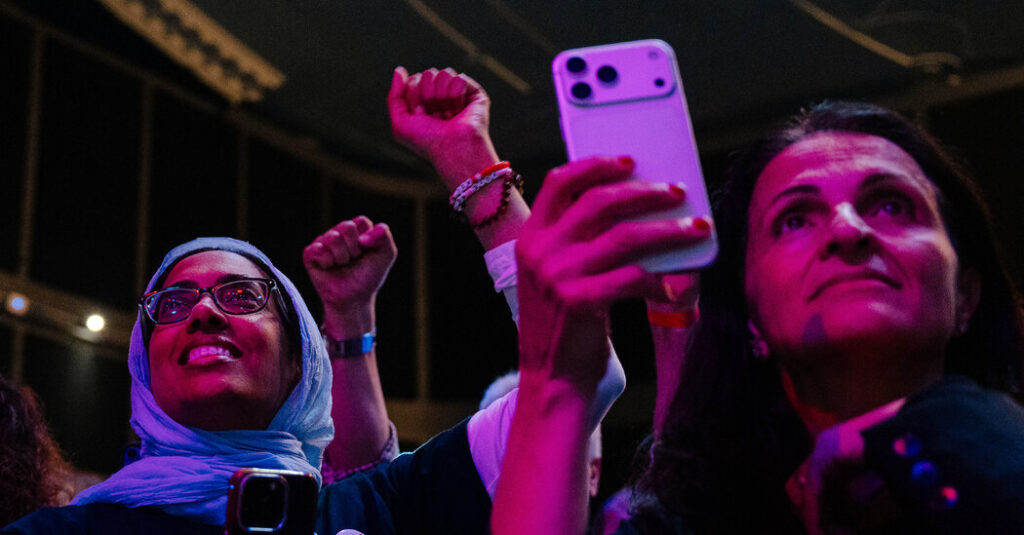
As Michigan’s acrid Senate primary between Dr. Abdul El-Sayed and Representative Haley Stevens ground to its end this morning, one thing was clear: He has a lot of work to do unifying Democrats.
El-Sayed, a former public health official, squeaked out a win over Stevens by, at last count, about 15,000 ballots, or less than one percent of primary voters.
Now, after a bruising campaign that involved accusations of antisemitism, sexism and racism, El-Sayed, a 41-year-old progressive, needs to bring skeptical Democrats over to his side to beat Mike Rogers, the Republican nominee.
“Tomorrow, we begin to mend fences,” he said last night, adding that Democrats have a “responsibility to assure that we unite to make sure that Mike Rogers never sees the inside of the U.S. Senate.”
His comments rankled some Democrats who believe that it’s El-Sayed, not voters who remain wary of him, who has the responsibility to bring the party together. That hasn’t stopped some party stalwarts, including Stevens herself and Senator Elissa Slotkin of Michigan, from lining up behind him as they face what could be one of the most competitive Senate races in the country.
“We have no choice but to unite,” Representative Debbie Dingell of Michigan told me. “We have to keep this seat a Democratic seat because we have to take the House and the Senate back in the fall. We will not be able to take the Senate back if we lose this seat.”
There are a lot of big questions about how — and whether — El-Sayed can pull his party back together. Here are some of them.
Can El-Sayed win over Jewish voters?
To Jessica Alexander, the chair of the Michigan Democratic Jewish Caucus, the primary felt nothing short of “seismic.”
“There’s a lot of damage. Like a lot,” she said.
The issue of Israel loomed large in the race, with El-Sayed saying he did not believe the country should exist as an explicitly Jewish state. When a Michigan temple was attacked this year, he condemned the violence but noted that it had been inspired by Israel’s actions overseas. And he made the more than $30 million spent for Stevens by the main super PAC of the American Israel Public Affairs Committee a major focus of his campaign.
“It wasn’t just money out of politics, it was Jewish money out of politics,” Alexander said. “If he wants to overcome that, he has a lot of work to do.”
In a victory speech on Wednesday morning, El-Sayed brought up AIPAC again — and made a direct appeal to Jewish voters.
“To all of my sisters and brothers of the Jewish faith, or any faith at all, or no faith at all, I want you to know that my commitment to your safety — to Jewish safety — is the same commitment that I have to the safety of my own daughters,” he said.
Can he make inroads with the rest of Stevens’s coalition?
El-Sayed performed well in college towns like Ann Arbor, and in some parts of the state with high median incomes. Stevens, by contrast, ran up the numbers in Detroit and in other areas that are home to a lot of Black voters, like Flint.
“The congresswoman was in the Black community. She was engaged there before she ran for Senate,” said State Representative Joe Tate, a former Michigan House speaker who endorsed Stevens. He said El-Sayed should try to emulate that.
“Taking a page from the congresswoman’s book, I think, will be helpful,” Tate said.
Mari Manoogian, a former state representative who is now the executive director of the Next 50, a group that aims to elect young Democrats, said El-Sayed also needed to make inroads with the working-class voters who supported Stevens.
“He needs to win the trust of people who were skeptical about his message, and skeptical about positions he’s taken in the past and communicate that he will be a good listener and a good representative for anyone,” Manoogian said.
Will other prominent Democrats get on board?
Stevens had the support of some of the most prominent Democrats in Michigan, including Gov. Gretchen Whitmer, who congratulated El-Sayed and the rest of the Democratic ticket in a video on social media on Wednesday morning. A Whitmer aide told me today that the governor has offered El-Sayed her support, and is ready to endorse him.
There are questions about how involved national Democrats like Senator Chuck Schumer, the minority leader, will be. Schumer had openly backed Stevens, but he quickly endorsed El-Sayed.
Mallory McMorrow, a liberal state senator who dropped out of the Senate race last month, endorsed El-Sayed in the wee hours of the morning.
“There was so much national attention on this race, on this state, to decide, which direction is the Democratic Party?” she said.
“To me, it says, we are a big-tent party and we always have been and there isn’t sort of one faction that dominates another,” McMorrow said. “That is both the beauty of the Democratic Party and the challenge.”
The post Can El-Sayed Patch Things Up With Skeptical Democrats? appeared first on New York Times.