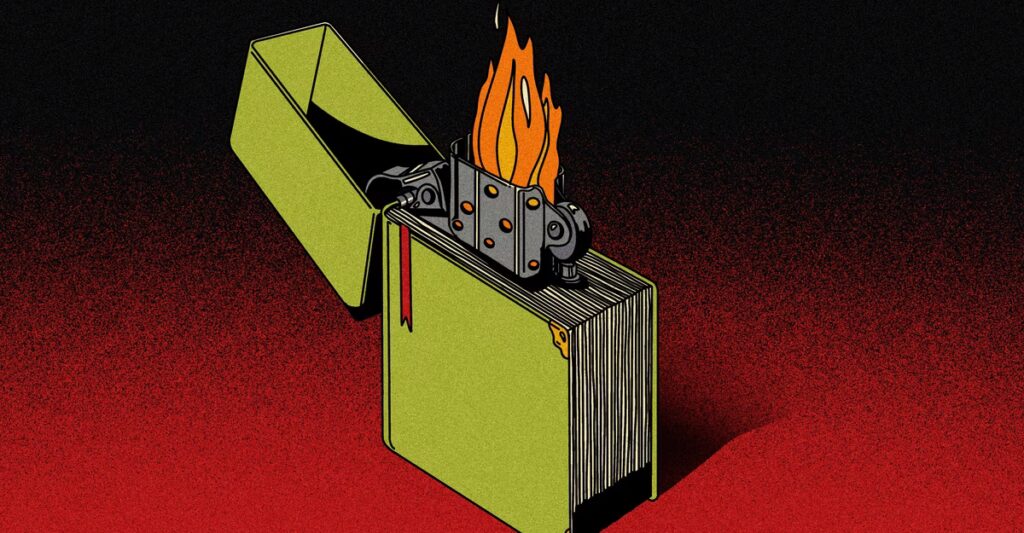
Last week, the internet raged as social-media posts and news articles accused AI companies of “destroying the world’s books”—including “millions of rare” ones—by chopping off their spines to scan them more easily, and discarding them afterward. One article said the news was “sparking concerns that the last remaining copies of out-of-print texts are being destroyed.” The investor and AI skeptic Michael Burry called the practice of sacrificing rare books “evil incarnate.” Even Elon Musk weighed in, posting that he had asked the engineers training xAI’s models to “preserve any rare books in a library and scan them the hard way.”
The destruction of physical books in the process of training AI has been public knowledge for more than a year, but debate over the practice intensified after an article by 404 Media, which described a large number of orders coming to booksellers, suggested that rare books might be included, and named a book-database company called ISBNdb as the possible buyer.
Lost in the outrage, however, are several unanswered questions. The 404 Media story said ISBNdb had advertised bulk buying of books for AI companies, but acknowledged that no evidence directly connects the company to the recent wave of purchases that booksellers have described. And although the story calls out rare-book sellers, it’s unclear how rare most of the books being bought actually are, or whether they’re of great value.
Despite that, the conversation rapidly intensified into a panic. So what is actually going on? And who is actually responsible?
[Read:]Is This What Comes After AI Slop?
Many of the specifics of this situation are obscured by hard-to-trace purchasing histories and the silence of AI companies and other potential buyers, so let’s lay out what we know. We know that at least one major AI company has used physical books to train their models. Documents unsealed earlier this year in a lawsuit against Anthropic reveal that in the spring of 2024, the AI giant bought millions of new and used books and destroyed them in order to scan the pages to train its AI models. Anthropic and other AI companies are likely keen on books published before the launch of ChatGPT, in 2022, which are all but guaranteed to be free of AI-generated text. Although AI-generated text is readable—if often unpleasant—to humans, it can be devastating to AI models: When trained on their own output, they can degrade significantly in quality in a phenomenon known as “model collapse.”
We also know that something mysterious is afoot. Someone—if not more than one group or company—has been snapping up massive volumes of books from shops around the world. “What’s with the online purchasing bonanza of used books right now?” asked one bookseller on Reddit three months ago. Several people who identified themselves as booksellers responded with their own stories of unusually large orders.
Charlie Becker, the manager of Becker’s Books, in Houston, told me that 95 of the past 100 books ordered through one of his online-selling platforms went to a single buyer. One of the orders was for 70 books. (To avoid breaking the terms of service of his selling platform, Becker would not tell me the name of the buyer.)
But contrary to many news reports, the old books bought from these sellers do not appear to be “rare” in the typical sense of the word. According to Becker and the online discussions I read, the books in these orders are almost entirely nonfiction, were mostly published from the 1970s to the 1990s, and were written in a variety of languages. Becker wrote in a blog post that he has received orders for “stuff like The Insider’s Guide to Metro Denver from 1995 or How to Use Corel WordPerfect 1991.” These belong to a category of books that you could call rare because a small number of copies remain, but they may also be out-of-date, undesirable to readers, and not valuable per se. In some cases, booksellers have noted, the cost of shipping exceeds the books’ resale value.
By most accounts, AI companies want a large volume of text for as little cost as possible. It would be strange if they were intentionally paying premium prices for first editions, unusual printings of cult classics, or yellowed books of esoteric knowledge. Yet it’s possible: The pursuit of training data that their competitors don’t have could lead them to such titles.
We also have a good sense of who’s behind the book buying—and it seems unlikely to be ISBNdb.com, the subject of the 404 Media story. For one thing, no bookseller I could find in online discussions had mentioned an order from ISBNdb. The company maintains a public book database and charges for access to it, but does not appear to buy or sell any books. Things get confusing because, in March, the company added a page to its website that offered AI developers the ability to buy physical books, “up to 1 million titles per order,” with a nondisclosure agreement to preserve anonymity.
When I asked ISBNdb about the service, I received an email from a customer-support representative claiming that “ISBNdb has never purchased, scanned, or destroyed a book—for AI training or anything else. We don’t train AI models, and we never have. The page was up to explore demand for a service we never brought to life.” In response to recent “concern,” the representative said, the company had removed the page advertising that service from its website.
Reddit users did call out a different company for “frequent and sizable online orders”: Zoom Books, based in Canada, claims to use “smart logistics” to “acquire, sort, and resell over 2 million books monthly.” Booksellers in Germany mentioned similar orders from Zoom, as did a New Zealand bookseller who wrote that Zoom had placed multiple orders, including one for 71 titles. Becker would not confirm or deny whether his bulk buyer was Zoom.
On May 26, a book-industry newsletter called Publishers Lunch noted accusations that Zoom was buying books for AI companies. On the following day, the newsletter included a response from Zoom, claiming that it “has no involvement in digitization, scanning, or destruction of books, and we do not sell books for those purposes to our knowledge.” (Zoom did not respond to a request for comment.)
Some booksellers who received orders from Zoom have reported that the shipping addresses on these orders belong to a company called PrepFort. PrepFort specializes in preparing items for sale on Amazon and Walmart, but as a third-party logistics company, it can route books to other destinations as well. Using such a company would be consistent with the AI industry’s practice of acquiring training data through intermediaries, a strategy that has been used for images, paywalled articles, and other media. I emailed PrepFort to see if it could provide any details about these orders. Sufyaan Kalota, a co-founder of the company, responded: “While we would love to assist, we unfortunately cannot share any details regarding our customer agreements due to our confidentiality commitments.”
In June, the NL Times, an Amsterdam-based publication, reported that some Dutch booksellers had received emails from a Singapore-based organization called 2077AI, which claims to be “revolutionizing AI data,” partly by creating training data sets. One bookseller reported that the email from 2077AI was accompanied by a list of 3,000 English-language titles the company wanted to purchase. The examples given were academic books such as Distinct Element Modelling in Geomechanics and Laser Shock Peening of Advanced Ceramics. Such books might legitimately be considered “rare”: they had small print runs, contain esoteric knowledge, but are important within a specific field. (404 Media linked to this story but did not reference these books specifically, or 2077AI.) 2077AI did not immediately respond to a request for comment.
For now, this is what we know: A lot of used books are suddenly being bought up by companies including Zoom Books. But we do not know how many of these orders are coming from AI companies, or whether these books will be destroyed. Based on the practices of Anthropic and the attempted purchases by 2077AI, it seems very possible that the books are destined for AI companies, but we can’t be certain.
Regardless, the idea of an AI behemoth destroying books has sent a bolt through the collective psyche. Book destruction is historically linked to authoritarian regimes and attempts to control public discourse, as well as ancient tragedies—the burning of the Library of Alexandria comes to mind. The encroachment of AI, particularly in the realm of books, is now everyday news: Last month it emerged that a top-selling Kindle book may have been partly written by AI, and grandparents are buying children’s books filled with AI-generated slop.
Even if a literal book burning is not under way, the process of ingesting millions of books, stripping them of authorship, and blending them into a homogenous “intelligence” branded with the name of a chatbot certainly feels destructive. It masks the hard work and collaboration that goes into knowledge creation, undermines incentives for authors to write books, prevents experts from finding one another, and gives AI companies tremendous power over what information people can access. Given this scale of cultural damage, the physical destruction of books seems almost quaint.
The post Are AI Companies Really Destroying Books? appeared first on The Atlantic.