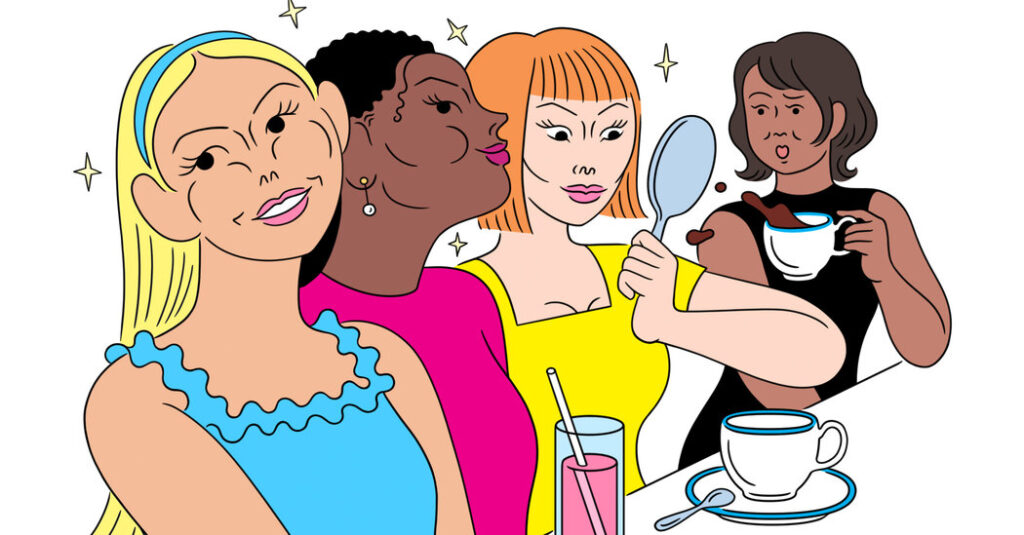
I have friends who look bizarre because of the amount of fillers and Botox they are getting. I want to tell them, but I feel that I should not, because I am afraid it will sound mean. If they are happy with how they look, it is none of my business. But I do not think they are happy, because they seem increasingly critical of themselves, and I do not think they realize how extreme it has become. Their aesthetic “clinicians” are selling them a look, along with a bizarre version of female empowerment centered on “me time” and self-prioritization. They are also selling packages that keep them plumping and smoothing and that encourage them to do more than they should out of fear of losing money on treatments they have already paid for.
I do not even know how to bring it up. First, I may be afraid to discover that they like how they look right now. (Although that might actually be a relief. If I knew they loved this look, I would worry less and be glad that they felt good about themselves.) Second, I am afraid that I could take someone who feels good about herself and make her feel bad. Still, I want to convey that many of these med-spa injectors and consultants are not their friends. They are selling a product to benefit their business, and their advice may not be in my friends’ best interests. — Name Withheld
From the Ethicist:
You seem quite convinced that your perceptions reflect the objective truth and little swayed by the old saw about beauty being in the eye of the beholder. But your friends may indeed like the way they look, even if it strikes you as strange; not everyone who embraces fillers, Botox and the like is aiming for a natural effect. You also have reason to wonder whether your disapproval of these interventions isn’t shaping your aesthetic response to the results.
If you had one friend who obsessed over invisible flaws in her appearance, you could worry that she had some form of body dysmorphic disorder and needed therapy. But you’re talking about a group of people participating in the same beauty culture; the phenomenon you’re seeing is social, rather than medical. Tell them you hate how they look and, in all likelihood, you’ll end up just losing friends.
You can share your views about these med spas, the insecurities they foster and the financial interests that drive them. It makes sense to be wary about cultures, and commercial enterprises, that manufacture dissatisfaction with ordinary faces and bodies. If a friend seems increasingly unhappy or self-critical, you can talk with her about whether the aesthetic that med spas promote is undermining her confidence. But maybe keep to yourself the part about how “bizarre” you think these women look. Friendship gives you reason and standing to be concerned about their well-being; it doesn’t give you license to decide what their faces ought to look like.
A Bonus Question
My partner and I are a male couple and have been together for more than a decade. His father, a minister, cut off contact after learning that we were a couple. He has a history of exerting his will over his wife and extended family based on his interpretation of the Bible. The reverend and his wife now reject us solely because we are gay, and even avoid their daughter’s house because she has welcomed us there.
My partner’s niece, with whom we are close, is getting married and has invited us both. Her grandparents say they will skip the ceremony, or perhaps boycott the entire wedding, if we attend together. The bride and groom know the situation and chose to invite us, even arranging the date so that we could be there.
I would not boycott the wedding just because my partner’s parents, who have treated us both unkindly, will be there. I think we should attend and leave them responsible for whatever choice they make. Any thoughts? — Name Withheld
From the Ethicist:
Your partner’s parents don’t get to decide who comes to their granddaughter’s wedding. Neither do you. Those decisions lie with her and her fiancé. The grandparents are entitled to express their disapproval of gay relationships in the family by staying away. But imposing that disapproval on everyone else is another matter.
Their position, as you recognize, parallels the one you would have taken had you asked your partner’s niece to disinvite them because you disapprove of their attitude toward gay people. Uncles and grandparents are on the same footing here. Go to the wedding and celebrate the happy couple. If the minister and his wife can’t bear your presence, they can answer for their own absence.
Readers Respond
The previous question was from a reader who discovered a lie in their last relationship. They wrote:
I recently ended a long relationship. … From the beginning, my partner described our relationship as ethical nonmonogamy. He was legally married, he said, but the marriage had become primarily a friendship and financial partnership. His wife no longer wanted a sexual relationship and had encouraged him to seek romance elsewhere. He also said they planned to separate amicably once their child became independent. … For years, apart from a brief hiatus, I accepted his account. As the promised transition approached, I pressed him for concrete plans. … Rather than answer my questions, he ended our relationship immediately. Since then, his story has seemed increasingly unstable. … Most troubling, I no longer know whether his wife ever consented to our relationship, much less encouraged it. … If I entered the relationship believing there was informed consent but later came to suspect there was none, is disappearing silently an act of respect for their boundaries or an act of cowardice?
In his response, the Ethicist noted:
The married man who assures you that his marriage is over (almost) and that he and his wife will split (eventually) is drawing from a very old cultural script, albeit updated with talk of “ethical nonmonogamy.” You have every reason to feel betrayed. This man appears to have abused your trust and, by manipulation, made you a party to a deception you wanted nothing to do with. So yes, he owes you an honest account of what happened, and an apology as well. … But what, exactly, do you expect from him? If he’s the practiced deceiver he seems to be, you’ll get nothing of genuine value. For that matter, you should feel free to tell his wife what you know — but equally free to involve yourself no further in their marriage. … What he owes you and what you can profitably seek to extract are, alas, separate matters. You’re entitled to the truth. Given what you’ve learned about him, you have no reason to think he’ll provide it.
(Reread the full question and answer here.)
⬥
I represented a significant number of cheated-upon, as well as cheating, spouses during my career as a family law attorney. The left-in-the-dark spouses all expressed anger at themselves (and anyone else who knew) for not recognizing the signs/reporting the infidelity sooner. Telling the other spouse would be a kindness to them and might benefit your mental health as well. — Kathryn
⬥
Telling his wife smacks of vengeance. That often backfires. I’m not even sure an apology is worth it. Tell him he failed you and block him. Self-esteem is the best outcome. Parting might not be sweet sorrow, but in my experience, confrontation only makes the injured party feel worse. — Keith
⬥
As a single woman, when I meet a man who claims he’s in an ethically nonmonogamous relationship, I often quip, “Oh, does your wife know?” If the situation ends up being something I actually want to pursue romantically, I will ask for his partner’s phone number so I can confirm his claim. If his situation is truly how he describes, he will give it eagerly; this not only signals “I’m interested,” but also “I understand the ‘ethical’ part of the arrangement.” — Amy
⬥
This man’s wife deserves to know that her husband has been carrying on an affair for years. I recommend telling her and providing evidence, not to break her heart, but to help her understand the truth about her marriage. — Jeannie
⬥
You had a yearslong affair with a liar and a cheat. Do not extend this relationship by holding out for an apology. Do some serious self-reflection and therapy to determine why you thought your life and happiness should be put on hold to please such a man, before you move back into dating. — Rose
The post Am I Obligated to Tell My Friends How Bad Their Botox Looks? appeared first on New York Times.