The American Israel Public Affairs Committee has told allies that it is considering a major financial campaign to support the Republican Senate nominee in the Michigan general election this fall, after it failed its biggest test of the primary season on Tuesday.
AIPAC’s super PAC spent $32 million in an unsuccessful effort to boost Representative Haley Stevens over Dr. Abdul El-Sayed, a relentless critic of Israel, during the state’s Democratic primary.
After Dr. El-Sayed’s victory, the group is unbowed and now appears willing to put what is expected to be tens of millions of dollars behind Mike Rogers, the Republican, as some of AIPAC’s major backers are urging, according to a half dozen people who have spoken with the group’s leaders.
In a statement, AIPAC suggested its supporters would be involved in the general election without laying out specific plans. “Our members remain determined to ensure that voters reject Dr. El-Sayed and his radical anti-Israel agenda in November,” said Deryn Sousa, a spokeswoman for AIPAC.
In an interview, Patrick Dorton, a spokesman for United Democracy Project, AIPAC’s main super PAC, said no official decision had been made about spending in the race. The organization had about $80 million on hand at the end of June, according to Federal Election Commission filings.
Backing a Republican in a competitive general election — especially in a crucial swing state — would be an extraordinary shift for AIPAC. The organization has long considered itself bipartisan and began spending in federal elections only in 2022.
Still, many AIPAC supporters consider Dr. El-Sayed to be a threat: He made opposition to Israel a centerpiece of his campaign and has repeatedly said that he would vote to cut off funding for the Jewish state.
“The days when we are told to shut up and be nice are over — that’s not what is going to happen here,” said Sam Markstein, the political director of the Republican Jewish Coalition, a national organization with several AIPAC donors on its board. “We are not going to be bullied, we are not going to be slandered. We are going to double down and we are going to do what we need to win.”
“We’d rather be respected and alive than loved and dead,” he added.
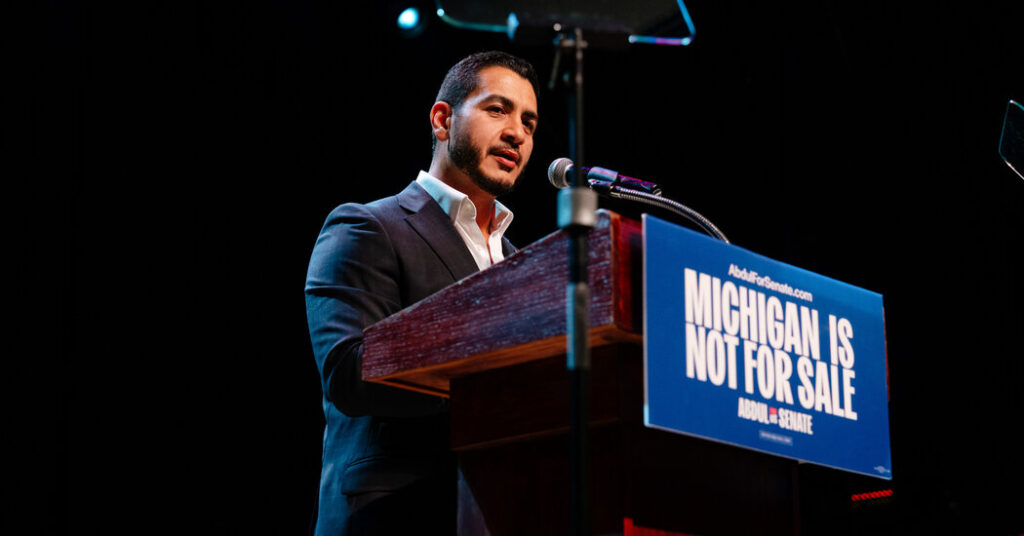
In his victory speech on Wednesday, Dr. El-Sayed sought to reach out to Jewish voters even as he continued to criticize AIPAC’s involvement in the primary. “To all of my sisters and brothers of the Jewish faith, or any faith at all, or no faith at all, I want you to know that my commitment to your safety — to Jewish safety — is the same commitment that I have to the safety of my own daughters,” he said.
Democratic and Republican operatives in touch with the organization said privately they expected AIPAC-affiliated groups to break from their traditional posture and spend millions for Mr. Rogers in November. Six people who spoke with AIPAC leadership before the primary said they left conversations with the strong impression that AIPAC planned to spend heavily against Dr. El-Sayed if he advanced to the general election.
Many political professionals saw AIPAC’s spending during the Democratic primary as counterproductive. Dr. El-Sayed appeared to be gaining in the polls and was using AIPAC’s involvement as a cudgel with which to attack Ms. Stevens.
But AIPAC leaders were unrepentant in private conversations about their expensive bet against Dr. El-Sayed, according to several people in touch with the organization, seeing the race as always likely to be close.
And in the race’s closing days, some political donors close to the organization found fault not with AIPAC but with its candidate, Ms. Stevens, or the media.
In the end, Dr. El-Sayed won by just a narrow plurality of the vote.
For decades, AIPAC has argued that supporting Israel is smart politics for American politicians on both sides of the aisle. But a new paradigm is emerging: Backing Israel has become a liability in some Democratic primaries. One recent poll showed that nearly half of Michigan Democrats had an unfavorable view of AIPAC, compared to just 12 percent who think of it favorably. With critics of Israel winning Democratic primaries in safe seats in New York, California and Illinois, the next Congress is likely to take the most skeptical view of the Jewish state since its founding.
AIPAC’s United Democracy Project has lost races before, but none where it spent so much money.
In the three election cycles AIPAC has participated in so far, it has gotten involved in only one general election race that included a Democrat and a Republican. In that race, United Democracy Project spent roughly $1.2 million against Representative Summer Lee of Pittsburgh, who easily defeated her Republican opponent.
AIPAC has also considered supporting Susan Collins, the Republican senator from Maine, this fall but is unlikely to get involved in both her race and the Michigan race, according to allies of the group.
The Michigan Senate primary was not the first race where AIPAC’s spending became an issue in the election. In an Illinois House Democratic primary this year, several PACs affiliated with AIPAC spend nearly $4.4 million to support Laura Fine, a state senator. But Daniel Biss, the mayor of Evanston, criticized Ms. Fine relentlessly for her support from the organization. Mr. Biss, who is Jewish and has deep ties to Israel, won the primary in the safely Democratic seat and made it clear he will push for change in U.S.-Israel policy if elected to Congress.
In Michigan, buoyed by polls showing him comfortably ahead in the final days of the primary race, Dr. El-Sayed practically dared AIPAC to spend against him in the fall.
“AIPAC, if you’re listening, burn your money, come back and burn it again in the general,” he said. “I’m happy to burn your money for you, and then we can get onto the business of governing and asking whether or not our foreign policy ought to be dictated to us by the interests of a foreign government.”
AIPAC is increasingly comfortable taking big risks like the one it is weighing in Michigan.
Jeremy Ben-Ami, the president of J Street, a more liberal leaning pro-Israel group that has repeatedly criticized AIPAC, said that if the group’s super PAC directly supported Mr. Rogers, it would amount to “political malpractice.”
“Every dollar that they are spending is deepening the problem that anyone who cares about Israel should want to resolve, not inflame,” he said. “To not read the room and not see this moment in the United States — it makes me angry and sad.”
Ron Weiser, a three-time chair of the Michigan Republican Party, has donated $125,000 to United Democracy Project during this election cycle. He said AIPAC should spend for Mr. Rogers, whom he considers a friend, for two reasons.
“First of all, because I am a Republican,” he said. “Secondly, I don’t need another voice that says Israel should be defunded and some of the other things that democratic socialists have said should happen.”
Mr. Weiser said he resented that many of AIPAC’s critics have successfully turned the organization into a boogeyman. “There are people that are supporting all sorts of causes,” he said. “What’s wrong with that?”
The post After Michigan Loss, AIPAC Weighs a Second Effort to Defeat El-Sayed appeared first on New York Times.