A Grover Cleveland campaign kerchief. A Betye Saar assemblage sculpture. A hand-lettered evening gown urging the passage of the long-stalled Equal Rights Amendment (E.R.A.). Posters by Norman Rockwell.
These were among the historical objects featured in the first show in the New York Historical’s new Tang Wing for American Democracy. Built at a steep cost of $175 million, it has been touted as an important expansion for the museum and a capstone to the architect Robert A.M. Stern’s career.
But, just one month since the show opened, none of those objects — several of which were called out in glowing reviews — are on display anymore.
Well, they still appear to be there. But look closely.
The wall labels quietly acknowledge that this object is actually a “reproduction” and that item is a “facsimile.”
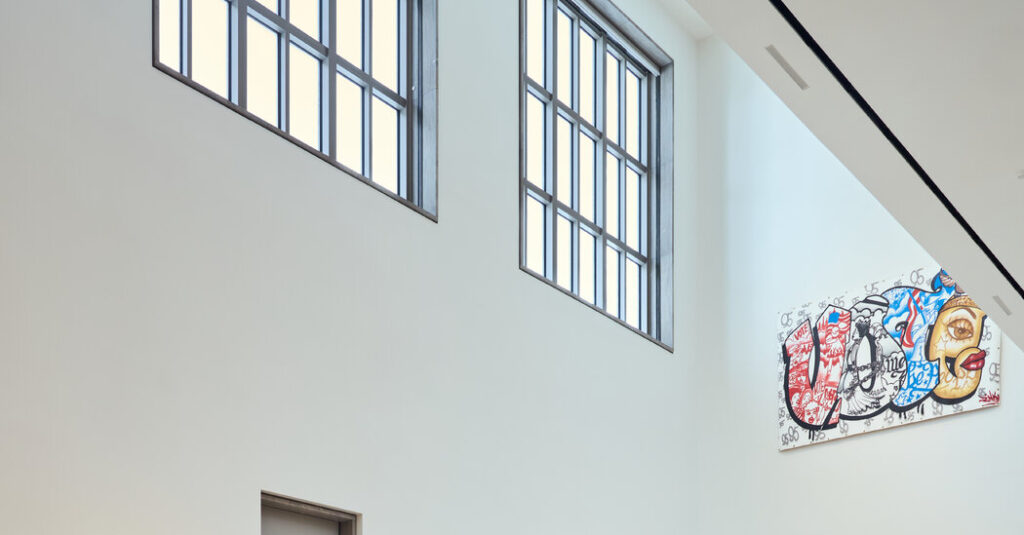
This is because it was only as the exhibition — “Democracy Matters” — was about to open on June 18 that the museum fully reckoned with the fact that windows in the new gallery would shower sunshine on some very light-sensitive artworks.
The museum’s first response was to lower blackout shades on the large upper windows. But when Louise Mirrer, the director of the museum (formerly the New-York Historical Society), realized how much that undermined the wing’s soaring architecture, she insisted the shades be raised back up.
“I felt it was disrespectful of the architect’s final museum project,” Mirrer said in an interview. “We had to find a means that could accommodate both the architecture and the exhibition narrative — which we did.”
So, to protect the vulnerable works, the museum replaced 17 of them with reproductions and removed another three.
In one instance, a three-dimensional assemblage by Saar — “Extreme Times Call for Extreme Heroines” — featuring what the wall label describes as a “mammy caricature” with an assault rifle on a washboard topped by a clock — was replaced by a simple digital photograph of the work.
In recent days, after The New York Times raised questions about the prevalence of reproductions in the show, the museum said it would remove the photograph because it did not adequately depict Saar’s assemblage.
Much of this has likely gone unnoticed by the many people who have visited and enjoyed the exhibition. The reproductions of Rockwell’s 1943 “Buy War Bonds” posters, for example, which were created by the museum’s digital printer, look strikingly like the images they replaced.
But museums — more so art museums than institutions that chronicle history — have long promoted themselves as places where visitors come in contact with authentic objects. Would patrons wait in long lines at the Louvre to see a reproduction of the “Mona Lisa?”
“What is real? What are visitors’ expectations? Are they evolving with younger generations who are often experiencing things digital first or replicas first?” Devon Akmon, chairman of the board for the American Alliance of Museums, said in an interview. “In a world where we’re seeing more and more things like artificial intelligence, do people want to see what they perceive as being the authentic piece? It’s a really interesting question that a lot of museums and a lot of scholars are trying to determine right now.”
It is certainly true that authenticity matters most in the art market, where the price for a painting thought to have been done by an associate of Rembrandt can soar by millions of dollars when it is re-attributed to the master himself. In such a setting, authenticity is not only a matter of visual aesthetics and visitor expectations, it is the essential foundation of financial value.
Gerhard Schlanzky, a 19-year veteran of the museum who worked on the “Democracy” show before stepping down as the creative director and director of exhibitions last month, was one of several current and former museum staff members who said they were disappointed by the changes.
“You come to see real things,” he said. “Otherwise people might just view them on their devices at home.”
In addition to the Saar, two other items removed from the show were the E.R.A. dress, worn by the Democratic New York congresswoman Carolyn B. Maloney to the 2021 Met Museum gala, and a mannequin in crocheted pink camouflage by the artist Olek that commemorates the 2017 Women’s March on Washington.
Informed by a reporter that their piece had been removed, Olek — who uses they/them pronouns — said in a WhatsApp message from Poland: “Art is safe in storage. But this is not what art is made for.”
Holland Cotter, in his New York Times review of “Democracy Matters,” cited the new wing’s “primary, high-ceilinged, light-flooded special exhibition gallery,” calling out in particular the Saar piece.
Schlanzky said he recently returned to see the show and was disappointed to find so many objects replaced or removed. “It sucked the life right out of it,” he said. “Particularly upsetting was the Betye Saar piece — to see something so dimensional and bright reduced to this not very good reproduction.”
This was especially distressing, Schlanzky said, given that Saar had just passed away, on July 26.
Alison Saar, one of the artist’s daughters, said in an interview that while she was “a little disappointed,” to hear about the situation, she gave “the museum the benefit of the doubt that this was done with the thought of preserving the artwork.”
“It’s unfortunate,” she said. “But you go down the hallway and can see a huge beautiful show of my mother’s dolls.” (An exhibition celebrating Saar’s 100th birthday featuring examples from the artist’s Black doll collection — a promised gift to the museum — is currently on view in another gallery.)
Schlanzky said Mirrer was aware of the light challenges early on. “The dialogue was always that if we were going to do an exhibition in that space, the windows had to be covered,” he said. “We never would have proposed light-sensitive objects if we knew the shades would be up.”
Mirrer said that, because she had been busy fund-raising for the $175 million project, she hadn’t paid sufficient attention to light issues in advance. She said her priority was to realize Stern’s vision of “a soaring, sweeping space that would invite the city in.”
The show’s curator, Wendy Nalani E. Ikemoto, who left the museum last month, said she had “no involvement in or advance knowledge of” Mirrer’s decision to raise the window shades and replace light-sensitive objects with reproductions. “I have documentation establishing that this decision was made after my departure,” Ikemoto said in an email.
David Nasaw, a historian who has frequently been a speaker at New York Historical, said authenticity is not essential to appreciating and learning from a historical object.
“When we go to Gettysburg battlefield or when we look at the Lincoln Memorial, we can’t see them exactly as the contemporaries saw them,” he said. “Paintings get dirty, buildings decay.
“A reproduction that we know captures the essence of the original artifact — that’s the second best,” he added. “If the only objects we can learn from are the originals, then the historians are lost and the history is lost.”
The post Yes, the Show Has Drawn Raves. But Some of the Objects Are Not Real. appeared first on New York Times.