Before long, every head of the Federal Reserve learns the lesson. Their words are parsed so closely that anything short of absolute precision has the power to upend financial markets and force the central bank to walk back a message that had become misconstrued.
Janet L. Yellen learned this at her first news conference as chair in March 2014 when she inadvertently suggested the Fed could raise interest rates much sooner than many had expected.
Jerome H. Powell exacerbated a market meltdown when, just months into the top job in December 2018, he characterized the Fed’s plan to reduce its portfolio of government bonds and mortgage-backed securities as on “autopilot” and signaled further rate increases to come. Mr. Powell changed tack just over two weeks later, helping to alleviate concerns that the Fed was dismissive of the warning shots that the markets were sending.
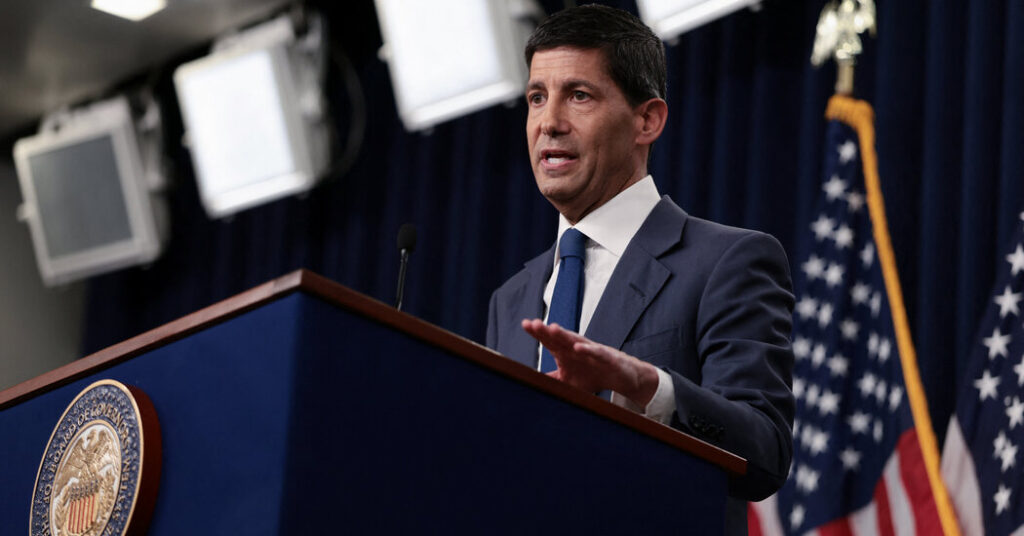
Kevin M. Warsh, roughly two months into his tenure as chairman, is facing his own reckoning after a news conference following the Fed’s July meeting that confused investors and called into question his commitment to quelling inflation, which has remained above the Fed’s 2 percent target for more than five years. It was a costly blunder, setting off a sharp market move that economists at Bank of America said was typically associated with “credibility shocks” faced by central banks in emerging markets.
Since last week, markets have stabilized, largely because of renewed hope that a deal to end the war with Iran is close. Stock markets are back around new highs, although longer term U.S. borrowing costs are still higher than they were before the Fed’s latest gathering.
The onus is now on Mr. Warsh to reset the narrative and make clear what it means in practice for the Federal Open Market Committee to have “no tolerance” for elevated inflation.
His next scheduled opportunity will be at the central bank’s annual conference in Jackson, Wyo., at the end of the month. Mr. Warsh, who has vowed “regime change” at the Fed and has been highly critical of past leadership, had initially wanted the speech to get at what he called the “big questions,” such as how a wave of higher productivity fueled by artificial intelligence is impacting the economy.
But more traditional, policy-focused remarks might be unavoidable to sidestep another bout of market indigestion. After that, the Fed’s next policy meeting, in September, will be another crucial test, especially if inflation does not moderate in the coming months.
“Every opportunity he has now to speak either with the F.O.M.C. or with the public is very important,” Jon Faust, a fellow at the Center for Financial Economics at Johns Hopkins University and a former senior adviser to Mr. Powell, said of Mr. Warsh. “There’s damage control to do.”
Already, several of Mr. Warsh’s colleagues have spoken out, emphasizing their willingness to raise rates if inflation does not begin to ease. They join three officials who believe the Fed should have already lifted borrowing costs by a quarter of a percentage point.
On Friday, Alberto G. Musalem, president of the St. Louis Fed, said he “expressed a preference” for higher rates at the meeting. Thomas I. Barkin of the Richmond Fed, said it was a “close call” whether rates were high enough to bring inflation down.
Those comments were followed by John C. Williams, president of the Federal Reserve Bank of New York, who on Monday said it would “absolutely be appropriate to act to get us on a trajectory that does bring inflation back to 2 percent” if price pressures did not abate as he expected. Mr. Williams is a member of the “troika,” the central bank’s internal policy-steering group that includes Mr. Warsh and Philip N. Jefferson, the vice chair.
Another voter on this year’s policy-setting committee, Anna L. Paulson, president of the Philadelphia Fed, said on Tuesday that “the passage of time without progress would itself signal that more restrictive policy is needed.”
Mr. Warsh might benefit from being as specific. But having made sending fewer signals a central pillar of his approach, it would require a shift in his communications strategy.
“This is a teething process,” Randall S. Kroszner, a University of Chicago economist who served as a governor at the central bank alongside Mr. Warsh, said of the leadership transition. “It’ll take a little while for the markets to figure out his seriousness about inflation and that he’s not going to tell them exactly what he’s going to do.”
“You don’t want to ignore market movements, but you also don’t want to be a slave to them,” Mr. Kroszner added.
There is a middle ground, suggested Donald Kohn, who served as vice-chair of the Fed from 2006 and 2010 when Mr. Warsh was a governor. What was most notably missing from Mr. Warsh’s latest appearance, he said, was “his sense of where he sees the economy going and how certain policy changes, or lack of changes, in the near term might help to advance toward their goals.”
That need not constitute “forward guidance” — a longstanding practice of the Fed to help guide markets during times of crisis that Mr. Warsh has sought to do away with — Mr. Kohn said. Rather, it would provide a framework to better understand Mr. Warsh’s objectives and how he would go about achieving them.
When Mr. Kroszner and Mr. Kohn worked with Mr. Warsh, the future chairman often framed the Fed’s institutional credibility as synonymous with its inflation-fighting one.
In a 2010 speech, Mr. Warsh warned about the risks of changing the inflation goal posts. “Substantial harm would be done to a central bank’s institutional credibility, and perhaps lead to an unmooring of inflation expectations,” he said. “Such damage could lead investors to seek alternative currencies, with prices of commodities and other hard assets likely to increase.”
He echoed a similar point more recently at congressional hearings last month. In one exchange with lawmakers on the House Financial Services Committee, he said, “My commitment to you is to take sticky prices and to unstick them.” In another, he stressed that his definition of price stability was something beyond just meeting the 2 percent target — a world in which price changes are mild enough “such that no one’s talking about it.”
In his opening remarks at last week’s news conference, Mr. Warsh emphasized that the Fed did not have a “soft inflation target,” meaning it would not accept anything more than 2 percent, as measured by the Personal Consumption Expenditures price index. He also said, “Where necessary and appropriate, we will not hesitate to act.”
But his responses later on at the same news conference sent an entirely different message, most notably his suggestion that the 2 percent goal was subject to debate.
“Who knows, come after next January, what we might say about strategy,” he said in reference to the Fed’s annual affirmation of its approach. He also mentioned his five task forces, one of which will take up the issue of how inflation is best measured. A change of that magnitude would require the backing of a majority of Fed officials, support that Mr. Warsh will not be able to amass at the very least until the current goal is met in a durable way.
Investors also struggled to look past Mr. Warsh’s hesitation to reiterate that rate adjustments were the primary tool at the Fed’s disposal.
The amount of pressure on Mr. Warsh to adjust course will depend in large part on how the data evolve. Next week’s Consumer Price Index report, which will capture the period after which the Iran war flared up again and oil prices revisited recent highs, will be of particular importance.
Before the September meeting, the Fed will have two full months of data related to inflation, the labor market and consumer spending, among other metrics. There is still a plausible case, according to officials, that higher rates will not be necessary and that inflation will retreat to 2 percent on its own.
A string of benign data would carve out a path for Mr. Warsh to once again stand pat when policymakers next gather. It will also give him the opportunity to flesh out in more detail how he sees other tools, such as shrinking the central bank’s large holdings of investment securities, helping on the margins. But having sent mixed signals about his own commitment to getting inflation down, inaction on rates will keep doubts aflame.
“The only way you regain confidence is actually hiking,” said Greg Peters, co-chief investment officer of PGIM fixed income. “The action is the most important at this point.”
The post Warsh Wanted ‘Regime Change.’ Markets Are Demanding a Reset. appeared first on New York Times.