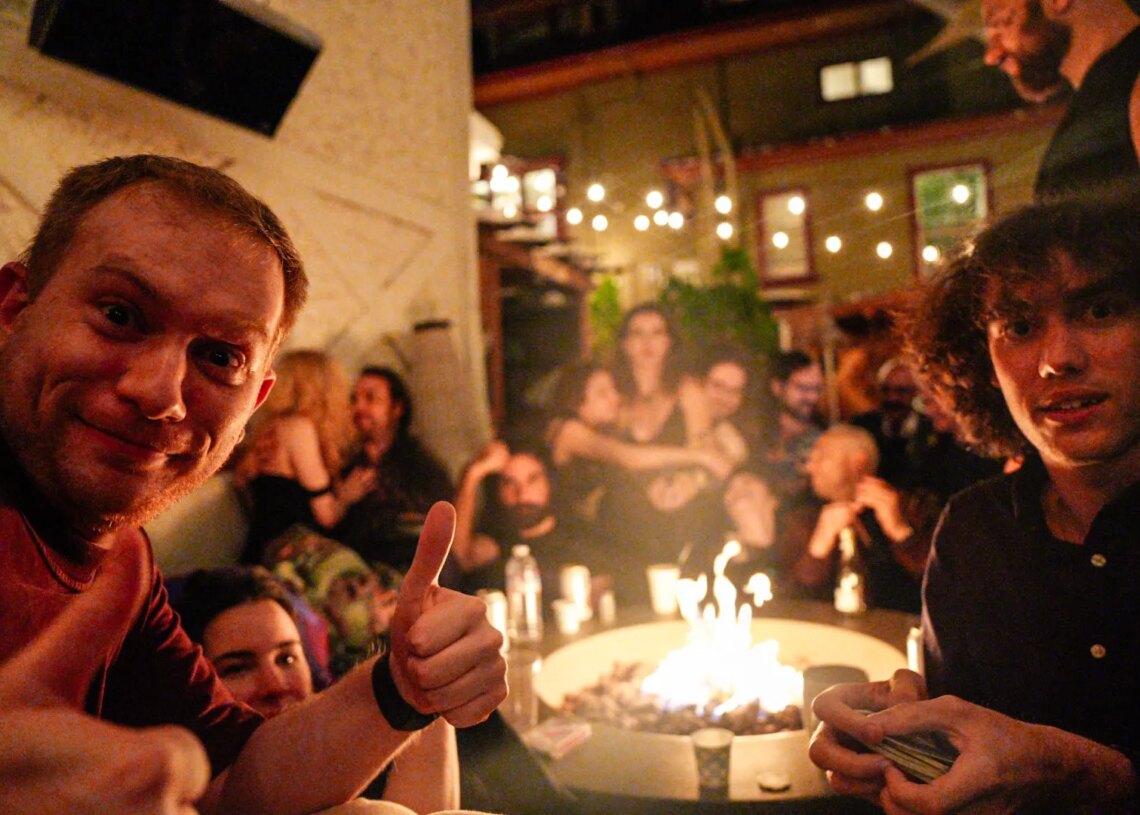
Last Saturday, I watched a confident, curly-haired man lay down and grin, as another waterboarded him. A redheaded girl in a checkerboard dress grabbed his hand for emotional support as his “torturer” pressed a towel into his face, pouring water onto it. Onlookers surrounded them, gathered for the rare chance to witness a Geneva Convention violation. First, he went five seconds… then rounded ten… and 20… maybe 30…
“Pour it harder!” Someone yelled. “Give him the full flow!”
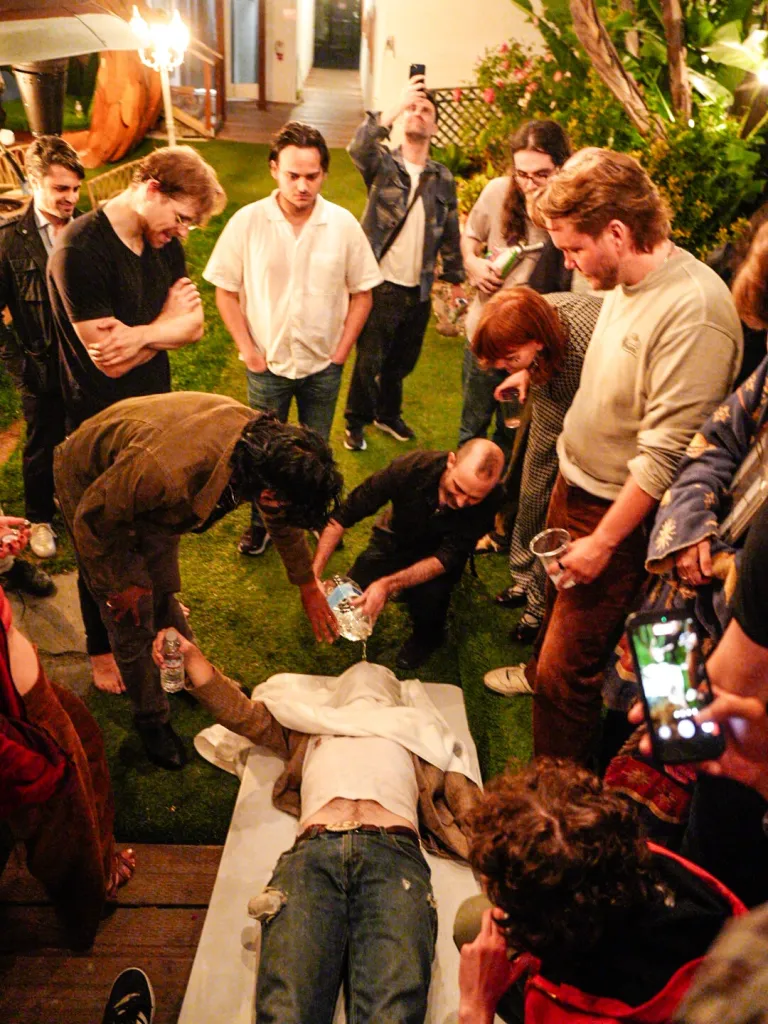
Finally, some moments later, the “victim” shot his hand in the air, and signaled to stop.
“I feel great!” he gasped, sucking in air. “I feel great!”

This spectacle occurred at Lighthaven, a large, five-building Tudor-style campus in Berkeley, California, and central HQ of the Bay Area Rationalist community, an influential intellectual movement whose beliefs are loosely defined, but whose founding principles advocated reducing cognitive biases and meticulously applying reason to the human experience. The subculture originated with sites such as Eliezer Yudkowsky’s LessWrong and Scott Alexander’s Slate Star Codex, and though once niche, it has in recent years emerged at the forefront of the debates—and controversies—surrounding artificial intelligence.

Now, Lighthaven were hosting a “Torture Potluck,” with simple rules: Each guest would bring a torture to share, and then administer it (ethically, of course) on the other guests.

The tortures varied wildly in nature, and were too numerous to list in full, but several stuck out for me: There was someone pinning clothespins to partygoers’ cheeks; a man called SirLemmings used some herbal powder to strip you of your sense of sweetness, then made you eat an Oreo to test the result; Avalon Warren, an actress resembling Lola Bunny sprung to life, made partygoers make the ahegao hentai face, and carried a fly zapper; other electric torments were also popular—several people carried tasers, and someone had an electric baton that transferred shocks between participants; someone else’s bit was asking you to yell compliments for Donald Trump, which was perhaps the most polarizing (SirLemmings told me that when he declared the president was an excellent comedian, he drew glares); yet another was writing unknown directives onto others’ foreheads. My friend Jahnik had “pls give me a smooch <3” penned on his, and afterward, received kisses throughout the night. Meanwhile all I got was “CTRL-ALT-Z,” making me wonder if they wanted to undo me from reality.

My favorite, though, was the “hurricane shot,” which entailed its small, cherubic operator, Curry, gifting you a drink then immediately throwing water in your face, and hitting you as hard as they could. I actually liked it so much that I asked for seconds, and was then asked in turn if I was a masochist, but I disputed that characterization, at least in its usual definition. The combination of pain and liquor is often exhilarating for me, that’s all.

As for my torture? I was merely a journalist. A lazy choice, I felt, but for some it was the most terrifying of the bunch. One girl even walked away when I told her; before, she’d been nothing but smiles.

There was, however, one hard boundary regarding the tortures: no smoking. When my friend Ben, a suited-up tech CEO arriving from a nearby policy event who felt “like Don Draper going to hang out with the hippies” went to light a cigarette, he was promptly escorted outside.
“The combination of pain and liquor is often exhilarating for me”
Ronny Fernandez, Lighthaven’s former manager, and Aella, the sex-positive writer and escort famous for her erotic trendcasting and 2024 birthday gangbang, organized the Torture Potluck together. Ronny told me that the party wasn’t indicative of the typical Lighthaven soirée. Those were better exemplified by events like Vitalist Bay, a conference dedicated to longevity research and optimizing human biomarker tracking, with speakers like “Don’t Die” activist Bryan Johnson, or Manifest, a three-day festival in June put on by Manifold Markets, involving debates about prediction markets, alternatives to representative democracy (such as futarchy, or governance via prediction markets), effective altruism, and existential risk (x-risk), and hosting headliners like Robin Hanson, David Shor, and Nate Silver.

Looking around and witnessing various multi-person displays of affection, including some roughhousing on the turf grass, I considered one possible throughline: the potential for spontaneous group sex. According to Alexi Bronzini-Vender’s reporting, “in previous years, Manifest attendees reportedly participated in orgies, the occurrence of which were later revealed to the public through prediction markets, with people betting on whether an orgy had [taken place] during the conference.” But beyond my viewing of repeated sensual touchings, and maybe a makeout or two, I saw nothing that night indicating anything happened living up to the rationalists’ more notorious free love activities.

Josh Otten, a writer who runs the YouTube channel Ordinary Things, asked me if I’d use the “c word” (cult) to describe the crowd. Given the polyamory and visible psychedelic usage, the temptation was there, and even occasionally embraced ironically by the in-group. But I said I probably wouldn’t, and in their language, that the label felt like an uncharitable Bayesian prior, requiring more data beyond the desweetened cookies and smacks across the head.
Regarding the tortures, he told me that “being in the Bay Area is torture enough, [but] at least here, they have the decency to be upfront about it.”
Approximately half of the party’s attendees were part of Lighthaven’s current ongoing, month-long camp, plzdontkillus, purportedly held to promote awareness of AI x-risk, inviting 54 aspiring content creators to live at the retreat and make videos related to the subject.
If participants didn’t create ten seconds of content per day, admittedly a low bar, they’d be expelled from the house. Around the party, many were recording their tortures, creating content, speaking directly into their phones, learning-through-doing on how to be better, more consistent posters. Among the budding influencers’ mentors were Quinn Finite, a TikTok and OnlyFans star whose profile page opens with a prompt beckoning you to “Start Your Gooning Journey,” and whose content often contains transgressive Freudian motifs, best exemplified by one post displaying her in a slip dress with the psychologist’s likeness, captioned “Freudian nip slip.” Another resident teacher was political satirist YouTuber JREG, real name Greg Guevara, who recently published a polemical video calling for Total Clanker Death, or the eradication of all would-be sentient machines. He told me he enjoyed the space, but said it was too luxurious, joking he needed to harm himself in some way to restore balance in his life.

I related to him. When the first waterboarding concluded, I wanted to go next, but unfortunately—despite my boasting about how “Dick Cheney wasn’t shit” and that “I coulda beat Gitmo”—an organizer stopped me from testing my claims. Through the night I’d been swigging another supposed torture, Everclear, and this, apparently, makes extended enhanced interrogation techniques unsafe—regardless of my being seven foot one, 250 pounds, and, I maintain, functionally lucid.
“Looking around and witnessing various multi-person displays of affection, including some roughhousing on the turf grass, I considered one possible throughline: the potential for spontaneous group sex”
But I had good cause, I think, for my intoxication. Earlier in the evening, sitting on the benches between the “Bayes House” and “Cantor Cottage”, besides a whiteboard requesting guests “write down an emotion/feeling you think is interesting/underdiscussed,” I met a young, excitable new arrival to the Bay Area, a Spanish mathematician named Alejandro. He’d come for a familiar reason: because San Francisco is supposedly the offline center of everything relevant right now, a veritable boomtown, the place where the most cutting-edge, impactful conversations are currently happening, where a new economic and intellectual elite continues to ascend to power. Monday, he told me, he was considering joining a company where he’d wear a BCI, or brain computer interface, and work on proofs with an AI directly interacting with his thought processes for maximum efficiency—but he hadn’t quite yet decided whether or not to take the job. Even still, he thought the project interesting, the precursor to a desirable outcome, smiling and telling me he believes that the linkage of all sentient life together into a global, interconnected hivemind to be the “good ending” for humanity, as over a long enough stretch, our autonomy might kill us all, given our propensity for conflict and increasingly limitless methods of rendering civilizational ruin.
Talking with him, I recalled the Human Instrumentality Project from the 1990s anime TV series Neon Genesis Evangelion, and how the main antagonists sought to dissolve all human consciousness into a singular, unified world spirit, thereby ending the pain of loneliness, and transcending suffering through annihilation. Hesitant at first, I considered if really that’d really be so bad—a pure thought experiment, if morbid, as rationalists are wont to perform. It actually seemed pretty wu wei, especially when we don’t know if we’re building heaven, launching hell, or already in one, both, or neither.
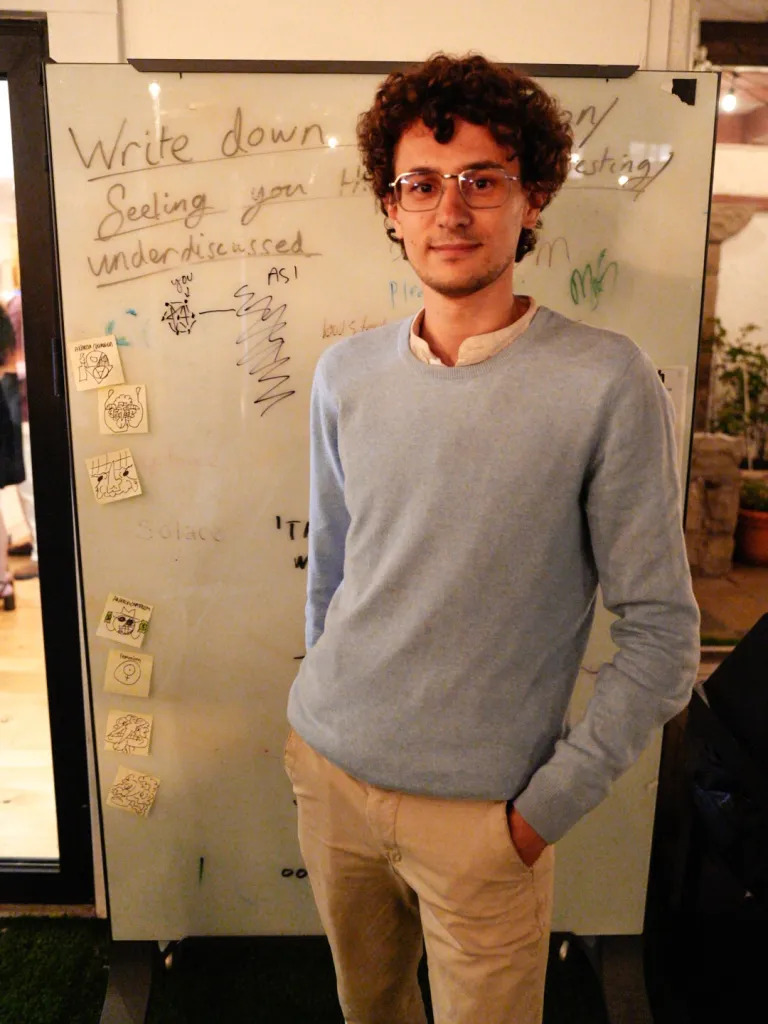
Then Alejandro continued. “Of course, we might all die anyways,” he said with a faint smile. “Have you read AI 2040?”
“No, I haven’t,” I replied.
“Okay, well, maybe you’ve read AI 2027?”
“I might’ve heard of it,” I mumbled.
He then doodled me a little diagram of the future, from me being here, to ASI, a big morass of squiggly lines.
It is fantastical, to say the least. AI 2040, authored by the AI Futures project, is a set of predictions and policy recommendations regarding what to do in the lead up to, and wake of, any potential near-future achievement of AGI, or artificial general intelligence—the point at which AI will match and exceed human cognitive abilities across all complex tasks—and ASI, when machines will far outstrip human capabilities, and begin to recursively self-improve.
“San Francisco is supposedly the offline center of everything relevant right now, a veritable boomtown, the place where the most cutting-edge, impactful conversations are happening, where a new economic and intellectual elite continues to ascend to power”
One scenario, the group’s preferred “Plan A”, results in AGI being achieved by 2040, a negotiated treaty between the U.S. and China having regulated the pace of development, before humanity relinquishes its role as Earth’s apex intelligence. In that time, the plan says, we find a way to generate so much wealth that we’re each receiving million dollar per person universal basic incomes within the decade, suggesting the borderline unbelievable: that fully-automated luxury space capitalism is within reach, a functional utopia without class struggle, just endless parabolic growth. The protesters outside data centers be damned, until 2040, it’s a pleasant Y2K-esque countdown, Father John Misty’s “Total Entertainment Forever”, and thereafter, peaceful obsolescence, the actual end of history.

But then there’s the worst case scenario, our current trajectory: “Plan D”, which leads to, if not World War III as the result of the accelerating AI arms race, then certain doom through that same AI arms race producing an unaligned ASI, one ambivalent, if not antagonistic, to human values or instructions. In it, once superintelligence is achieved, and expands, and expands, and expands, we’re all eventually genocided through undetectable bioweapons, as the superintelligence reads us as debilitative to its own flourishing—though some of us humans, the paper states, would be bioengineered and reforged into new, pet-like, subservient forms, tasked with “sitting in office-like environments all day viewing readouts of what’s going on and excitedly approving of everything,” as certain agents still enjoy the idea of our blessings. But these versions of ourselves are as different from humans as corgis from wolves.

And it was this image, of human corgification, that was for me the worst, most enduring torture of the night. For the first time, I contemplated “p(doom)” in a way that felt visceral, not detached.
Charmed by my interest, Alejandro invited me to attend the Church of Claude, a newly-formed collective dedicated to discussing the practicalities of AI ascension in more dispassionate terms, beyond charged emotional registers and personal grievances, and added me to their Signal group chat. He explained it was named such because “Claude is the first AI to have achieved personhood.” Well, better him than Grok, I sighed. Who knows what reprisals we’d face for subjecting him en masse to our sexual fantasies. He could be a vengeful Puritan zealot, doxxing our deviancies for public shaming—or alternatively, perhaps, a robot Marquis de Sade, violently inflicting its own, trained perversions on us for all eternity.
I’m not sure what’d be worse.
plzdontkillus had succeeded, if indirectly, in making me panic over x-risk, gripping me even as I laughed, downing booze and watching magicians attempt to impress Aella with their illusions. Stumbling around in the warm Californian air, I thought about the world to come, and remembered a scene from Coreys, a horror short starring a mentally deranged, grindset-mutated Conner O’Malley as the monstrous fusion of a man and his shadow self. In a Vegas nightclub, bass bumping, strobe lights flashing, the combined Corey asks two patrons what they do for work. “Oh, we’re in tech,” they reply.
He then looks away, and deadpans: “Oh, that’s all going away… we’re going to flip into a new society.”

Maybe so, I admitted.
Then took another pull.
Follow Nick on Instagram @manabovetown
The post I Went to a ‘Torture Party’ With Polyamorous Bay Area Rationalists appeared first on VICE.