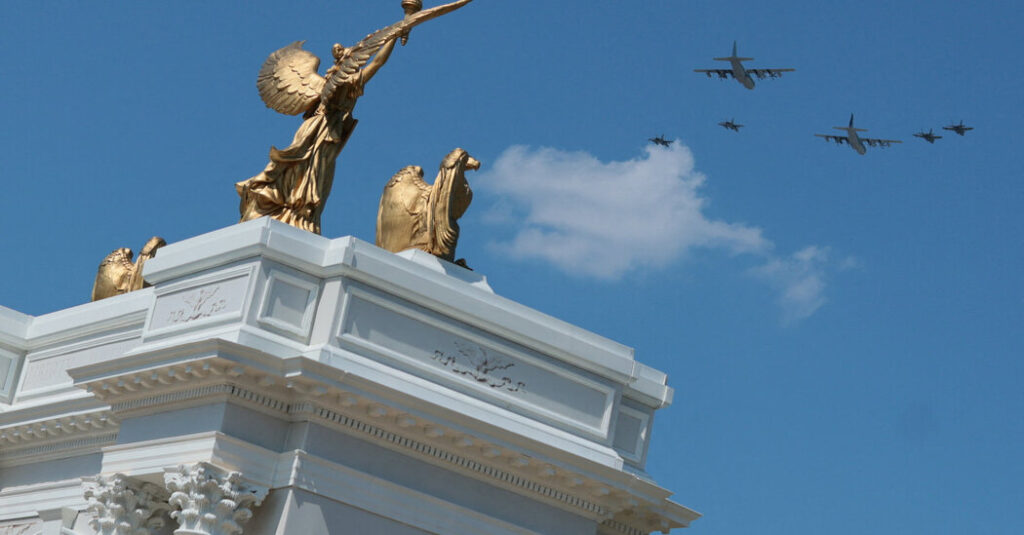
President Trump’s proposed 250-foot-tall triumphal arch would change the skyline of Washington to such an extent that it would intrude on views at dozens of historic sites around the capital, according to an assessment by National Park Service staff.
It would disrupt the symbolic relationship between the Lincoln Memorial and Arlington National Cemetery, obstruct sightlines from the Kennedy Gravesite and Robert E. Lee’s home, and alter what official documents call “one of the most magnificent” views in Washington at the National Cathedral four miles away, the Park Service said.
The assessment of the arch’s impact on surrounding historic properties is a key step the administration must complete before the project can receive final approval by the National Capital Planning Commission, which could come as soon as its next meeting on Sept. 3.
The Park Service is supposed to seek ways to reduce such “adverse effects” on historic sites under the National Historic Preservation Act. But the arch is expected to move forward with little change given that Mr. Trump has shown no interest in the most obvious remedies — scaling down the project, or building it somewhere else.
Precisely because the arch was designed to be so large and prominently located — it’s taller than the capital’s height limits allow, and more than twice as tall as the nearby Lincoln Memorial — it would be visible from many significant sites around Washington, altering what are considered defining characteristics of those places.
The recently updated list of affected sites, which the Park Service has asked outside groups to comment on by Thursday, is notable for its length and the many major buildings (and surrounding districts and landscapes) on it:
“These adverse effects are intentional and inherent in the design of the arch; it is intended to dominate the surrounding landscape,” wrote Roger W. Kirchen, Virginia’s State Historic Preservation Officer, in a June letter to the Park Service after it began the review.
Adverse effects mean “you’re building something that will irreversibly harm the experience in these other locations,” said Ed Stierli, the vice president for government affairs with the National Parks Conservation Association. Given that the administration is expected to proceed anyway, he said, this list looks like a reflection of the career civil servants and the Trump political staff “contradicting each other on paper.”
The assessment is part of what’s known as a Section 106 review under the preservation law, which requires federal agencies to consider how a wide range of “undertakings” — new courthouses, road expansions, pipeline permits — would affect sites that are on or eligible for the National Register of Historic Places. The law prescribes no particular outcome but is meant to get agencies to pause, consult experts and the public, and consider alternatives or design changes.
State preservation officials in Virginia and Washington and other organizations have charged that the arch review has been rushed and began too late for meaningful change. The review started after the site was selected, and after the design was approved by another federal panel. David Maloney, Washington’s historic preservation officer, proposed an alternative location on the Anacostia River due south of the Capitol, a solution that appears off the table as the White House sprints to complete the project before the end of Mr. Trump’s term.
The National Park Service did not respond to questions about the review process.
As the administration moves swiftly through the review, it is simultaneously pushing to overhaul the rules governing historic reviews nationwide, curbing public participation and the kinds of places and harms that would be considered. The new regulations are unlikely to take effect before the arch review is complete. But the president’s prized project illustrates how consequential the rules changes would be. In fact, nearly all of the “adverse effects” of the arch would no longer be recognized.
The harms identified by Park Service staff largely describe changes to the setting and views at historic sites, not physical damage to them. But the sightlines, surrounding landscapes and symbolic links to other monuments and memorials are documented features of their historic designations — ones that shape how visitors experience these places today.
The proposed regulatory changes would narrow the focus of reviews to material harm, like damage from construction.
Trump Administration: Live Updates
Updated
- Iran, in talks about reopening the Strait of Hormuz, casts doubt on Trump’s claims about a broader deal.
- Blanche moves to appease two senators ahead of a vote to advance his nomination.
“Visual sightlines, relationships, setting, context — none of that matters,” said Greg Werkheiser, a lawyer and founding partner of the firm Cultural Heritage Partners, which works on preservation cases.
Those very features are at the core of opposition to the arch. The case against it by veterans, preservationists, historians and Washington residents is that it would alter the meaning and feel of the places around it — not just the ground inside Memorial Circle, where it would be built.
The arch would interrupt a carefully planned corridor between the Lincoln Memorial and Lee’s Arlington House that was designed to symbolize the reunification of the North and South after the Civil War. From Lee’s memorial, much of the Lincoln Memorial would be obscured by the arch. From Arlington Memorial Bridge connecting the two sides of the river, the arch would insert a “triumphal” symbol into a space that’s also the solemn entrance to Arlington National Cemetery.
Gary Langston, a retired Army officer who has spoken against the arch during its public design reviews, wants officials to imagine a veteran visiting the gravesites of fallen fellow service members.
“And you’re going to look up and you’re going to see this thing looming over you,” he said in an interview. “And then it’s going to have a viewing stand with tourists looking down at you.”
The plans for the arch include an observation deck that its proponents say would introduce sweeping new views of the capital region. But the immediate proximity to the cemetery means that tourists looking west would often be observing private funerals and grieving families, veterans say. And if they look toward the Lincoln Memorial and Capitol to the east, they would turn their backs on the cemetery.
The Park Service assessment acknowledges that from ground level inside some parts of the cemetery, the arch would become part of the scenery. It would also obstruct views from the Eternal Flame at President Kennedy’s gravesite, on a hillside facing the Lincoln Memorial.
Mr. Langston and other veterans also fear that the thrum of construction — projected by the administration to run for 20 hours a day for multiple years — would disrupt burials. “Atmospheric or audible” effects would no longer matter under the new rules either. That would limit protections for places whose significance and function depend on silence, said Sara Bronin, who served during the Biden administration as the chair of the Advisory Council on Historic Preservation, the federal agency responsible for the Section 106 rules.
Beyond the cemetery, the arch would become part of the experience of visiting the front steps of the Jefferson Memorial and the upper stories of the U.S. Capitol. It would be visible from the Georgetown waterfront and the grounds of the Washington Monument.
To supporters of the arch, those may be features, not intrusions. The arch will become one of the most iconic landmarks not only in Washington, but also throughout the world, said Davis Ingle, a White House spokesman.
“It will enhance the visitor experience at Arlington National Cemetery for veterans, the families of the fallen, and all Americans alike,” Mr. Ingle said in a statement, “serving as a visual reminder of the noble sacrifices borne by so many American heroes throughout our 250-year history so we can enjoy our freedoms today.”
Under the Section 106 process today, once the Park Service identifies affected historic properties, it is then supposed to seek ways to “avoid, minimize or mitigate” any harms. But it’s hard to see how that’s possible with the arch, preservationists said.
“There’s been no effort to avoid” harms by considering alternative sites, said Rebecca Miller, the executive director of the D.C. Preservation League. “There has been no effort to minimize, because the president has told them not to. And what is the mitigation for destroying the cultural landscape? I don’t know that you can mitigate this.”
If the proposed regulatory changes are adopted, the phrase “avoid, minimize or mitigate” would be deleted.
Julia Jacobs contributed reporting. Francesca Paris contributed graphics.
The post Park Service Finds Trump’s Arch Could Detract From Dozens of Historic Places appeared first on New York Times.