President Trump headed into the weekend having vowed that U.S. forces would unleash a furious new round of attacks against Iran, saying that the military would be “hitting them very hard.” By Saturday night, Mr. Trump said that the military was still “locked and loaded” to carry out the strikes, but that he had decided to call them off.
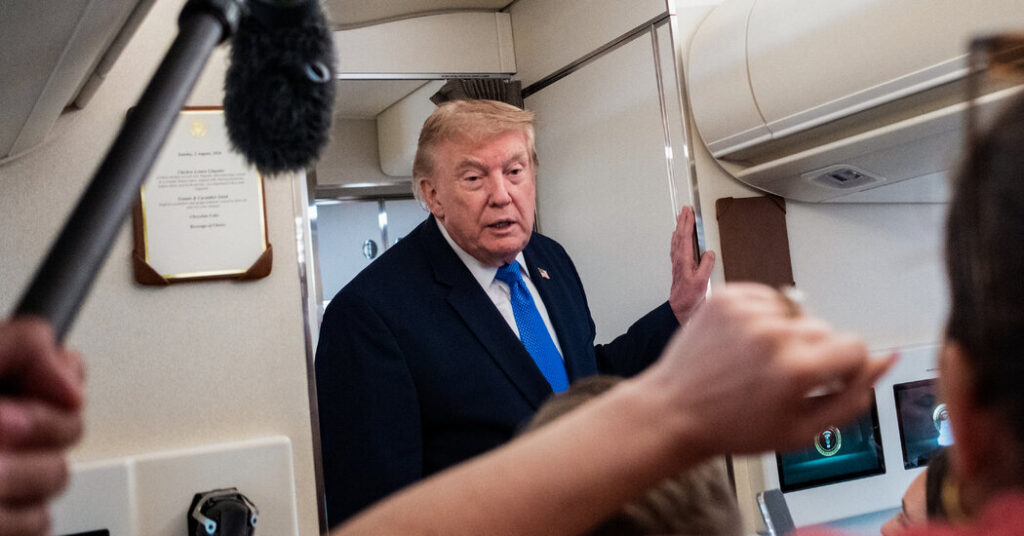
“I was asked to by Saudi Arabia, by U.A.E., by Qatar and by Iran,” Mr. Trump told reporters on Sunday evening aboard Air Force One on his way back to Washington from his golf club in New Jersey. “We were all set to go. Just about at this time, right now. The reason they asked is they think there’s a deal.”
Mr. Trump said that talks with Iran would begin on Monday, and that he was told there could be a deal to reopen the Strait of Hormuz, a crucial shipping route, as well as “a deal on the nuclear.” He has, of course, said most of this before. Repeatedly.
Over the five months since the war began, Mr. Trump has reached this point in the cycle several times, threatening to unleash hell and then trumpeting a coming negotiation with Tehran. Just over a week ago, Mr. Trump decided not to go through with a previous round of threats to escalate against Iran after advisers had raised a number of concerns, including worry that intensifying the war could dangerously drain an already diminished supply of Patriot antimissile interceptors.
Over the weekend, the White House and the Pentagon offered scant new details about what might have brought the Iranians to the negotiating table this time, if in fact they have agreed to talks. That left lawmakers, strategists and Middle East experts working to divine whether the president is moving the conflict craftily to an end or just cycling through a series of unappealing options.
“A cul-de-sac is as good of an explanation as I could come up with,” said Khaled Elgindy, a visiting scholar at the Center for Contemporary Arab Studies at Georgetown University. The president, Mr. Elgindy said, “seems to go in the direction of the last person he spoke with, which was M.B.S., and before that was Netanyahu.”
Mr. Elgindy was referring to Crown Prince Mohammed bin Salman, the de facto ruler of Saudi Arabia, who spoke with Mr. Trump over the weekend and influenced him not to carry out his latest threats to escalate militarily against Iran, according to a former senior U.S. official and other officials familiar with the call, who were granted anonymity to discuss sensitive talks.
Earlier in the week, Mr. Trump met at the White House with Prime Minister Benjamin Netanyahu of Israel, who in February helped persuade the president to enter the conflict. Several hours after their meeting last week, Iran launched a new round of attacks on the Muwaffaq Salti Air Base in Jordan, where several U.S. service members were killed by strikes in July.
Saudi Arabia, which has been targeted in the war, has been concerned about its regional spread and continues pushing toward a negotiated deal. The U.S. Navy, meantime, continues to enforce the military’s blockade of commercial ships entering or leaving Iranian ports. There have been no U.S. military strikes against Iran since dozens of Iranian sites were hit in the middle of last week.
Several Republican lawmakers said on Sunday that they were unclear where Mr. Trump would go from here. Last week, Senate Republicans declined to limit Mr. Trump’s power to continue the war. Days later, they were publicly lamenting the lack of information shared by the administration about the conflict.
“I don’t know whether the president should start a new bombing campaign again, because I don’t have the military intelligence,” Senator John Kennedy, Republican of Louisiana, said on Sunday during an appearance on NBC’s “Meet the Press.” “Now, that’s a problem, too, because it’ll cause a lot of pain. It’ll cause energy prices to go up, and a lot of inflation for the American people. They’re all hellish choices.”
Mr. Kennedy also questioned whether the Iranians were really interested in negotiating, and laid out the advice he would give the president: “He has to remember that the Iranian government learned to lie before they learned to talk.”
Representative Michael R. Turner, Republican of Ohio, who was interviewed on CBS’s “Face the Nation,” said that he did not “think anybody is satisfied with the level of information we’re receiving, although it is a dynamic conflict.”
The White House did not immediately respond to requests for comment on Sunday about what the president’s latest announcement meant. Analysts who have studied the conflict said that Mr. Trump’s oscillation between bombing and negotiation appeared to resemble a public relations strategy, not a military one.
“Trump’s entire premise for this war — that Iran is weak and as a result the U.S. can coerce it into capitulation — has proven false over and over again, yet Trump is unwilling to accept this,” said Trita Parsi, the co-founder of the Quincy Institute, which is critical of American foreign policy that relies on military aggression. “He’s looking for a knockout blow when there is none.”
Democrats had their own criticisms of the way Mr. Trump has managed the conflict, including putting people without extensive foreign policy experience in charge of negotiations. Steve Witkoff, Mr. Trump’s longtime friend who is now special envoy for peace, and Jared Kushner, his son-in-law, both helped broker a cease-fire in the war in Gaza last year, and they have been consumed by Iran negotiations in recent months.
“They’re stuck, they’re responsible for this, and the president is the one that has to try to figure out a way out of this,” Senator Mark Kelly, Democrat of Arizona, said during an interview on CBS on Sunday. “I would suggest to him, though, that the solution is not to do the same thing that he’s been doing — not to have his real estate buddy and his son-in-law in charge of a negotiation.”
Mr. Trump, for his part, spent Sunday afternoon at his golf club in New Jersey, celebrating what he said was a big win in a golf tournament.
“I won with a score of 70, and am so honored in that, unlike the rest of the field, I’m given very little time to practice, because I’m focused on many other things,” Mr. Trump wrote on social media. “It’s called TALENT, and I have it, and they don’t!”
Eric Schmitt contributed reporting.
The post New Round of Trump Threats and Pullbacks Raises Uncertainty in Mideast appeared first on New York Times.