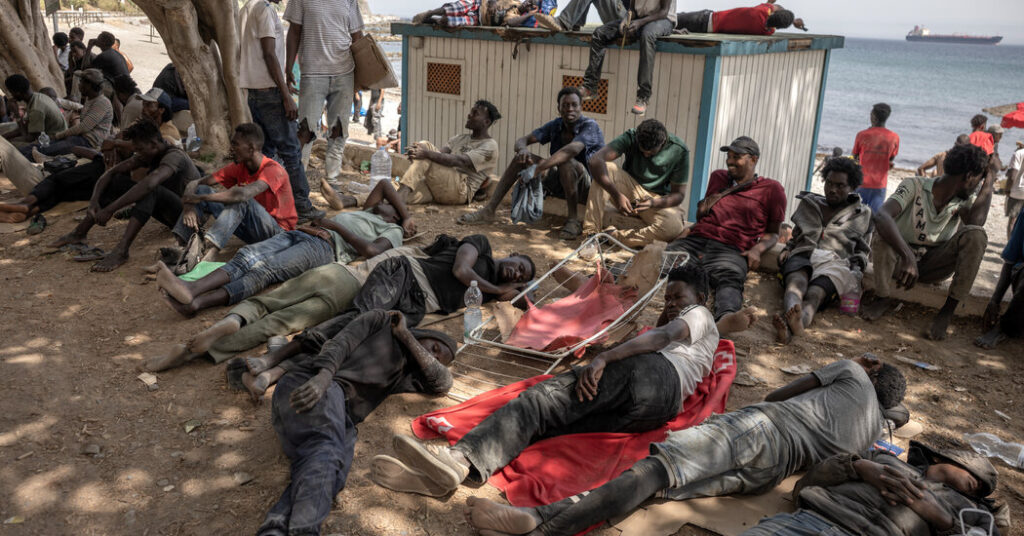
Sitting on a beach on Saturday in Ceuta, Spain, a Senegalese man called Djibril Mboup pulled a bag of pistachios from his pocket and began rationing them, one by one, among his newly made friends. The bag, given to him by a Spanish police officer, contained the only food, he said, that he had eaten in the nearly two days since he entered this small Spanish territory in North Africa.
Yet despite his hunger, Mr. Mboup, 30, said he was not going to return across the border to Morocco.
“I speak for everyone here,” Mr. Mboup said, raising his voice as the young men around him murmured in agreement. “Even if we don’t eat, even if we don’t drink, we are not going back to Morocco. We are staying here.”
Mr. Mboup was among roughly 400 men, most of them from sub-Saharan Africa, who were gathered on this beach on Saturday. Many of them lay on ragged sheets of cardboard, their feet blistered from crossing the border and roaming Ceuta’s streets.
By late Saturday, the fate of this group had become one of the last unresolved questions for Spain’s government in the short term after at least 50,000 people, mostly young Moroccan men, crossed into Ceuta on Thursday and Friday, overwhelming the city of just 84,000 residents.
Most of those arrivals had left by Saturday morning, returning to their homes in Morocco after they realized that there was little for them in Spain. The 400 men on the beach, at the opposite end of Ceuta from the border they had crossed, were among the last holdouts, and for them the crisis was far from over.
With few prospects in Morocco, they waited anxiously on the beach for news about their future in Spain, under the watchful eyes of Spanish police officers. Some were so exhausted they did not react when people stepped over them. Mr. Mboup was so tired it took him a moment to remember which day he had arrived in Spain.
“The situation is very difficult,” said Ramsés Mohamed, an activistfrom a local humanitarian organization, who had come to the beach to tell the migrants about their rights. He warned that if the government did not provide food, “a humanitarian crisis could begin to unfold.”
The fate of some of the holdouts “is not the same as that of the Moroccans,” Mr. Mohamed, 26, said. Unlike Moroccans who had joined the exodus to Ceuta on a last-minute whim, some of the sub-Saharan migrants are from war-torn regions and had journeyed for months to get to Europe. “They genuinely have the right to request international protection,” Mr. Mohamed said.
Minutes later, a man wearing official credentials arrived at the beach to address the migrants. Dozens surrounded him and began chanting cheerfully, “A-si-lo, a-si-lo” — “asylum, asylum” — in the hope that he had the power to help grant them sanctuary.
Some of the recent arrivals have opted to go into hiding. On Saturday, small groups of Moroccans were making for the hills around the city, and others were concealing themselves in the bushes. Here and there, police officers gave chase.
For those on the beach, the best possible outcome as they navigated the complexities of the European Union’s asylum system was to be transferred to the city’s official migrant reception center. But on Saturday, that appeared unlikely, at least for now: It was already overcrowded with hundreds of people, even before this crisis began.
David Cebrián, a spokesman for Spain’s Migration Ministry, said that officials were working to assist those already at the reception center and were “strengthening” its capacity “to provide an adequate, coordinated and effective humanitarian response to this extraordinary situation.”
Mr. Mboup grew up in Dakar, the capital of Senegal, earning a diploma in logistics, he said. After struggling to find work in his early 20s, he decided to leave the country in 2018 and made his way to Morocco by navigating the deadly smuggling routes through the Sahara. He settled in Casablanca, a coastal city, where he scraped by working illegally as a taxi driver at the airport.
Until this past week, Mr. Mboup had never tried to cross into Europe, thinking it would be too dangerous.
On Thursday morning, Mr. Mboup said, his friend told him she had seen posts on WhatsApp saying that the usually heavily guarded border between Morocco and Ceuta was open, and she suggested that they go. He initially dismissed the reports as a hoax.
When a food vendor in Casablanca told him that he, too, was heading to the border, Mr. Mboup changed his mind. If Moroccans believed it was true, he thought, then it must be.
“Let’s pack and go,” Mr. Mboup recalled telling the friend.
They hired a van, he said, and drove with several friends 200 miles to the border, to find thousands of people gathered there. For hours, they tried unsuccessfully to find a way across on foot because, unlike Mr. Mboup, his friends did not know how to swim, he said.
As night fell, Mr. Mboup told his friends that he would try his luck alone, he said. But he was still afraid to do so because he feared how the Moroccan police would react, he said. According to Mr. Mboup and other sub-Saharan Africans, Moroccan police officers tried to prevent Black people from crossing the border on Thursday, even as they encouraged Moroccans to head for Ceuta.
“Only Moroccans could enter,” said Kamal Omar, 24, another new arrival, who said he fled war-torn Sudan three years ago. “When they saw a Black man, they hit him.”
The Moroccan government did not respond to requests for comment.
Institutions including Human Rights Watch and the State Department have reported similar accusations in the past. In response, the Moroccan government has previously said that its border guards act in “self-defense” and that their “use of force is generally a reaction to violence suffered by law enforcement officers.”
Hoping to avoid the police’s attention, Mr. Mboup joined a group of Moroccans swimming toward Ceuta, he said. He reached the Spanish shore after roughly 30 minutes, he said, though he did not feel that he was in Spain until he saw the cars — the “Spanish cars.”
His happiness quickly gave way to disappointment, he said.
“I kept looking for signs toward Madrid and Barcelona,” he said, only to realize that he was still “on an island” and that mainland Europe was far away.
Then came another setback. The residents of Ceuta had shuttered their shops, and there was no food or water to buy.
By Friday evening, most of the Moroccan migrants had returned home. That mainly left the group of sub-Saharan Africans who seemed determined to stay despite having nothing to eat. Rather than forcing them out, the Spanish authorities directed them to this beach in the city’s northwest, close to the migrant reception center.
By Saturday, those holdouts seemed caught between two bad options.
“We are very, very hungry,” Mr. Mboup said. “I appeal to the good will of Spaniards — we need help.”
Mr. Mboup warned that the situation was untenable and could grow more volatile as people on the beach grew more desperate.
By Saturday evening, though, it was the city center that was showing signs of volatility. In a central shopping street, a prominent far-right politician — who had traveled to Ceuta to call for the migrants’ expulsion — faced off against a crowd of residents who accused him of stirring up tensions.
The politician took shelter in a bar, as the residents pounded on the windows. Later, the police escorted him away, drawing cheers from the locals.
“Ceuta united,” they chanted, “will never be divided.”
Lynsey Chutel contributed reporting from London, and Finbarr O’Reilly from Ceuta.
The post After Most Migrants Leave Ceuta, Exhausted Holdouts Find Shelter on Beach appeared first on New York Times.