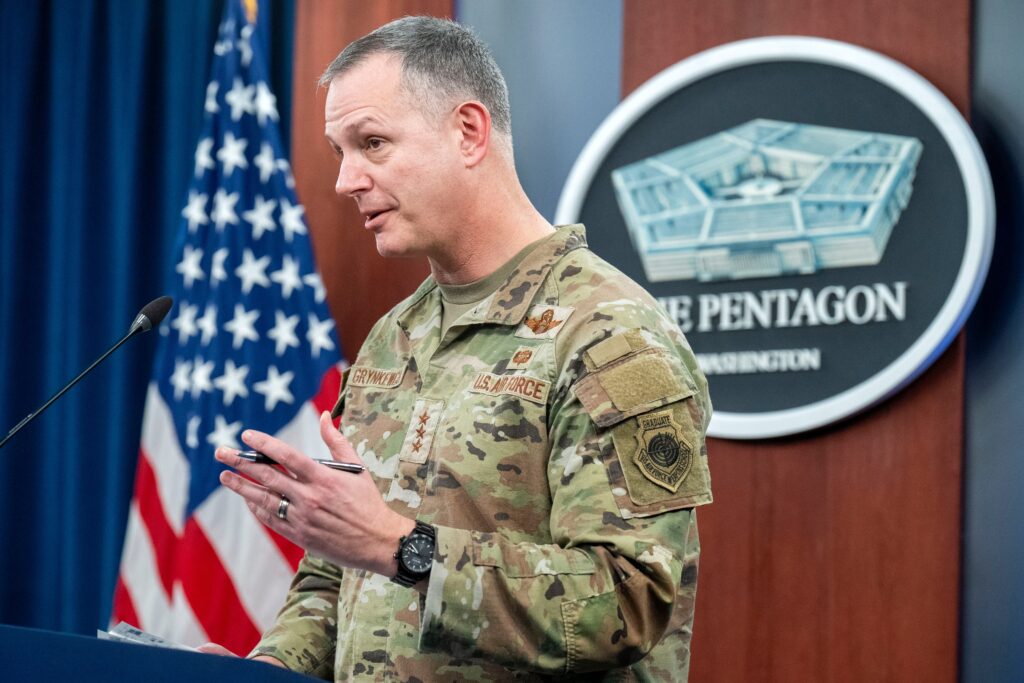
The top U.S. general in Europe privately warned the Pentagon this week that he lacks sufficient naval forces to continue protecting Israel from incoming ballistic missiles, officials said, illustrating how the ongoing Iran war has imposed constraints on the military.
Gen. Alexus Grynkewich, the head of U.S. European Command, sent written notification to senior Pentagon officials saying that without another Navy destroyer he will be forced to choose defense of the United States “homeland” over that of Israel, said the officials, who like some others spoke on the condition of anonymity to discuss the correspondence.
A U.S. defense official said Grynkewich’s notification appears consistent with past outreach to the Pentagon from the military’s top generals when they see certain risks that require Washington’s consideration. This can occur, the official said, as commanders compete for finite resources and weapons.
The Pentagon declined to comment. U.S. European Command did not respond to requests for comment. A spokesperson for the Israeli Embassy in Washington could not be reached for comment.
The general’s warning comes at a tenuous moment in the five-month conflict, as near-daily attacks have resumed following the collapse of peace talks between Washington and Tehran and the operation’s intensity has drained U.S. supplies of key defensive weapons.
The Navy has been particularly taxed, as the Trump administration has directed a blockade of Iranian ports in response to Tehran’s closure of the Strait of Hormuz. The standoff has stymied the movement of Middle Eastern oil and other commodities through the narrow waterway, upending the global economy.
U.S. naval destroyers in the eastern Mediterranean Sea have been employed as a part of Israel’s defense for many years. The vessels, equipped with powerful radar and armed with an array of missiles, have downed missiles aimed at Israel not only by Iran, but by Houthi militants in Yemen that are equipped by Tehran.
European Command is central to this mission, as it coordinates military operations in the Mediterranean. At the same time, its forces must remain ready for any Russian incursion into territory protected by the NATO military alliance. Russia also poses a ballistic missile threat to the United States, with missiles capable of reaching the U.S. mainland.
The Navy has five destroyers that deploy from a U.S. port in Rota, Spain, with a sixth expected to arrive there later this year, Pentagon officials have said. But maintenance issues have piled up due to the Iran war’s tempo, complicating matters for Grynkewich, officials said. The Washington Post withheld specific details about the ships’ availability at the request of military officials, who cited security concerns.
As The Post reported in May, Pentagon assessments conducted earlier in the war showed that U.S. forces have shouldered the brunt of defending Israel from Iranian ballistic missiles. The assessments found that American weapons, including the Terminal High Altitude Area Defense and naval interceptors launched from the eastern Mediterranean, were used far more frequently than Israeli air defense weapons.
Two destroyers, the USS Paul Ignatius and the USS Roosevelt, were in the Mediterranean Sea on Friday, a U.S. official said. Three destroyers were in Rota: the USS Arleigh Burke, the USS Bulkeley and the USS Oscar Austin.
Closer to Iran, an armada of additional vessels was in the Arabian Sea, including two aircraft carriers, the USS George H.W. Bush and USS Abraham Lincoln, and at least 15 other warships, this official said. Eleven are destroyers.
The fleet has been central to the Trump administration’s blockade of Iranian ports. It also has been involved in an effort called “Project Freedom,” in which the U.S. military has helped protect vessels in the contested Strait of Hormuz.
Another destroyer, the USS Gonzalez, is in the Red Sea, where Yemen’s Houthis have attempted to enforce their own blockade of commercial shipping in a bid to further the economic pressure facing the U.S. and its allies in the region. Saudi Arabia, a key U.S. partner, has sought to thwart the Houthis, a longtime adversary, by developing a military coalition to ensure freedom of navigation.
The Iran war is increasingly unpopular among the U.S. public, and members of Congress — from both political parties — have grown frustrated with the administration as top officials struggle to articulate a plan for ending the conflict on terms deemed favorable to the United States. There is a deepening worry among many Republicans, particularly, that the war’s impact on the price of gas, food and other goods will cost the party in November’s midterm elections.
Tom Karako, director of the Missile Defense Project at the Center for Strategic and International Studies, a think tank, said the warning issued by Grynkewich highlights the scope of the Pentagon’s challenges.
“Being on a wartime footing is going to take a toll in terms of readiness and munitions inventory levels,” he said. “Now the question is: What’s the strategy here?”
The post U.S. general warns Pentagon he lacks sufficient forces to protect Israel appeared first on Washington Post.