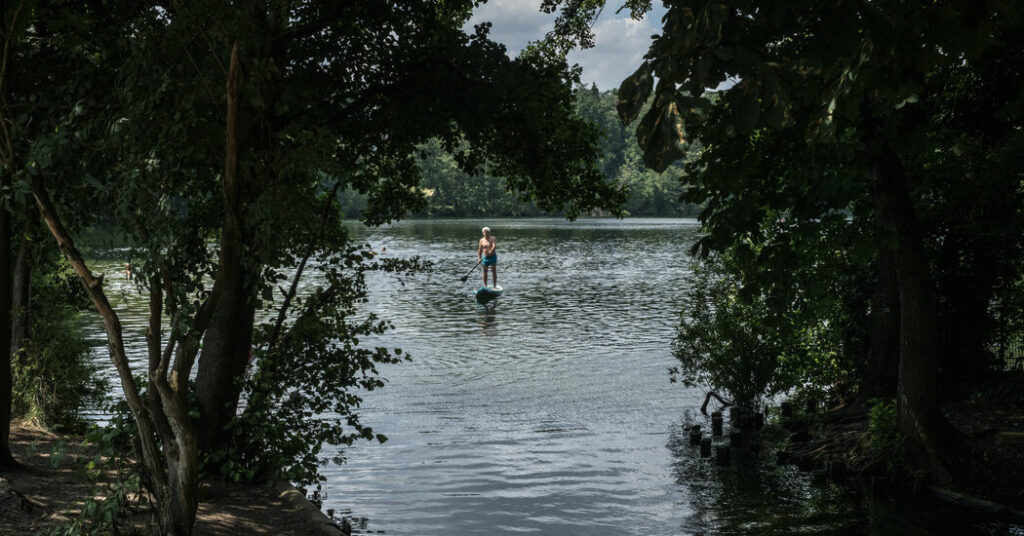
Christiane Bielenski took her father and her young children on a sparkling Friday morning in June to the shores of Krumme Lanke lake, in a leafy and wealthy nook of western Berlin. It was a nice morning for water-splashing and card-playing and building sand castles on the beach, the kind that Ms. Bielenski enjoyed during her own childhood in Bavaria.
With one sweltering exception.
“It wasn’t that hot” when she was young, Ms. Bielenski, 38, said. “Definitely not that hot.”
Temperatures in Berlin and across Germany soared above 100 degrees Fahrenheit in June, breaking records and leaving thousands more dead than would typically die at that time of year. Another heat wave has been hitting this past week.
This is the new reality in Europe, the world’s fastest-heating continent, where children are growing up with a radically changed version of summer from what their parents or grandparents experienced.
“The generation that was at school in the ’70s lived in a very different time,” said Achim Steiner, 65, the chairman of the Hamburg Sustainability Conference, which works to mitigate and adapt to climate change.
Mr. Steiner recalled his youth, in northwestern Germany, near Osnabrück, where his school had a policy of closing if the temperature rose above about 80 Fahrenheit. That happened once every few years, he said.
But over the past two years, he said, “We would have had days and days of school closures.”
It’s changing the way children see summer.
“Some days it’s too hot, and the heat is just so oppressive. I’m more of a winter person,” said Sophia Nachtsheim, 15, who visited Krumme Lanke on Thursday with her mother and three younger siblings.
“You really can tell that it’s getting warmer every year,” she said. “That’s pretty crazy.”
Alba Ostermann, 7, also cooled off at the lake on Thursday with her mother, Isabel. Her mother said that the heat had made it impossible for Alba to sleep in her attic bedroom, sending her to a tent in the yard.
“I’m camping in the garden!” Alba confirmed.
Germany and Europe have experienced drastic increases in summer temperatures in recent decades, largely as a consequence of the burning of fossil fuels.
Data from the German Weather Service shows that the number of extremely hot days per summer has doubled since the 1990s and tripled since the early 1960s.
That increase has reshaped travel planning. As southern Europe experiences some of its worst wildfires in modern history, the European Union reports that travelers are increasingly shunning the scorching shores of the Mediterranean during summer and instead vacationing farther north. Southern destinations like Spain have seen a rise in visits in spring and autumn, when temperatures are cooler.
Residents of countries with milder climates, like Germany, are spending more to install air-conditioning.
The added heat is disrupting even the simple routines of when it feels safe to visit beloved cooling-off spots. Ms. Bielenski, for example, left Krumme Lanke a little after noon, when the temperature had climbed above 95 Fahrenheit.
“I see it as a threat, especially for the little ones, like a baby,” she said. “For my father, who’s in his early 70s, and for my 103-year-old grandmother in a nursing home, I’m actually quite worried.”
Some northern Europeans say they welcome the end of the damp, cool summers of their youth. Another Krumme Lanke visitor, Walrab von Buttlar, 84, recalled childhood summers “in Holland by the sea, and in Germany on the Baltic Sea, that were rainy and cool, and where you get the feeling that God is cheating us out of nice weather.” On a personal level, he said, “warm, sunny summers are a step in the right direction.”
Polling data suggests that older and younger Europeans alike are struggling with the new normal.
More than half of German respondents told the pollster YouGov in June that they were coping poorly with the heat. The heat has claimed about 10,000 lives across the country, according to estimates by the Robert Koch Institute, a federal agency that tracks diseases.
Other research finds that heat events are helping to increase climate concerns among all Germans, with younger generations growing even more worried about the climate than older ones.
Mr. Steiner, of the sustainability conference, said there was a danger that voters might feel helpless and give up on efforts to reduce emissions and mitigate temperature rise. “That is the risk at the moment of having some of the most worrying climate scenarios playing out,” he said.
At Krumme Lanke in June, Ms. Bielenski’s 72-year-old father, Helmut, expressed similar concerns. He said he worried that children today “will be the last generation to live a dignified life on Earth.”
He wasn’t just concerned about the heat in the air, which was climbing past 90 degrees. He was worried about the temperature of the lake his grandchildren were splashing in to cool off. It felt much warmer than usual, he said.
“As the water temperature changes, so does the ecosystem,” Mr. Bielenski said. “It’s just a slow, creeping change, but one that’s somehow irreversible.”
The post Extreme Heat Has Transformed What Summer Means Across Generations in Europe appeared first on New York Times.