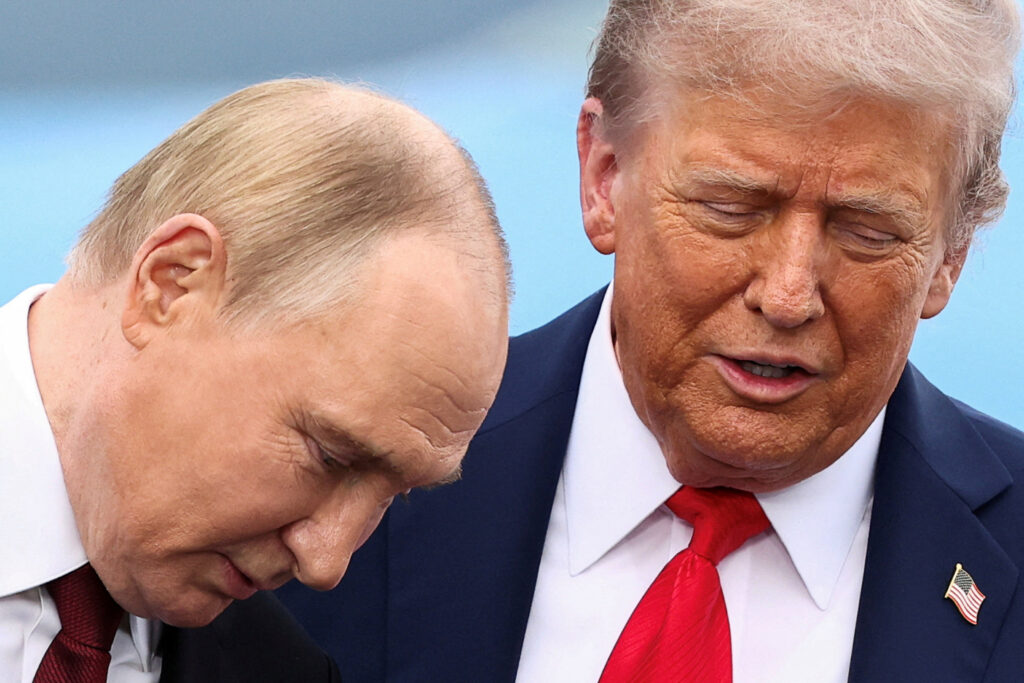
The Senate this week voted 86-12 to advance the Lindsey O. Graham Sanctioning Russia Act of 2026, named after the late South Carolina Republican who co-authored the legislation. I’m a staunch supporter of Ukraine, and I have long argued for ramping up sanctions on Russia. But I don’t know whether to cheer or jeer as the bill nears passage. There are a lot of good provisions in the legislation but also two bad ones. It’s far from clear whether the good outweighs the bad, or vice versa.
The positive sections would strengthen U.S. sanctions on “Vladimir Putin, senior Russian political and military leaders, oligarchs, state-owned enterprises, and foreign companies supporting Russia’s defense industrial base,” according to the bill sponsors’ summary. The bill also “sanctions Russian financial institutions,” along with “Russia’s largest state energy projects” and “their controlling owners and executives.” More sanctions would be imposed on anyone connected to the “shadow fleet” that smuggles Russian energy products in violation of Western sanctions.
Any company trading with a sanctioned Russian entity could be cut off from the SWIFT system that enables most international financial transfers. According to the Kyiv Post, “This SWIFT provision could make trade with Russia toxic for many countries and businesses, since a trader caught violating it would risk losing access not just to the US market, but to the means of conducting business anywhere in the world through the SWIFT system.”
So far, so good. But keep in mind that President Donald Trump already has a lot of authority to impose sanctions on Russia. He just hasn’t used it much, because he has a soft spot in his heart for Russian dictator Vladimir Putin. He could also avoid imposing the sanctions contained in the Graham bill, because Section 115 grants him the power to waive any sanctions as long as he provides an explanation to Congress. So it’s entirely possible that the draconian sanctions in the bill would be watered down or never implemented.
There is an even bigger problem in Section 113, which hands the president the authority to impose tariffs of up to 100 percent on the five largest importers of Russian oil or natural gas. Russian goods imported into the U.S. would face an even higher levy — 500 percent.
In June, the largest purchasers of Russian crude oil were China, India, Turkey, the European Union and Myanmar. The largest purchasers of Russian natural gas were the E.U., China, Japan, South Korea and Turkey. (Within the E.U., the biggest buyers of Russian fossil fuels were Hungary, France, Spain, Belgium and Slovakia.)
All those countries could face the 100 percent tariff. Japan, South Korea and the European nations might be exempt, admittedly, because the bill states that tariffs will not be imposed on countries whose natural gas imports constitute less than 15 percent of total Russian exports if they are also taking “significant steps” to reduce Russian imports. But it would be up to the administration to decide what is “significant.”
The bill also allows — but does not require — the president to impose 100 percent tariffs on the top five countries “facilitating Russian oil sanctions evasion.” It’s not clear which countries those are, but candidates include China, Turkey, the United Arab Emirates, Armenia and Kazakhstan. Now Trump wants to add Iran tariffs to the bill too, although the U.S. imports almost nothing from that country.
In sum, the legislation gives Trump an awful lot of authority to impose massive tariffs on a number of countries, notably India and China, if they don’t cut off all Russian energy imports. They are unlikely to do so, because both India and China are heavily reliant on Russian energy — all the more since the U.S.-Iran war has reduced oil exports from the Persian Gulf. Trump’s efforts to use 25 percent tariffs to wean India from Russian energy imports already failed last year.
The problem is that there is nothing to stop Trump from imposing tariffs on any of those countries for some other reason and using the Graham bill as legal justification. He might even use the legislation to go after U.S. allies in Europe and Asia.
Trump has a record of imposing tariffs based on pretexts. After the Supreme Court invalidated his “Liberation Day” tariffs in February, Trump slapped a temporary 10 percent duty on U.S. trade partners by citing bogus “balance of payment” concerns. When those tariffs expired in July, Trump replaced them with nearly identical levies that he justified by claiming to be combating “forced labor.”
Given the president’s penchant for igniting costly trade wars on a whim, the last thing that Congress should be doing is handing him more authority to impose massive tariffs. It’s like giving matches to a pyromaniac.
“The Congress has clear constitutional authority over tariffs and should be curbing the president’s use of that power and its constitutional authority,” trade expert Edward Alden of the Council on Foreign Relations told me. “Instead, if this passes, it will further enhance Trump’s tariff arsenal. That is not a good thing.”
That’s why many Senate Democrats were reluctant to support the Graham bill. Most ultimately came around because they want to send a strong message of support for Ukraine. President Volodymyr Zelensky lobbied personally for the legislation.
I sympathize with the desire to squeeze Russia, but I also hope that, when the House takes up the legislation in September, it will strengthen the bill by stripping out the tariffs and making other sanctions mandatory. The House should also fold inlegislation backed by House Financial Services Committee Chairman French Hill (R-Arkansas), which would force the Treasury to transfer frozen Russian assets under U.S. control (estimated to total $19 billion to more than $50 billion) to Ukraine.
There is no reason for Congress to pass deeply flawed legislation when it can easily be improved. An unhappy Trump might veto it if the tariffs are removed, but if two-thirds of both houses support the revised bill, it will become law.
The post What’s tucked inside the Senate’s Russia sanctions bill appeared first on Washington Post.