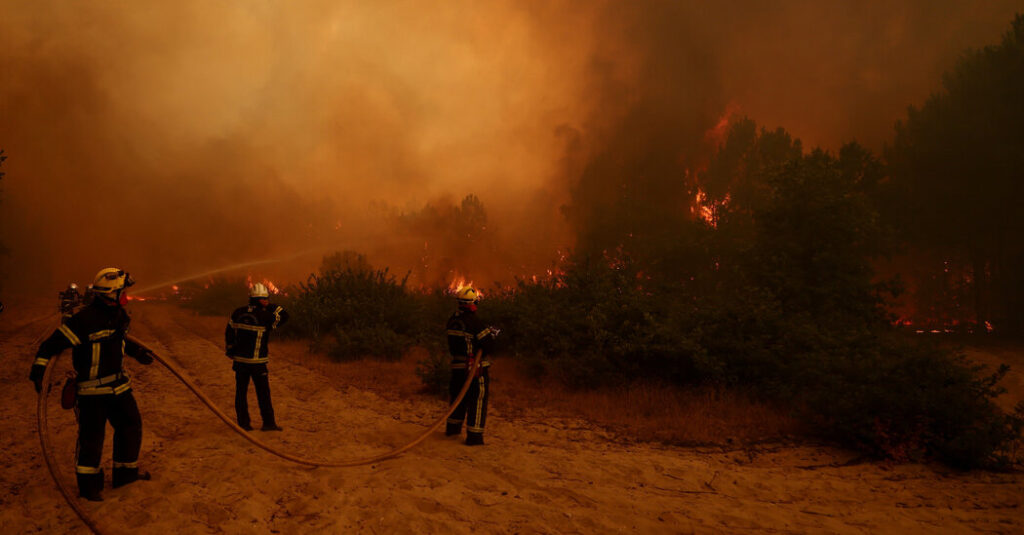
Deadly wildfires in Europe, fueled by extreme heat and dry brush, have forced hundreds of thousands of people to evacuate in recent weeks and destroyed huge swaths of land.
And the blazes are breaking records: The two largest wildfires, burning in France and Spain, are the largest recorded in those countries since European Union data collection began. At least two people in Spain have also died, officials said, and the blazes have led to their largest peacetime evacuations in those countries.
Climate change is fueling extreme temperatures and making wildfires more widespread and the devastation is widespread. In Greece, a wildfire has killed two firefighters on the island of Crete and one in the Peloponnese, and forced thousands to flee. And in Scotland, a wildfire has burned for the last two weeks of July, forcing evacuations and threatening a national park.
On Thursday, the European Forest Fire Information System said that “very extreme” fire danger conditions — the highest category in its forecast — were expected to dominate a large area of Western and Central Europe through Aug. 5. Britain and Ireland were facing the same elevated risk.
Fires are raging in several countries around Europe
France
Thousands of emergency workers have fought fires across the country, the two biggest of which have burned large swaths of the southwestern coast in the Gironde area, which includes the city of Bordeaux, and also the Landes area, farther south.
On Thursday, the Gironde fire was one of four active in France, said Laurent Nuñez, the interior minister,, Around 250,000 acres have burned in France this year.
In Gironde, the blaze had endangered vineyards . But on Thursday, there were some signs of recovery. The local government official said that about 84,000 people who had been evacuated could return home, after more than 220,000 were forced to flee.
Two French firefighters died battling a previous fire near Bordeaux earlier in July.
Spain
In recent days, wildfires in the mountains west of Madrid forced about 90,000 people to evacuate or take shelter.
By Thursday, officials said, those blazes had largely stabilized and almost all of the 60,000 people who had been displaced in the area could return home. The firefighters had also contained a blaze in Castellón Province, near Valencia.
But Spanish officials warned that high temperatures and low humidity could quickly ignite other blazes. New wildfires in Zamora and León, in the northwest, have forced hundreds of people to evacuate.
“The emergency is not over,” Prime Minister Pedro Sánchez said, even as he declared an end to the national wildfire emergency in the Madrid area.
And in mid-July, a wildfire in the southeastern province of Almería killed 13 people, making it one of Spain’s deadliest fires on record.
Greece
The deadly fire on Crete — one of several that the Greek authorities were trying to contain on Thursday — has been fueled by strong wind, complicating efforts to put out the flames.
Greek officials said that two firefighters died . The circumstances of their deaths were not immediately clear. The firefighter who died on Wednesday in the Peloponnese was on the sidelines of a blaze in the area of Gytheio.
Many Greek areas remained at high risk on Thursday, including greater Athens, Crete, the Cyclades islands and much of the Peloponnese, according to civil protection authorities. There have been sporadic evacuations around the country.
Britain
In Scotland, firefighters have been fighting a fire that has burned for two weeks and destroyed forests and moorland in the Cairngorms national park.
Large parts of England were also officially declared in drought on Wednesday. And on Thursday, dozens of people were evacuated from homes and vacation parks in eastern England as fire crews tackled a wildfire about four miles from a nuclear power plant.
How have the authorities responded?
The Spanish and French authorities have ordered hundreds of thousands of people to evacuate, set up emergency shelters, deployed firefighting planes and helicopters and sent security and military reinforcements to support firefighters.
On Saturday, the prefect for the Gironde area ordered the evacuation of several western suburbs of Bordeaux as a precautionary measure. Thousands of people had previously evacuated the Cap Ferret peninsula, a popular holiday destination. Hundreds fled by boat.
Do we know what caused the fires?
Connecting a specific heat wave or fire to global warming is hard to do. But experts agree that human-caused climate change is behind the increasingly high temperatures that have increased the frequency and severity of wildfire in general.
In this case, the exact origins of the blazes in France and Spain were not immediately clear, but they are part of a broader surge of wildfires this summer across Europe fueled by repeated heat waves since late May.
Carlos Barragán contributed reporting from Madrid.
The post What to Know About the Deadly Wildfires Raging in Western Europe appeared first on New York Times.