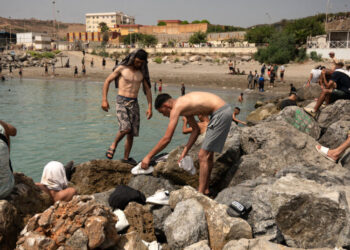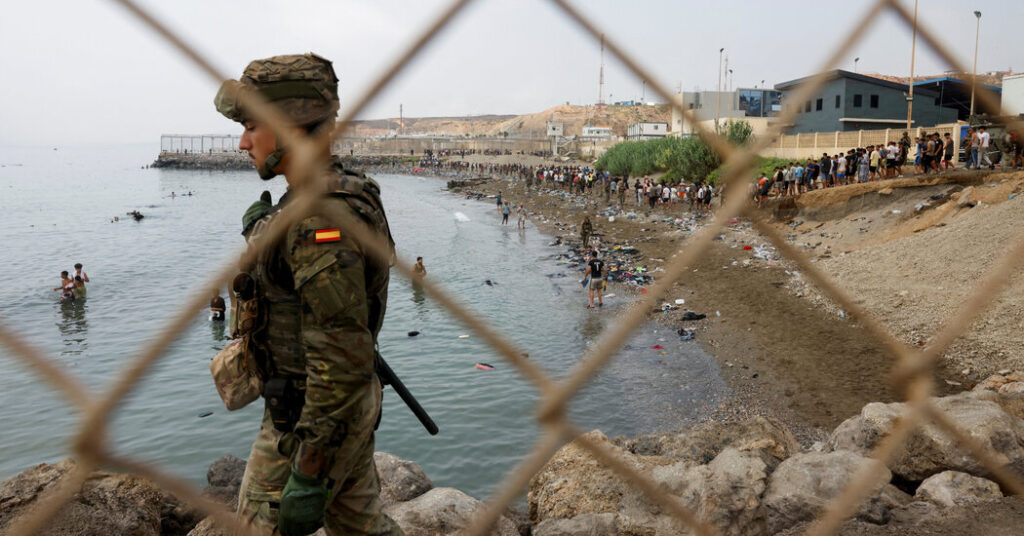
When tens of thousands of migrants began crossing on Thursday into Spanish territory in Africa, leading to chaotic scenes and political infighting across Europe, there was one major question that sparked wildly different explanations. How did this happen?
Among the theories:
-
The European far right joined the White House in accusing Spain’s prime minister, Pedro Sánchez, of inspiring the crossings with his migrant-friendly policies.
-
Mr. Sánchez blamed human-trafficking networks for misleading migrants about the ease with which they could remain on Spanish territory.
-
Migrants said in interviews that the Moroccan authorities had encouraged their crossing.
In reality, said Krzysztof Borowski, a spokesman for the European Border and Coast Guard Agency, “It’s too early to give a real account of why this surge happened, or how it moved so fast.”
Here’s why the surge prompted such speculation.
Morocco’s lax border restrictions
Usually, Moroccan officials make it hard for migrants to get close to Ceuta, the Spanish exclave that neighbors Morocco. This week, several migrants said in interviews, police officers waved them through, allowing them to overwhelm Spain’s border fence with relative ease.
That has led to suggestions that Morocco was seeking to pressure Spain for political reasons. Perhaps, analysts said, Morocco wanted to deter Spain from strengthening ties with Algeria, Morocco’s neighbor and rival. Mr. Sánchez visited Algeria in July, weeks after his foreign minister made a similar trip and spoke of importing more Algerian gas.
“For me, that plays a fairly central role,” said Lorenzo Gabrielli, a senior researcher at Pompeu Fabra University in Barcelona who researches migration in Ceuta. “It is impossible for nearly 50,000 people to cross the border between Morocco and Spain in a single day without Morocco having a hand in it,” he added.
He said it recalled an episode in 2021, when more than 10,000 people came over the border in two days, and said it was part of a cycle that Morocco uses to exert pressure on Spain.
The Moroccan government did not respond to requests for comments and had not made any public statement on the mass crossings by Friday evening.
Moroccan analysts said the government may not have been behind the huge numbers of arrivals. They said that was partly because it would not have wanted to endanger the country’s Throne Day celebrations, which are taking place near Ceuta, and are aimed at highlighting the country’s economic achievements.
“It would therefore be inconsistent to send contradictory signals by encouraging a migration crisis that could undermine this message,” said Said Saddiki, a professor of international relations at Sidi Mohamed Ben Abdellah University, in Fez, Morocco.
Mr. Saddiki also did not see a link between the recent events and the improvement in relationship between Spain and Algeria, which “does not, on the available evidence, provide sufficient motive for such a high-risk move,” he said.
Spain’s immigration politics
Mr. Sánchez has developed an image as a pro-immigration liberal and a leading opponent of the Trump administration’s hard line against migrants. He made global headlines this year by allowing more than a million migrants living illegally in Spain to apply to formalize their status.
According to Mr. Sánchez’s right-wing opponents, that move enticed the migrants who crossed Ceuta’s border this week. “By regularizing hundreds of thousands of illegal immigrants, the socialist prime minister of Spain, Pedro Sánchez, has opened the doors of Europe,” wrote Jordan Bardella, a far-right leader in France.
Mr. Sánchez has dismissed such claims, noting that illegal migration to Spain had been lower in recent years than in Italy and Greece. He instead blamed human traffickers for spreading misinterpretations of a recent ruling by Spanish judges, who last month,placed restrictions on when the Spanish authorities can expel migrants who attempt to swim by sea to Spain’s territories in Africa.
Some Moroccans said Mr. Sánchez may have been right. “All of this was triggered by messages circulating on social media about the Spanish Constitutional Court’s decision, which created a pull factor,” said Abdullah Abaakil, a left-wing political leader in Morocco.
Smuggling networks exploited that “within days,” said Rachid El Houdaigui, a research fellow at the Policy Center for the New South, a think tank in Morocco.
Aida Alami and Jason Horowitz contributed reporting.
The post What Caused the Surge in Ceuta? appeared first on New York Times.