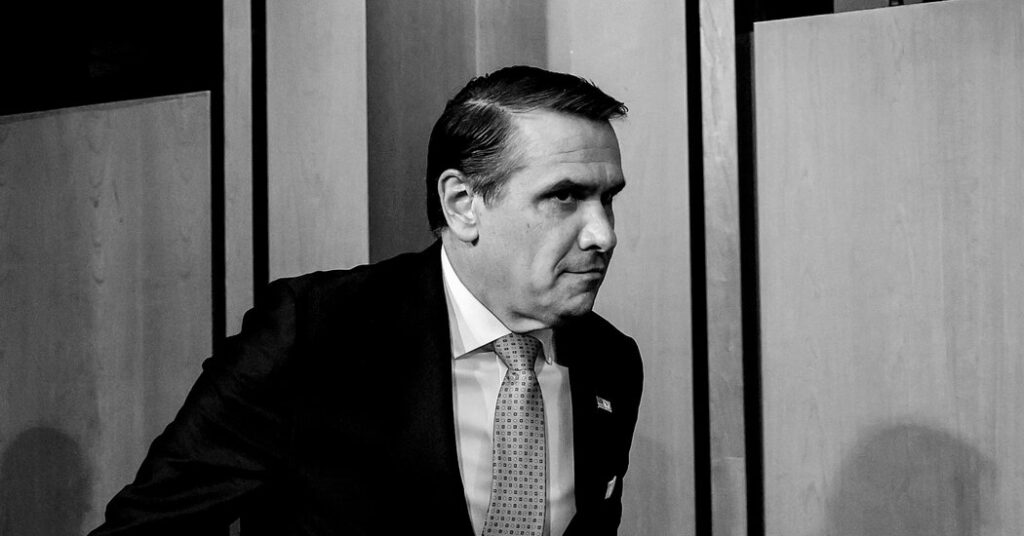
“Todd Blanche is a STAR,” President Trump declared defiantly on social media on Thursday as he sought to clear resistance from two Senate Republicans to his nominee for attorney general. Instead of quickly acceding to the senators’ modest requests — for written guarantees confirming the elimination of a slush fund for Jan. 6 rioters and the limiting of a tax immunity deal for Mr. Trump — the president raised withdrawing Mr. Blanche’s nomination until next year, after they leave office, as a way to sidestep their opposition.
The episode made the case against confirming Mr. Blanche even stronger, highlighting the chaos and incompetence that has marked his time at the Justice Department and providing a timely reminder of what he would bring to the job.
Many others have pointed out that Mr. Blanche has targeted Mr. Trump’s political adversaries with bogus criminal cases and overseen an exodus of some of the Justice Department’s most experienced lawyers.
Less noted but as important: He is also embarrassingly bad at lawyering.
The quality of the department’s work has sharply deteriorated under his leadership, in high-profile cases and in routine, low-level matters. The result has been a crisis of confidence that is draining the Justice Department’s legitimacy with the courts and the public — a crisis that Mr. Trump deepened on Thursday with his latest ploy to get his attorney general nominee confirmed, no questions asked.
During Mr. Blanche’s tenure as deputy to Attorney General Pam Bondi and as acting attorney general following her departure from office in April, federal judges across the country have in effect accused department attorneys of squandering the trust and credibility their predecessors had built up over decades. Justice Department lawyers have had to correct factual misrepresentations they made to judges, apologize for failing to meet deadlines and retract their own legal positions. Last week, a judge forced federal prosecutors to withdraw subpoenas issued to four New York Times journalists after finding that they had made serious errors.
The department failed last year to convict a man accused of assault for throwing a Subway sandwich at a federal agent, but not before Jeanine Pirro, the U.S. attorney in the District of Columbia, released a juvenile video taunting him.
In April, the department filed a brief in a case concerning the construction of the new White House ballroom that contained two introductory pages filled with Trumpian flourishes, including the word “FAKE,” arbitrary capitalization and a reference to “Trump Derangement Syndrome.” Several days later, Mr. Blanche seemed to imply that Mr. Trump had dictated those pages himself.
Mr. Blanche and Ms. Bondi tried to install Lindsey Halligan, one of Mr. Trump’s former lawyers, as the U.S. attorney in the Eastern District of Virginia, so that she could push a case against the former F.B.I. director James Comey. But judges found that she had been improperly appointed and threw out the case against Mr. Comey, as well as a separate one Ms. Halligan tried to bring against New York’s attorney general, Letitia James. One magistrate judge sharply criticized Ms. Halligan for a “disturbing pattern of profound investigative missteps.”
Mr. Blanche later signed a filing defending Ms. Halligan’s appointment that included, as the presiding judge put it, “a level of vitriol more appropriate for a cable news talk show.” (Mr. Comey recently moved to dismiss a second weak indictment against him, in which he was charged with threatening the president in a social media post.)
In May, a judge in Chicago told prosecutors that her trust in the government’s lawyers had been “broken” when she learned that they had manipulated the grand jury process to secure an indictment against protesters outside a federal immigration facility. The prosecutors had to drop the charges.
Even if you agree that these cases were worth pursuing, the cascade of missteps — basic factual, legal and professional errors; sloppy and unprofessional legal filings; the public taunting of criminal defendants — damages the department’s reputation and hinders its work.
Grand juries are refusing to return indictments in cases brought by federal prosecutors, a once-unthinkable problem. Ms. Pirro’s office reportedly could not persuade a single grand juror to sign off on proposed criminal charges against six Democratic lawmakers who released a video encouraging members of the military to refuse illegal orders.
Mr. Blanche has personally made multiple serious prosecutorial missteps in public.
His attacks on federal judges have foolishly antagonized the courts. The judge who dismissed the human smuggling case against Kilmar Abrego Garcia cited some of Mr. Blanche’s remarks in declaring that it was a vindictive prosecution.
Worse, Mr. Blanche last year tore into a federal judge who halted the Trump administration’s attempt to send back to Guatemala dozens of minors who had arrived unaccompanied in the United States. Mr. Blanche called the ruling “disgusting” in an interview on Fox News and accused the judge of preventing the government from sending children back “to their parents in Guatemala.”
Mr. Blanche’s claim was highly misleading. Within weeks, a Trump-appointed judge said that the administration’s explanations for the deportation effort had “crumbled like a house of cards.” He wrote, “There is no evidence before the court that the parents of these children sought their return.” In fact, Guatemalan officials “could not even track down parents for most of the children.”
Mr. Blanche and other senior Justice Department officials have proven willing to cut legal and ethical corners to please the White House. But that’s only part of the explanation for this sorry record. The flight of career attorneys from the department means inexperienced lawyers must fill the gaps. A desperate Justice Department now recruits criminal prosecutors straight out of law school and offers signing bonuses for new hires.
The gratuitous pandemonium around Mr. Blanche’s nomination, so easily avoided if he had been willing to assent in writing to two simple requests, will not encourage good lawyers to join the Justice Department or judges to give federal attorneys their trust.
Damaging the credibility of the department and the public’s confidence in it will make the legal system less reliable and less fair. With government attorneys increasingly unbound by a professional ethos, baseless lawsuits, wrongful convictions and unjust outcomes will occur more often. Judges and juries will hesitate to accept the government’s representations even when cases are appropriate. Even if the consequences are less severe, taxpayers should not have to foot the bill for the shoddy lawyering that has become commonplace.
Mr. Blanche is no star. He’s not even a very good lawyer. The Senate should reject his nomination, whenever it comes up.
Ankush Khardori is a lawyer and legal analyst who writes the Open File newsletter. He was an attorney at the Justice Department from 2016 to 2020, prosecuting financial fraud and other white-collar crime.
The Times is committed to publishing a diversity of letters to the editor. We’d like to hear what you think about this or any of our articles. Here are some tips. And here’s our email: [email protected].
Follow the New York Times Opinion section on Facebook, Instagram, TikTok, Bluesky, WhatsApp and Threads.
The post There Are So Many Reasons to Reject Todd Blanche. Here’s Another One. appeared first on New York Times.