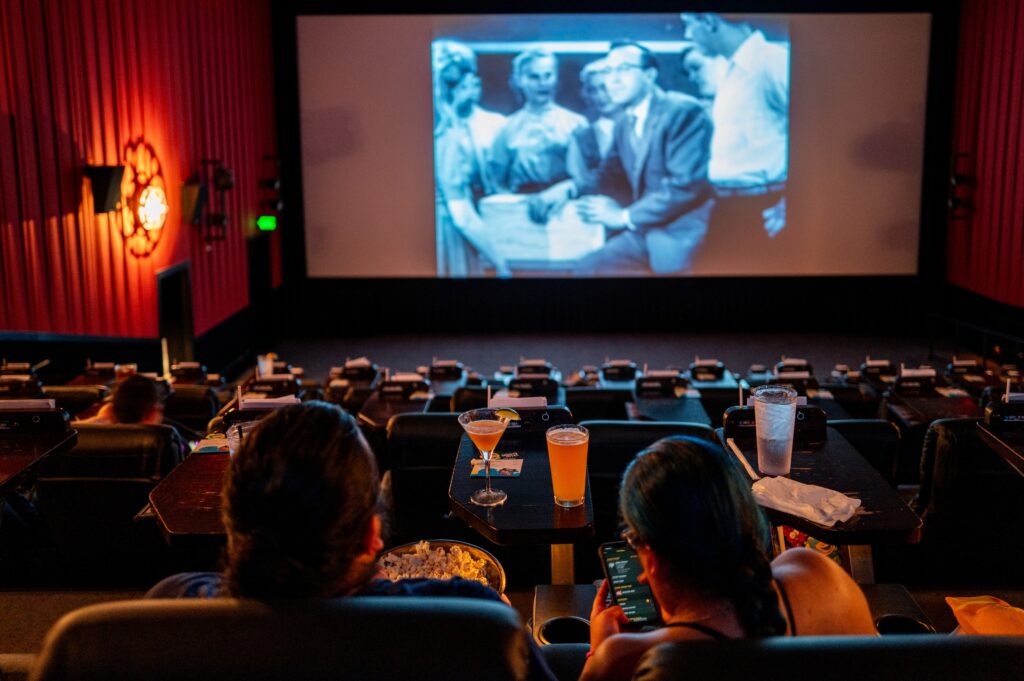
“Kids today don’t go to the movies.” I hear this all the time from fellow parents and Generation Xers. “It’s not like it was in our day. They just want to be on their phones all the time.” This sort of comfort-food nostalgia does have some basis in reality. When my generation (and the baby boomer generation before it) was growing up, going to the movies was the go-to activity. And now it supplies some of our most vivid childhood memories.
Being awed by “E.T.” with my parents as a child (I screamed so loud when E.T. came out of the cornfield that my mom thought I’d been bitten by something). Being amazed by how real the “Jurassic Park” dinosaurs looked. Being so moved by “Hoop Dreams” that I wondered if I’d ever see the world in quite the same way again. When I close my eyes, I am right back in those moments.
Movies were our lives. During high school, I worked at the primary movie theater in my tiny Midwestern hometown and thus felt like the ringmaster of my social circus: Every Friday night, it seemed like I saw everyone I knew, like I was at the center of the universe.
The thing is, though: This still happens, just not for adults. Movie attendance hasn’t dropped in the past few years because young people have stopped going. It has dropped because older ones have.
A Fandango survey taken in January revealed that 87 percent of Generation Z and 82 percent of millennials saw at least one movie in a theater in 2025, with each demo averaging about seven visits a year. But you know who wasn’t close to those numbers? Generation X (70 percent) and baby boomers (58 percent) — the ones who have all those fond memories of movies, and the ones always complaining about These Kids Today. The kids aren’t the problem. The olds are.
You can see this abiding interest most vividly in the recent successes of two low-budget horror films made by directors in their 20s: “Backrooms” (directed by 20-year-old Kane Parsons) and “Obsession” (directed by 26-year-old Curry Barker). There is also, of course, “The Odyssey,” which is already one of the biggest hits of all time, and the upcoming “Spider-Man: Brand New Day.” The movies that have underperformed this summer are legacy films with established brand names in large part targeted at older audiences: “Supergirl,” “Star Wars: The Mandalorian and Grogu,” “Masters of the Universe.” Those movies are aimed at the very people who have stopped going to movies.
Historically, whenever Hollywood has realized that a youth movement is afoot in the industry, the result has been good movies — even revolutionary ones. The studio system reacted to the success of “Easy Rider” and “The Graduate” by unleashing exciting young directors like Francis Ford Coppola, Martin Scorsese and Robert Altman, who produced some of the greatest American films ever made. The independent scene of the ’90s was a similar revolution, with the emergence of Quentin Tarantino, Paul Thomas Anderson and Steven Soderbergh. Hollywood has a way of reinvigorating itself when it has to, and it tends to look to the youth to do it.
But as a Gen Xer myself, I can’t help but implore my generational cohort to return to its moviegoing roots. You’re really missing some great stuff. I host a weekly movie podcast with my childhood best friend (and now professional film critic) Tim Grierson, so I see everything, and let me tell you: If you think movies were better when you were a kid, you’re wrong. There is so much great cinema out there right now.
In the past month alone, I’ve seen a hilarious Canadian time-travel comedy (“Nirvanna the Band the Show the Movie”), a dark, amazing, surrealist Thai drama about political complicity and falling in physical love with household appliances (“A Useful Ghost”) and a British science fiction thriller about a haunted boat shot entirely using an ancient camera that can’t film for longer than 27 seconds (“Rose of Nevada”). Oh, and “The Odyssey.” That was great, too.
I could go on and on about how many outstanding movies are being made today. That’s not the problem. The problem is that older generations have stopped seeking them out. That’s what’s changed. And for what it’s worth: I see my parents on their phones a lot more than I see my kids on them.
As a parent, I understand how this happened; I wasn’t moseying over to the art theater every night when my kids were in diapers, either. Our lives evolve; our priorities shift. But we sell ourselves short when we act like there’s nothing out there to see. The problem with nostalgia isn’t just that it makes the past out to be better than it was; it’s also that it makes the present out to be worse than it is.
There is so much to see. Ask your kids. Ask your grandkids. They know. That’s why they’re going to the movies — just like you did. So put down your phone, Grandpa, and get back out to the theater. You will find something new and wonderful. And you might just feel young again.
The post The real reason movie attendance has dropped? Grandpa. appeared first on Washington Post.