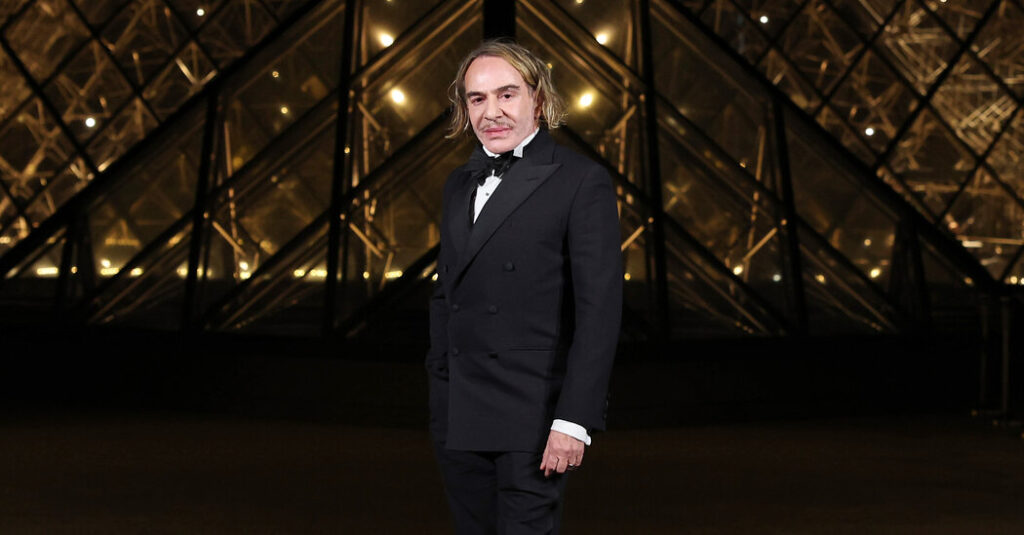
The group of people gathered for a closed-door meeting at the Metropolitan Museum of Art in May was unusual by any measure: Anna Wintour, Vogue’s global editorial director and a Met trustee; Andrew Bolton, curator in charge of the Met’s Costume Institute; the fashion designer John Galliano — and a handful of the most influential rabbis and Jewish leaders in New York City.
The meeting had been orchestrated to get their thoughts on the potential issues with next year’s planned fashion extravaganza — a show dedicated to Galliano’s work — and perhaps their blessing for it. It was one of several such meetings held with Jewish leaders over the last year.
Galliano is considered by many in the fashion world to be one of the most important contemporary designers, whose work as head designer of Dior, a job he held from 1996 to 2011, went beyond mere fashion to enter the realm of fantasy. But he became a household name after a video of him making antisemitic comments became international news in 2011. He subsequently lost his job at Dior, was convicted of a hate crime in a Paris court, and embarked on a period of rehabilitation; he returned to fashion as creative director of Maison Margiela in 2014.
All of which still makes him a thorny choice for the show at this moment. Antisemitism is on the rise, and some Jewish New Yorkers are uneasy with the leadership of Mayor Zohran Mamdani, most recently after the stabbing of two men last week in broad daylight, one of whom was leaving a Jewish community center in Manhattan. The attack is being prosecuted as a hate crime.
The Galliano exhibition — which will be kicked off by the annual Met Gala, perhaps the most closely watched red carpet in the world — would make him only the third living designer ever to be made the subject of a solo exhibition at the museum, joining Yves Saint Laurent and Rei Kawakubo. It’s the highest honor the institution can confer on a designer.
“The fear clearly was the show could be met with a lot of resistance — not just skepticism, but a feeling of it’s wrong,” said Rabbi Rick Jacobs, president of the Union for Reform Judaism in North America, who had been among those at that meeting in May. But Galliano impressed him. “The word I come back to is ‘sincerity,’” Jacobs said. “He was open. He looked right at us and spoke in a clear way, not as if he had memorized talking points.”
Jonathan Greenblatt, chief executive of the Anti-Defamation League, said in an email to The New York Times: “We believe John Galliano has genuinely worked through the issues that led to his antisemitic outburst years ago in Paris, and we have long since accepted his apology. His efforts to repair the damage his words caused and to learn from that incident should be applauded.”
Some in the room spoke of the Jewish principle of teshuvah, or repentance, and the importance of second chances.
But there was also concern about how the show could celebrate Galliano’s work while wrestling meaningfully with the realities and consequences of his past behavior.
“What we had said to them is it would be powerful, poignant and productive if they were able to leverage it as an opportunity to teach about the reality of antisemitism, and somehow wrap into the exhibition the importance of fighting back and the dangers of antisemitism in this moment,” said Rabbi Joshua Davidson of Temple Emanu-El, a 180-year-old synagogue just a few blocks south of the Met.
Bolton, who said Galliano’s contributions to fashion’s history were “undeniable,” also said he had been considering a Galliano show since 2010, though he had not gotten serious about it until 2024. At that time, he said, both he and the museum’s board decided they needed more consideration — though he denied that the hesitation had anything to do with fears over Galliano’s past.
Now, he said, the current climate made the exhibition even more relevant.
“I completely understand why the timing might feel particularly difficult now, given the alarming rise of hate, but I do feel it makes the current questions more urgent — not less,” Bolton said. “For me, the larger question is not whether artistic behavior excuses transgression, but how to hold artistic achievement and ethical accountability together without allowing one to erase the other. And at a moment of heightened division, I feel the museum and myself have a real responsibility to confront these issues.”
“Avoiding his work doesn’t remove his influence on fashion or solve the ethical questions around it,” Bolton continued. “Our responsibility is neither to celebrate uncritically nor avoid that difficult history, but establish the record honestly, provide context and create the conditions for visitors to make an informed judgment.”
Bolton said he would open the show with an “orientation gallery” that will delineate what he calls “the rupture” that has ultimately defined Galliano’s career as much as the beauty of his work, though he is still working out exactly how that will be presented. Although he said he was planning to use the designer’s own words as much as possible — he noted that his meetings with the Jewish community leaders had underscored the idea that clarity was paramount, and that euphemisms should be avoided — he also said that his job was not to represent Galliano’s version of events, but the most accurate version. He is also considering creating an online forum where more discussion can take place.
A master of the bias-cut dress and an imaginative world-builder, Galliano, 65, is the man most responsible for transforming Dior from a well-mannered French heritage house into a global phenomenon. Then, in 2011, he was captured on video saying “I love Hitler,” along with other, equally shocking remarks, in a Paris bar.
In “High & Low: John Galliano,” a 2024 documentary on his rise, fall and later return, Galliano said he had been blackout drunk and addicted to drugs during the video incident, as well as during two separate events, when he made similar painful remarks; he called his words “foul” and “horrific.” After his conviction, he went to rehab, and worked with a rabbi in London, as well as Abe Foxman of the Anti-Defamation League in New York, to learn about Judaism, antisemitism and the Holocaust. He then spent a decade at the helm of Maison Margiela, and celebrities like Zendaya, Tyla and Amal Clooney routinely wear his vintage designs on the red carpet. His clothes set records at auction.
Throughout, Wintour, 76, has remained one of Galliano’s foremost champions — and perhaps most powerful. Wintour is also the mastermind of the Met Gala, and has raised so much money for the department that its basement galleries were named in her honor in 2014 and the Costume Institute is close to amassing an endowment fund that will ensure its future economic security.
She was instrumental in orchestrating Galliano’s return, and was one of the first people to wear one of his dresses publicly after his disgrace. In 2024, she told The Times, “I feel quite strongly that our culture has begun to move too quickly toward condemnation — toward a feeling of certainty that particular offenses or mistakes are unforgivable. The truth is we rarely know the full story, and all of us are fallible.” A Galliano retrospective at the Met has been a longtime goal for Wintour, and would be an affirmation of her power to shape the fashion world and another element of her legacy.
“There is no one more deserving of an exhibition of this scale than John Galliano,” Wintour wrote in a text message. “Designers dream of changing the world with a single collection; John has done it over and over again. His career isn’t defined by a single moment — something he will live with for the rest of his life.” But, she went on, “the exhibition won’t shy away from any of the darkness.”
Certainly, fashion seems to have moved past any discomfort with Galliano. In January, he sat front row at Jonathan Anderson’s debut couture show for Dior — his first time back at the house since his dismissal — and was mobbed afterward not only by members of the audience but by Dior’s owner, Bernard Arnault, and his entire family.
In March, Zara announced a two-year collaboration with Galliano. The response, in both cases, was excitement rather than castigation. And indeed, there is a long history in fashion of subordinating transgressions to talent, going back to Coco Chanel, who chose to collaborate with the Nazis rather than risk her business during World War II.
It remains to be seen whether that attitude will extend to the broader Met audience and the Galliano show, which will open May 9, 2027, and be on view through Jan. 9, 2028. However, there are plans for it to travel to other museums after the Met — another rare honor — and the leaders of those institutions will undoubtedly be watching the reactions closely.
“There may be many in the Jewish community who find this to be problematic,” said Davidson, the Temple Emanu-El rabbi. “People may very likely be upset by it. I can understand those feelings.”
That is why some rabbis expressed worry that they were being used as a Band-Aid. A person familiar with the museum deliberations said the Met’s leaders were aware that this decision could be a mistake that might have serious repercussions.
But if the museum can meaningfully grapple with Galliano’s history, said Jacobs, of the Union for Reform Judaism, the show could become “an opportunity to raise consciousness and awareness about what can be done. It could have a profound and positive effect.”
The post The Next Met Fashion Blockbuster and Gala Will Honor Controversial Designer John Galliano appeared first on New York Times.