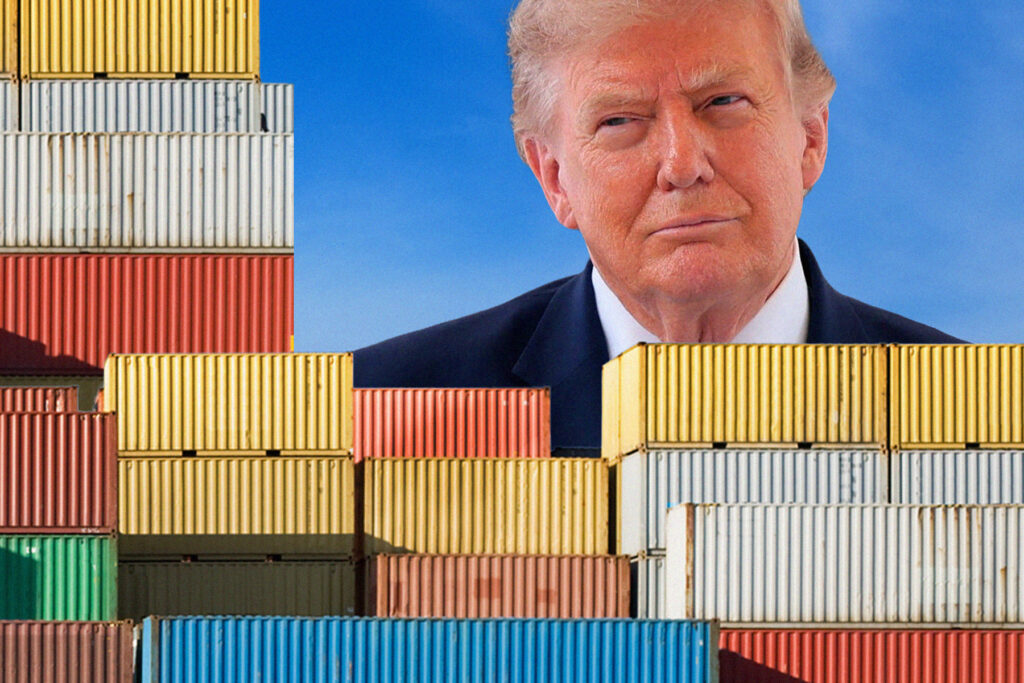
For those who thought the Supreme Court had ended Donald Trump’s obsession with tariffs, think again. In February, the court struck down his sweeping “Liberation Day” levies, ruling that the president did not have emergency powers to tax imports from almost every country on earth. Trump’s response has been to search the statute books for ever more unusual, obscure and maybe illegal ways to restore very similar tariffs.
First came a temporary global tariff. When that expired, the administration imposed tariffs of 10 to 12.5 percent on 60 economies — more than 80 countries — claiming unfair trade practices. For Canada, Trump reached back to Section 338 of the Smoot-Hawley Tariff Act of 1930, a provision that had never been invoked before.
For these new sweeping tariffs, the rationale — discovered suddenly in the last few months — is alleged forced labor. The administration has declared that countries ranging from Cambodia and China to Norway, Japan and Australia have failed to keep products made with forced labor out of their markets, and that this failure burdens American commerce. The charge is so obviously spurious and sweeping (Sweden is as bad as Cambodia?) that it gives away the game. It was almost certainly devised because the White House needed a legal pretext to subvert the spirit of the Supreme Court ruling against Trump.
This is more than ordinary political spin. The president appears to be ordering the United States government to formally certify as fact something it knows is not true. Agencies must publish findings, construct legal arguments and affix the authority of the American state to a falsehood manufactured for the apparent purpose of evading the nation’s highest court. That is how institutions are corrupted: first they are asked to bend the truth, then to attest to the lie. And then the lies become routine, so no one thinks they are unusual. It is the road to Orwell’s world.
Incidentally, Walk Free, the human rights group that compiles the Global Slavery Index, estimates that America imports $169.6 billion worth of goods annually that are at risk of being made with forced labor — by far the highest total among the Group of 20. That does not prove American enforcement is worse than that of every country Trump has targeted. But it makes the administration’s moral posture look even more absurd than it already is.
The economic case against tariffs is stronger by the day as the numbers roll in. Spending on manufacturing construction, which surged under Joe Biden and peaked at about $250 billion at an annual rate in September 2024, fell to about $175 billion by May of this year. Manufacturing employment is down roughly 75,000 jobs since Trump returned to office. Factory output has risen, but the gains are concentrated in advanced manufacturing and artificial intelligence, much of it reflecting investments planned before Trump took office, and little related to tariffs.
Consider Greg Fraley, whom the U.S. Chamber of Commerce wrote about a few months ago. He helps run FALCO, a small Arizona company that makes aluminum parts for commercial aircraft. This is precisely the kind of business Trump says he wants to help: an American factory employing American workers.
FALCO’s aluminum costs are up 72 percent. The company cannot simply buy American metal; domestic production meets only about half of U.S. demand, according to the Chamber of Commerce, and much of that output is not available on the open market. So FALCO keeps importing aluminum, pays the tariff and absorbs the damage. It has frozen hiring, postponed expansion, allowed its workforce to shrink by at least 20 percent through attrition, dipped into cash reserves and added a “tariff surcharge” to customer bills, according to Fraley.
Meanwhile, even after the so-called Liberation Day fallout, Trump doubled the tariff on imported aluminum to 50 percent and recently offered producers a discount if they built smelters in the U.S. Rio Tinto, one of the world’s largest aluminum producers, immediately said no. So the tariff has achieved a trifecta: higher costs for an American manufacturer, fewer jobs and less investment there, and no new smelter from the foreign producer it was meant to entice.
The logic is upside down. Aluminum smelting accounts for only a small fraction of American aluminum jobs. The vast majority are in recycling and in the midstream and downstream industries that turn the metal into aircraft parts, cars, cans, machinery and building materials. Trump is protecting the tiny upstream slice by taxing the much larger industrial base that depends on it and employs many more people.
For eight decades, the U.S. led the world toward open markets and open trade. In barely two years, Trump has transformed it into effectively the most protectionist major advanced economy. The result has not been a manufacturing renaissance. It has been higher prices, weaker investment, fewer manufacturing jobs — and a government increasingly willing to make falsehood official policy in order to defend a failed economic creed.
The post The dishonesty inside Trump’s new tariff plan appeared first on Washington Post.