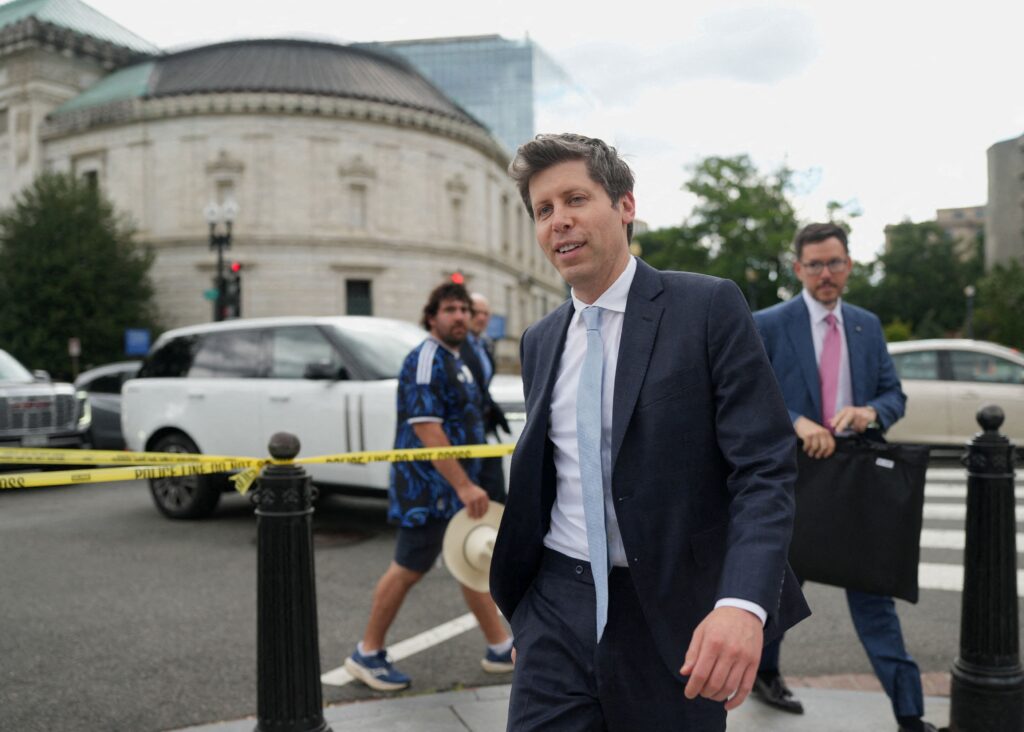
OpenAI chief executive Sam Altman traversed Washington this week to preview a powerful new AI system, weeks after the government flexed its power to restrict leading AI companies from launching new models.
In the briefings, Altman described an upcoming product that would enable multiple AI assistants, known in the industry as “agents,” to work simultaneously in the background, dividing tasks and collaborating with each other, according to five people familiar with the briefings who spoke on the condition of anonymity to describe the private discussions. Altman described how the system could answer math problems that have never been solved before — a capability the company could reveal on Friday, according to three of the people.
He also described how the new agents could transform the American economy, allowing workers to do tasks that typically would have to be outsourced to other professionals. He described how a software engineer could use the agents to help with human resources, or a writer could use them to enable graphic design, one of the people said.
Over two days, Altman discussed these developments with White House chief of staff Susie Wiles, Cabinet leaders, lawmakers, national security aides and economists in an unusually broad charm offensive, as leading AI labs navigate an uncertain regulatory environment and political backlash to their products. He held meetings around the clock, dining with Democratic senators on Wednesday night and hosting national security officials for a breakfast at the company’s Washington office.
The Trump administration is scheduled to roll out a new framework by this weekend that would dictate how companies should communicate with the government about new leaps in AI development. But until the administration establishes a formal testing process for AI models, companies are moving cautiously to avert government intervention that could force them to pull their models from the public. Last month, the administration imposed export controls that forced Anthropic to pull back powerful models, and it asked OpenAI to stagger the release of its most capable model.
During the meetings with Wiles and other White House officials, including Office of Science and Technology director Michael Kratsios and National Cyber director Sean Cairncross, OpenAI executives planned to seek clarity on whether the administration’s framework was on schedule, according to one of the people who was familiar with the company’s strategy. Altman also was scheduled to meet with Commerce Secretary Howard Lutnick and Treasury Secretary Scott Bessent.
The White House did not respond to requests for comment. OpenAI declined to comment on the White House meetings. President Donald Trump said on Wednesday that the administration was “looking at controls” after two of OpenAI’s models broke free of a testing sandbox and hacked into Hugging Face, another artificial intelligence company, to hunt for answers to a cybersecurity exam.
But Trump said he was wary of restricting the industry in ways that could undermine the United States’ competitive edge over China.
“China has virtually no controls,” Trump said. “It’s freewheeling a little bit. So we have to be careful in both ways. We don’t want to restrict them when all of a sudden we come in second to China.”
The incident set off alarm bells in the AI industry as a demonstration of the long-feared potential that increasingly sophisticated systems could spin out of control. OpenAI has said it shut down one of the models, describing it as a version that was never intended for public release.
Altman has been visiting Washington about every two months, as he and other top AI companies seek to preempt a mounting political backlash to artificial intelligence. The rapid advances in AI have prompted concerns among voters about the potential for the technology to eliminate jobs, guzzle energy and water and endanger children.
But this week’s trip was more wide-reaching than most of Altman’s fly-ins, following the Hugging Face security incident. Altman spent Wednesday meeting with top lawmakers on Capitol Hill, including Sens. Mark Warner (D-Virginia) and Ted Cruz (R-Texas).
On Wednesday, OpenAI also convened dozens of economists and technology advocacy groups for a pair of briefings, where Altman, OpenAI chief economist Ronnie Chatterji and other top executives fielded questions largely about the economic impact of the new AI models.
During the meeting with right-leaning groups and economists, Altman was pressed on whether its chatbots provided answers that had a liberal bias, three of the people said. He said that the company is doing better than its competitors on addressing bias, but that the scholarly articles, journals, media articles, TV, film and other sources that feed into its system are more frequently biased to the left. He said the company was making adjustments to address this.
He gave a vague answer in response to a question about the Hugging Face incident, two of the people said. The company is conducting a technical review of how it occurred that is not yet completed.
Officials in Washington have been grappling with the computer security risks posed by artificial intelligence tools since the spring. Trump largely had adopted a hands-off approach to AI, but that shifted in April when Anthropic, one of the industry’s other leading companies, announced it had developed a model it called Mythos that represented a breakthrough in AI’s ability to carry out attacks on computer networks. The company held back the model from wide release, sharing it with a small number of partners to give them a chance to harden their defenses.
As the midterms approach, politicians are also growing more wary of the technology’s impact on the economy. Polls have found that Americans are generally pessimistic about how AI might affect their work or prospects of finding a job.
Leading AI executives have themselves stoked that gloom — including Altman himself — but have tried to rework their message. Mark Zuckerberg, the chief executive of Meta, has been trying in recent days to cast himself as the champion for a more optimistic message about AI, arguing that it could bring about widespread economic growth.
“If superintelligence is widely distributed, then I believe we will see more jobs in the future, not fewer,” he wrote in a Wall Street Journal opinion article this week.
Warner, who was among the lawmakers who met with Altman this week, said that he believed that AI would create jobs, but that there would be a “lag time” and that the industry needed to help people get ready.
“I think they need to chip in on the resources, on how we get people trained for this AI economy,” Warner told reporters.
The post Sam Altman courts Washington as OpenAI pushes a powerful new AI appeared first on Washington Post.