For months, the government in Baghdad has sought to curb the Iran-backed militias that have long operated in Iraqi territory, struggling to meet the Trump administration’s demands that it bring them under state control, disarm them and cut off their funding.
A wave of U.S.-Saudi airstrikes that targeted the militias early Wednesday now risks upending those efforts. The attacks, which killed at least 20 people, have provided a new justification for Iran’s allies in Iraq to hold on to their arms and claim that they are the forces best positioned to protect the country’s sovereignty. And for Iran, the violence presents a chance to encourage these allied militias to join the regional war.
“The era of shedding Iraqi blood with impunity is over,” Mohammad Tamimi, leader of the Iran-aligned militia al-Waad al-Sadeq, said. “Our response will not be mere statements. It will be actions on the ground to enforce the equation: a bombing for a bombing.”
Iraqi political leaders on Wednesday questioned the wisdom of the sweeping attack, which was carried out, they said, without coordinating with the Baghdad government. In a statement, Iraq’s National Security Council vowed to try to rein in the militias on its own. It condemned the violation by the United States and Saudi Arabia of Iraqi sovereignty and warned the airstrikes could stoke further chaos.
Since the U.S. invasion in 2003, Iraq has struggled to balance the interests of its superpower ally, the United States, and those of neighboring Iran, the regional Shiite Muslim power. Iran supported militias from Iraq’s Shiite majority that fought the U.S. occupation, and the Iran-backed forces also helped draw Iraq into decades of sectarian bloodshed, which has only recently ebbed.
That balancing act has grown increasingly fraught in the past year, as the Trump administration has ratcheted up pressure on Iraq to curb the Iran-aligned militias. The war launched by the United States and Israel on Iran in February quickly turned Iraq into one of the conflict’s battlegrounds.
The U.S. military said the joint strikes on Wednesday were retaliation for 72 hours of drone attacks on “U.S. forces and Saudi energy infrastructure” originating in Iraq.
So far, the source of those attacks remains unclear. No group has claimed responsibility for them, and Iran’s militia allies in Iraq have publicly said they were not behind them. The groups had previously been quick to take credit for attacks in the region, before the April cease-fire between Washington and Tehran that briefly paused the war. But since the resumption of hostilities, the militias have not claimed responsibility for attacks outside Iraq.
By contrast, the Houthis, Iran-backed militants who control large parts of Yemen, have publicly declared a blockade of Saudi Arabia and repeatedly struck at Saudi oil tankers. The Houthis have also taken responsibility for drone attacks on Saudi energy installations, including on the day that Saudi Arabia accused Iraqi militias of striking them.
Sabah al-Numan, a spokesman for Iraq’s army chief, said the U.S.-Saudi strikes had “obstructed investigation efforts regarding the alleged targeting of Saudi Arabia.” He demanded evidence that the attacks on Saudi Arabia had come from Iraq and said none had been provided yet.
The Iraqi militias had kept relatively quiet over the past month, despite the war re-emerging in the region, as Iraq’s newly appointed prime minister, Ali al-Zaidi, sought to address the Trump administration’s demands that the Iran-aligned groups be disarmed. In recent years, the groups appeared to operate more independently of Iran, steadily amassing wealth and power by forming political parties and obtaining lucrative Iraqi government posts and contracts.
But Renad Mansour, an Iraq analyst at the London-based Chatham House, said Iran’s powerful Islamic Revolutionary Guards Corps has stepped up its involvement in the activities of Iraqi militias in recent months. The war with the United States, he said, has prompted Iran to exert more control over them.
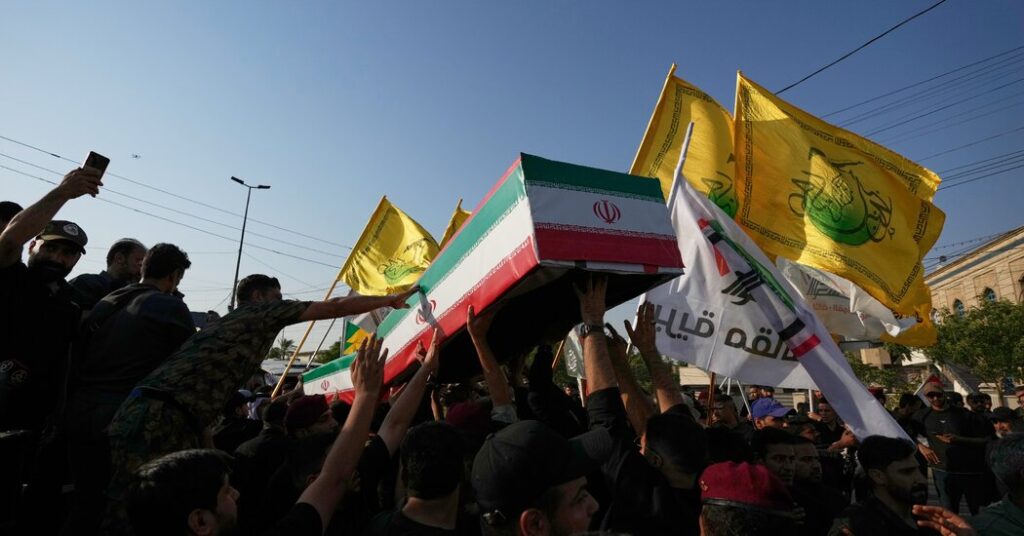
Evidence of Iranian involvement has emerged in the aftermath of the latest airstrikes. Images released by Sabereen News, an agency linked to Iraq’s Kataib Hezbollah militia, showed five coffins wrapped in Iranian flags during a funeral procession on Wednesday. One Iraqi militia commander privately said those slain were Iranian military advisers killed at an intelligence headquarters for the 24th Brigade of the Popular Mobilization Forces, the network of militias under government control.
There had been growing popular pressure in Iraq for the militias to heed calls to disarm, but the strikes on Wednesday turned the tables on the government.
In joint public statements, the Iran-aligned militias skewered the government for demanding they disarm while failing on its part to prevent violations of Iraqi sovereignty.
The groups gave the Iraqi government a “deadline” of Tuesday to take decisive action, warning that otherwise, they would take matters into their own hands, without detailing what action they might take. “Our response to the American enemy is inevitable and will come,” the statement said, “and we may target its tools in Saudi Arabia if the situation demands it.”
Two Iraqi militia leaders said privately that the deadline was meant as a challenge. They knew Iraqi officials could not act forcefully against the United States or Saudi Arabia. By claiming to give Iraqi authorities a chance to respond first, the militias may not only be trying to justify future retaliation but also their refusal to disarm.
“If the government fails to fulfill its duty, the patriotic Iraqi people must demand that the government’s weapons be placed exclusively in the hands of the resistance,” Abu Mahdi al-Jaafari, the spokesman for the Iran-allied militia Saraya Awliya al-Dam, said in a statement.
The Iraqi groups have varied agendas, and some are more inclined to take confrontational action. Mr. Mansour, of Chatham House, said U.S. and Israeli efforts in recent years to kill many of the groups’ leaders has made tracking their activities more difficult.
“The Iraqi militia space has become incredibly fragmented, and that’s certainly the case even more since this war,” he said. “The more the U.S. attacks these groups, the more that fragments chains of command and coherent structures, leading to more rogue groups and actions.”
Iran has for decades relied on supporting a proliferation of militant groups “that deliberately obscures who is pulling the trigger,” said Ramzy Mardini, the founder of Geopol Labs, a Middle East-based geopolitical risk advisory firm. The country that may stand to lose the most from the confrontation is Saudi Arabia, he said.
“Saudi Arabia has unwisely given Iran more room to escalate by proxy under the cover of defense while advancing its overall objective of disrupting global oil supplies,” he said. “The Iranian-linked groups in Iraq are more than capable of wreaking havoc on Saudi energy infrastructure.”
Ismaeel Naar contributed reporting
The post U.S.-Saudi Attack on Iraqi Militias Risks Drawing Them Further into War appeared first on New York Times.