More than a month after a fire ripped through an enormous cold-storage warehouse in Los Angeles, residents who live nearby say they have found little respite from the endless stench of rotting food and are anxious about the dangers that may still be lurking in their homes.
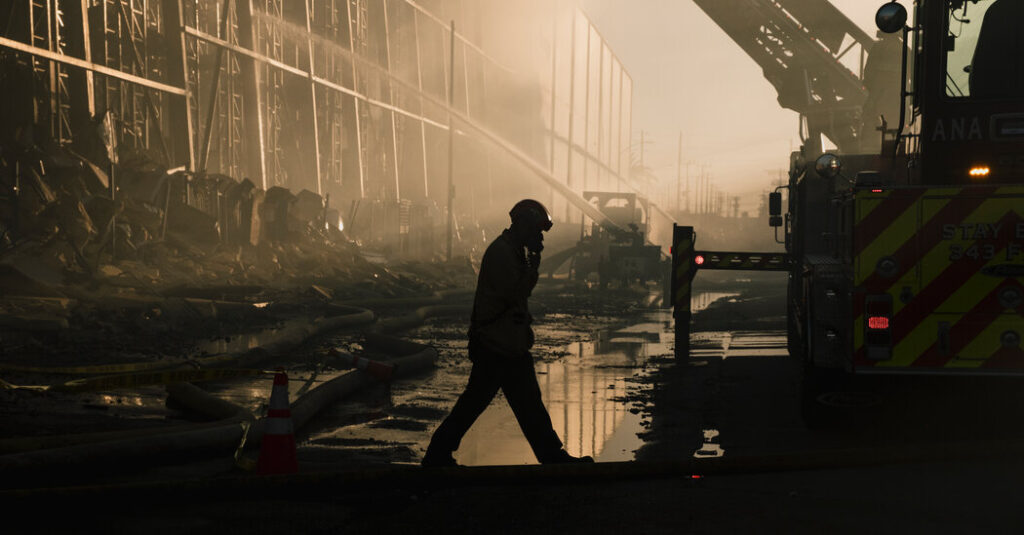
The nearly 500,000-square-foot facility, operated by a company called Lineage Logistics, burst into flames on June 17, blanketing the neighborhoods of Boyle Heights and East Los Angeles in thick smoke for days. Amid the disaster, the roughly 85 million pounds of beef, pork, poultry and seafood stored inside the warehouse began to rot, spreading foul odors throughout the area.
Mayor Karen Bass of Los Angeles has given Lineage until Aug. 13 to clean up the site, and the company said it was working to meet that deadline. But more than that, many residents blame the government for botching its response to the fire, providing inadequate answers and resources in the aftermath. The fire’s cause remains under investigation.
The stench has been described as a pungent mix of mold and dead animal, attracting swarms of rats and bottle flies, which are drawn to rotting meat.
“It’s like living in hell,” said Aurora Flores, 56, who lives with her husband near the warehouse. “We feel like we’re being asphyxiated.”
Lineage said on Wednesday that it had finished hauling out about 60 percent of the waste. But there was renewed outrage toward the company this week after city records showed that a permit was submitted to rebuild the fire-damaged portions of the warehouse. The permit, filed on Monday, noted that there would be “no change to building footprint, square footage, height, use, or occupancy.”
Mayor Bass on Tuesday called the move a “slap in the face” to the community, and has said that the city would consider taking legal action should Lineage fail to meet her August deadline.
The mayor and other officials have sought to re-examine the future of the property in the wake of the disaster. And some neighbors, like Mrs. Flores, have already begun suggesting alternatives.
“We want them to take the Lineage warehouse down,” Mrs. Flores said, “and replace it with green space, a park for kids and the community.”
In a statement, Lineage said the permit was “normal course in the repair process and will not impact or distract us from the important work of cleanup.” It added: “Cold-storage facilities are critical infrastructure that keep food moving from farms to ports to grocery stores across Los Angeles. Communities around the region have depended on them for over 100 years.”
Most of the community outrage, though, has been directed at the government’s response from the very first day of the fire. Residents were not told to evacuate, even as the smoke darkened the skies and shrouded their homes.
City and county government officials subsequently distributed masks and air purifiers in the area and set up mobile clinics for people with symptoms to get checkups. Yet some people reported being denied the purifiers and masks because they lived in the wrong jurisdiction — Boyle Heights is part of the city and East Los Angeles is in the county — or because another tenant or family living at the same address had already claimed the assistance.
Many residents in the largely working-class, Latino neighborhoods say they have been forced to pay higher utility bills as they constantly run air purifiers. Some have even taken to wearing masks indoors.
Adelita Lopez, 60, who struggles with emphysema and was rushed to the emergency room in the early days of the fire, lives in a cramped apartment with her mother just feet from the warehouse. She has had to rely on her oxygen tank more than usual to breathe and has resorted to sleeping on the floor where, somehow, the odor is less pungent.
Before the fire, Mrs. Flores said, she would wake up in the morning to the sound of the chirping birds that lived in several fruit trees in her backyard.
Now, she said, they’ve all disappeared. “The birds are gone, but now we have cockroaches and a lot of flies, something we didn’t have before.” Mrs. Flores said that she and her husband often drove miles away and spent hours at a park or eating out to get away from the stench.
In a statement on Wednesday, Mayor Bass acknowledged the anger directed at the government.
“We understand residents’ frustration, and from the very beginning my priority has been protecting public health and supporting the recovery of the Boyle Heights community,” she said, pointing to relief programs to help residents with utility costs.
In a community survey of 650 households released on Monday by the county health department, a vast majority of the households reported very strong odors and an increase in pests over the previous week, and almost half reported ash or smelling lingering smoke in and around their homes.
And as a summer heat wave has stifled Southern California in recent weeks, people in cities miles downwind have complained about the smell. As of Tuesday, more than 3,600 odor complaints in connection to the warehouse fire had been filed across the county.
One community group, called Protect Los Angeles Now, has demanded that officials, including the governor, issue mandatory evacuation orders and provide housing until the disaster site is cleared.
Local health officials have acknowledged the concerns about air quality and other hazards and the residents’ need for temporary relocation. But at a county board of supervisors meeting last week, the county health officer insisted that the situation had not met the threshold for evacuations.
“We do not have an imminent endangerment in terms of health. Therefore we don’t use that very blunt instrument to really say that nobody can be in the area,” said the county health officer, Dr. Muntu Davis.
The Los Angeles County Department of Public Health and the South Coast Air Quality Management District, the regional air regulator, have urged Lineage to speed the cleanup and do more to mitigate the odors. Perfume misters that the company erected at the site have been ineffective in reining in the smell. Both agencies have issued citations and fines to the company in recent weeks over the conditions.
Lineage said that its crews were working as fast as possible and described debris removal as a complex process that was complicated by unsafe conditions inside the damaged building.
Residents who have received substantial help, such as one-week vouchers for rental stays outside the area, remain fearful that their actual homes have become uninhabitable because of smoke contamination.
At a board of supervisors meeting on Tuesday, Trinidad Alvarez, speaking softly in Spanish through a translator, urged the board to help his family immediately relocate.
He said he was among those on a long waiting list for housing, and was worried about his children who are getting nosebleeds and fighting the urge to vomit when they go outside.
“We’ve gotten no help,” he said. “Just air filters.”
The post L.A. Warehouse Fire Leaves Behind Rats, Flies and an Unending Stench appeared first on New York Times.