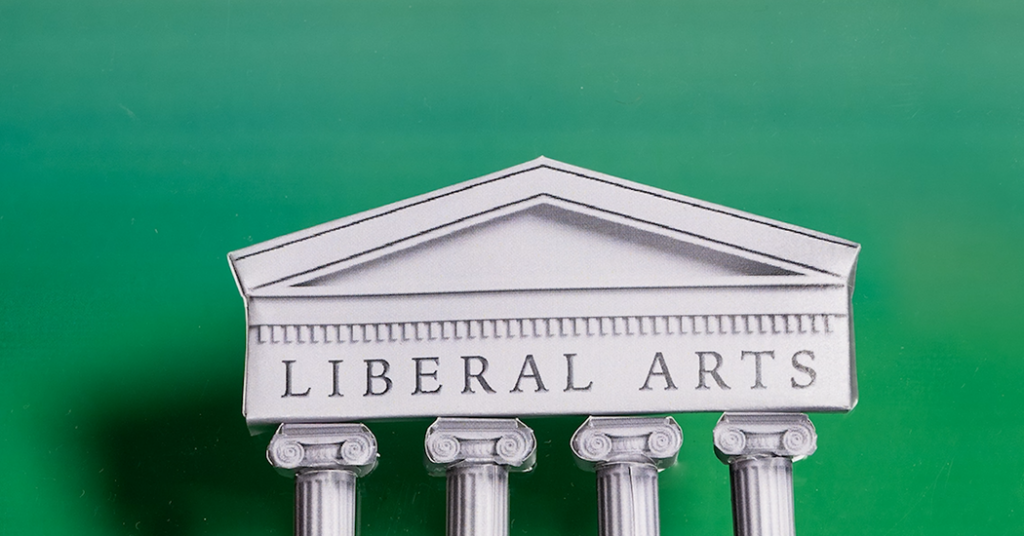
The term “liberal arts” does not have the most glorious reputation these days. Online, there’s a starter pack of associations: useless degrees, fake jobs, oat milk, pink hair, Marxism. When a newspaper reports on college graduates struggling to find jobs, somebody asks how many have STEM degrees versus “the usual liberal arts,” like dance or “sexual intersectionality.” The Babylon Bee — which is like The Onion, but with conservative commonplaces instead of jokes — runs the headline “‘Liberal Arts Degrees’ Renamed ‘Non-Essential Worker Degrees’” and imagines colleges admitting that “the pottery, French literature or zero-gravity space station basket weaving classes you’re taking are completely useless.” Even the individual words are unpopular: liberal and arts! One educator writes about a rural college president who stopped using them after a neighbor asked: “What’s wrong with ‘conservative arts’?”
There are also some long-suffering people who keep pointing out that these critiques may be misunderstanding what “liberal arts” means. (One even took The Chronicle of Higher Education to task for how it used the term.) In 2022, a physics professor named Chad Orzel grumbled about people constantly confusing “the collection of academic disciplines shorthanded as ‘the liberal arts’ with the idea of liberal arts education.” That’s not a major; it’s the simple idea that every student should “study a broad range of topics. A range that, in any sensible formulation, includes math and science.”
Orzel is correct: “Liberal arts” traces back to ancient Greek ideas about teaching a full spectrum of knowledge — arithmetic, music, rhetoric, astronomy, etc. — in order to cultivate agile-minded men capable of wise self-governance, not peons trained for a single task. It’s liberal as in free, not the much-newer political label. The idea was sustained across centuries in Europe — people were writing about “liberal artes” in Middle English — and built into the foundations of higher education in the United States, where Ben Franklin imagined students at the future University of Pennsylvania learning art and oratory and debating “justice and injustice.”
But Americans have come to use “liberal arts” for loose sets of specific disciplines. One community college administrator wrote that some on his campus used it for “anything nonvocational” while others used it for “anything not math-based.” Fine arts and humanities like philosophy almost always count; social sciences like anthropology sometimes do. Law is curiously exempt (people point “liberal arts” at things they consider indulgent or impractical); the proverbial “basket weaving” is not (despite probably being a trade). In meme after meme, “STEM” is presented as liberal arts’ utilitarian opposite — a lucky break for pure math, where you can study stuff that makes literature look like HVAC repair.
That makes “liberal arts” the chief label for a lot of fields people resent — the ones accused of having devolved into woke-leftist nonsense or minting pointless credentials for unskilled elites. The arguments aren’t entirely new. (People once debated whether reading Cicero in Latin was elite claptrap or proper education; in 1919, somebody lamented that higher education would teach anything but Greek and Latin, “from plumbing to basket weaving.”) But they’re at a high pitch lately, and the standard-issue defense of a liberal education — bromides about learning how to think, producing broad-minded citizens, exploring human experience — can sound a bit gooey and idealistic when rents are high.
If you were judging by the internet alone, rife with jokes about trade schools and depressed baristas with gender studies degrees, you might imagine that most conservatives reject those ideals. Charlie Kirk wrote that “college should be about career preparation” and that schools shouldn’t be “forcing humanities and liberal arts classes upon students.” Representative Lauren Boebert doesn’t want more people thinking “2,000 years of history, structure, cultural norms and philosophy is suddenly wrong because they took a liberal arts course in college once and their neo-Marxist professor told them so.”
But conservatives have also been among the great defenders of liberal arts education. A few decades ago, Lynne Cheney was hailing it as a grounding in precisely the 2,000 years of culture it’s now accused of corrupting, giving interviews about how the humanities facilitate “examined lives” and produce “people who can think.” And despite the jokes on X, the movement is circling back to this position — only adding some crucial new verbiage to take the stink off “liberal arts.” The Republican Party platform calls for “the restoration of Classic Liberal Arts Education.” The influential activist Christopher Rufo aimed to turn Florida’s progressive New College into a “classical liberal arts institution.” And a “classical education” model of primary schooling — which aims to resurrect the kinds of rigorous curriculums that have kids reading Aristotle and Dante — is embraced by both the secretary of education, Linda McMahon, and the secretary of defense, Pete Hegseth.
The approach isn’t inherently conservative. But it is easy to pair with certain conservative preferences, including the restoration of the kinds of 18th-century assumptions Franklin held — say, that Western intellectual history is central and superior and should be vigorously celebrated, or that Christianity can be, as Hegseth once put it, “front and center” in learning. Or that education should be morally elevating, doing gooey, idealistic stuff like producing wiser, more virtuous citizens.
All of which can create a touch of dissonance. On X, beneath a post from McMahon praising classical education, somebody asks how that’s defined: Hopefully it includes machine shop and automotive repair! There’s an argument afoot over how practical education should be. “Liberal arts” is a useful term for having it. But that’s not quite what everyone understands the words to mean.
Nitsuh Abebe is a story editor for the magazine.
The post Conservatives Like the Liberal Arts, Actually. They Just Don’t Like the Phrase. appeared first on New York Times.