In September 2024, a handful of patients showed up at the emergency room in the coastal city of Fano, Italy, with mysterious symptoms: a rash on their hands and feet, fever, nausea, and diarrhea. Doctors sent for various tests until one came back with a positive result for dengue, a viral infection spread by mosquitoes, usually in tropical regions of the world. They tested the other patients, and, sure enough, they had dengue too. The strange thing? None of the patients had recently traveled to a country where they might expect to pick up a dengue infection. The only thing they had in common was visiting a particular neighbourhood in Fano.
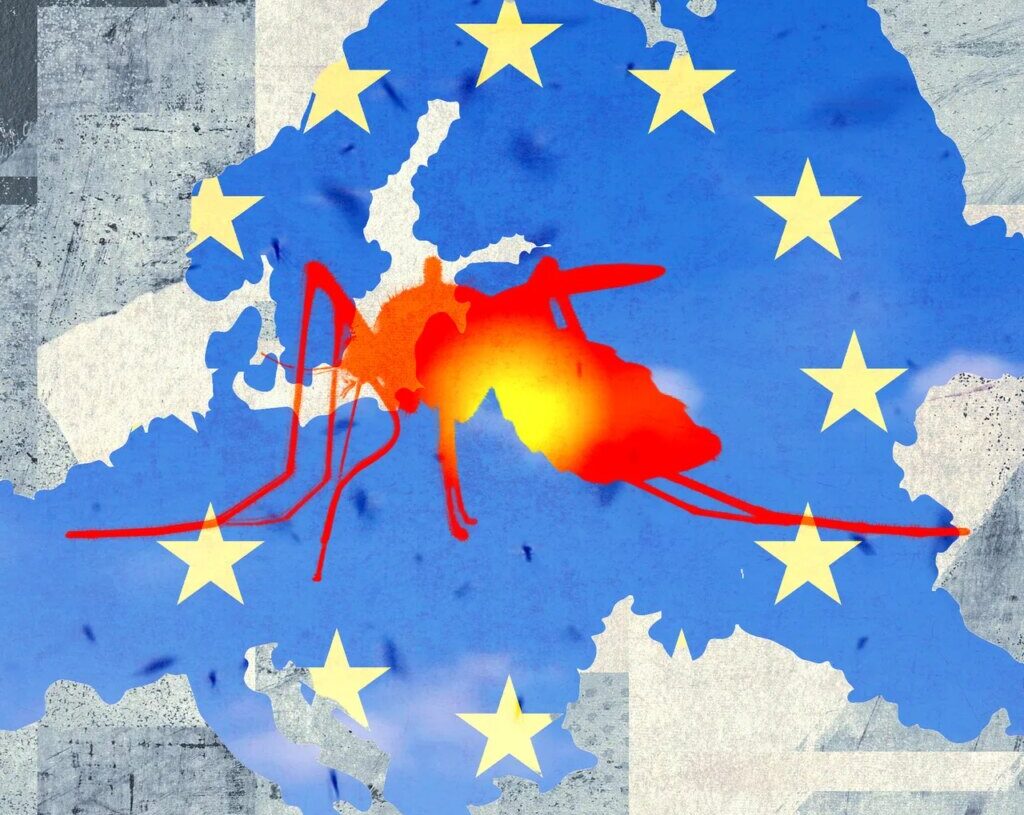
As climate change increases temperatures across Europe, invasive mosquitoes are spreading and introducing disease agents that Europeans would usually think about only when traveling to other continents. The Fano outbreak wasn’t the first time dengue had been detected as spreading locally in mainland Europe, but it was significantly larger than previous incidents, with 199 cases detected between mid-August and mid-October of 2024. Over the past few years, European countries have reported outbreaks of other mosquito-borne viruses such as chikungunya, a painful disease that causes joint swelling, and West Nile virus. In a heating world, so-called tropical diseases are no longer restricted to tropical regions—and researchers expect the trend to continue.
The main current culprit is the mosquito Aedes albopictus, commonly known as the Asian tiger mosquito (or just the tiger mosquito, given it’s now found across all continents). Unlike many mosquito species, it bites in the daytime as well as at night. The tiger mosquito already has established populations across Europe, particularly in the south, and we can expect it to move north, says Riccardo Moretti, a senior researcher at the Italian National Agency for New Technologies, Energy and Sustainable Economic Development (ENEA), who has been working on tiger mosquitos for more than 20 years.
The tiger mosquito thrives between 20 and 30 degrees Celsius (68 to 86 Fahrenheit), but it can still live at around 10 Celsius (50 Fahrenheit). “This means that at the moment there are already conditions that could allow for the spread of the Asian tiger mosquito, even in England,” Moretti says. At the moment, these conditions are limited to the warmest part of the year in northern European countries. But farther south, such as in Greece, the mosquito season is elongating. Moretti says researchers have found adults buzzing around until December and reappearing already in March; they overwinter as eggs. “There is a concrete risk that in the next few years, we could have a population capable of surviving throughout the year,” Moretti says.
At the moment, cases of mosquito-borne diseases in Europe tend to occur toward the end of summer. This is when tiger mosquitoes are most prevalent, and it’s also when more people return from travel. Someone unwittingly brings back an infection that isn’t found in Europe—dengue, say—and gets bitten by a tiger mosquito. The mosquito goes on to bite other people, and the disease spreads locally. But as the weather cools, the mosquitoes get less active and cases subside. If the mosquito season lasts longer, however, more infections can occur. Ultimately, says Moretti, there’s a risk that tropical diseases like dengue could become endemic in parts of Europe, meaning the disease is always there. “It is completely different dealing with occasional cases of virus transmission, and instead dealing with a permanent status of possibility of transmission,” he says.
A difference of a couple of degrees can make a big difference. Earlier this year, a study found that the conditions required for tiger mosquitoes to transmit chikungunya were cooler than previously thought. The mosquitoes can spread the virus at just 14 degrees Celsius (57 degrees Fahrenheit) rather than 16 (61 degrees Fahrenheit), meaning outbreaks could occur in most European countries and for longer periods. “That difference of two degrees matters a lot when we are talking about global warming,” says Sandeep Tegar, an epidemiological modeler at the UK Centre for Ecology and Hydrology, who led the study.
While warmer temperatures may generally create better conditions for mosquitoes, this isn’t the full story. Too hot—more than 35 degrees Celsius (95 degrees Fahrenheit)—and tiger mosquitoes struggle to survive. Southern France and Spain, impacted by recent heat waves and wildfires, may actually have fewer mosquitoes this year, says Frederic Bartumeus, an ecologist at the Spanish scientific research center CEAB: “It’s not been a great mosquito season in these areas, because it’s too hot and it’s too dry.”
Rain is important, as mosquitoes need standing water to breed: This is where they lay their eggs, and where the larvae and pupae develop. “If it rains too little, then there’s not sufficient breeding sites,” explains Felipe Colón González, technology lead and expert in climate and infectious diseases at the UK-based health foundation Wellcome. “But if it rains too much, then it can wash away the mosquito breeding sites.” Humidity also plays a role. Beyond mosquitoes, climate conditions can have different effects on the viruses they carry, and on the behavior of humans—an important consideration in the spread of disease. This all makes modeling patterns of mosquitoes and the diseases they spread more complex, so ongoing surveillance is critical.
It may be possible to reduce mosquito populations if they’re caught early enough. ENEA’s Moretti is part of a team that recently ran an experiment to control a tiger mosquito population in Italy by releasing more than a million male mosquitoes that were reproductively incompatible—meaning when they mate, the female lays sterile eggs. This significantly reduced the number of fertile mosquito eggs in the area. But breeding mosquitoes in a specialized biofactory was expensive. In this case, the mosquitoes were bred in Miami by Google’s Debug program and shipped to Italy.
In any case, it would be impossible to eliminate mosquitoes, Moretti says—they’re too efficient at colonizing new areas. “But what is important is to drastically reduce the risks of transmissions of tropical viruses.”
Colón González says the main test for European countries is whether public health systems can keep isolated outbreaks from becoming major crises. “A common misconception is that preparedness is mainly about predicting disease outbreaks,” he says. “In reality, preparedness is about building the system that allows the public health infrastructure to effectively react when the risks emerge.” In this regard, Europe has an advantage over some parts of the world: Reliable public health and information systems mean that, so far, cases of mosquito-transmitted diseases have remained lower than in other areas of the world with a similar climate.
As invasive mosquitoes continue to settle across the Continent, Europeans may have to get used to taking the kinds of precautions that people in tropical regions are accustomed to. In Spain, Bartumeus already has mosquito nets on his windows and regularly empties standing water, such as that left sitting in flower pots. He uses mosquito repellant and wears long trousers if he’s going to be outside in the evening. “Simple things like that, that’s the only thing you can do,” he says.
Soon, the tiger mosquito may have company. Another invasive species, Aedes aegypti, or the yellow fever mosquito, has already established populations in Cyprus and the Portuguese archipelago of Madeira. As its name would suggest, it can transmit yellow fever, but it also carries dengue, chikungunya, and Zika. Yellow fever mosquitoes can’t tolerate temperatures quite as cool as the tiger mosquito can, but it has been detected making occasional jaunts north, likely transported on cargo. Its most recent destination: a service station in Luxembourg.
The post Tropical Diseases Like Dengue Fever and Chikungunya Are on the Rise in Europe appeared first on Wired.