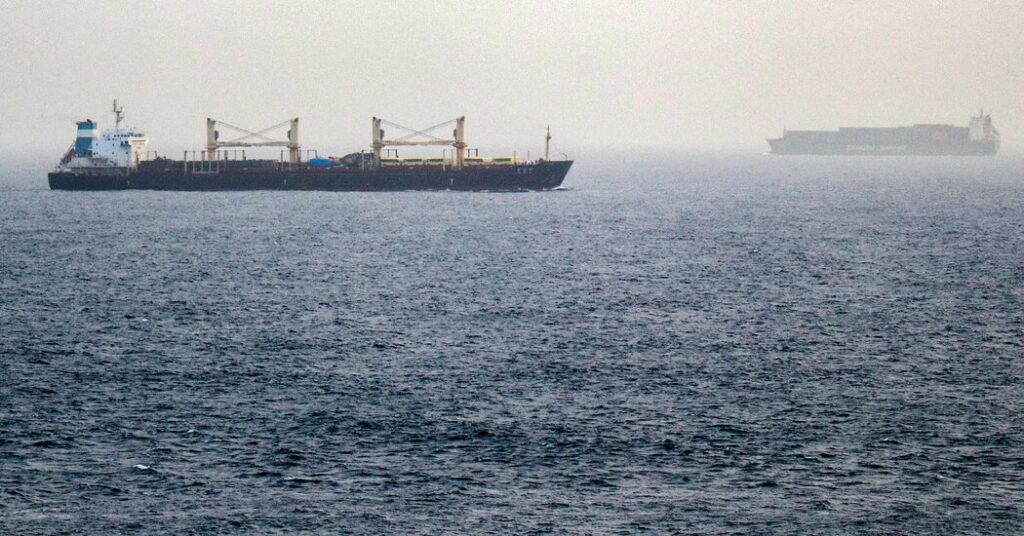
Ships transporting energy products out of the Middle East face a heightened risk of attack in two critical waterways, further disrupting the supply of oil and natural gas to world markets.
Fighting continued in the Middle East on Wednesday, with the United States and Iran launching missile attacks, and the conflict has slowed traffic through the Strait of Hormuz, the primary route for oil shipments out of the Persian Gulf.
Now, the conflict is also increasingly disrupting navigation through the Bab al-Mandab Strait in the Red Sea, which has become a critical valve for Saudi Arabia’s oil exports that can’t make it through the Strait of Hormuz.
The number of vessels passing through Bab al-Mandab is down by one-fifth since July 20, according to Windward, a maritime data agency.
Since the war in Iran started five months ago, Saudi Arabia has reduced its reliance on the Strait of Hormuz by pumping much of its oil through a pipeline and loading it onto tankers in the Red Sea, which runs along the west of the Arabian Peninsula. Most of the tankers then carry the oil south through the Bab al-Mandab Strait, which Yemen borders, making the vessels vulnerable to attacks by the Iranian-backed Houthi militia, which announced a blockade on Saudi Arabia’s Red Sea ports on July 20.
The Houthis claimed to have struck a Saudi tanker in the Red Sea off the coast of Yemen on Tuesday, according to Yahya Saree, a Houthi spokesman, though it was unclear if the ship was actually hit. The United Kingdom Maritime Trade Operations, which is administered by Britain’s Royal Navy, recorded a report of “suspicious activity” in the southern Red Sea in which a ship’s master reported hearing an explosion. The vessel and crew were safe.
Even as the Houthis target Saudi-linked vessels, some Chinese vessels appeared to be broadcasting their nationality and sailing through freely. China has close ties to Iran, the Houthis’ main sponsor.
One Chinese-flagged vessel transited the Bab al-Mandab Strait to Jeddah, a Saudi Arabian port city, with its location transponder on and without any GPS manipulation, according to Windward. The ship’s transponder broadcast the messages “CHINA SHIP CREW SUEZ” and “CHINA SHIP CREW.”
David Smith, an executive at the insurance broker McGill and Partners, said insurance costs for vessels in the Red Sea had increased across the board, even for vessels with no Saudi links. And some insurers are not providing coverage at all for ships that pick up cargo at Saudi ports, he said.
Although 41 ships passed through the Bab al-Mandab Strait on Tuesday, a rise from 39 on Monday, “higher traffic should not be mistaken for lower risk,” said Kpler, a ship-tracking firm. The location transponders on four of those ships were turned off, it added, reflecting the elevated risk levels because the ships may have been trying to avoid detection.
In June, before the Houthi threats, 355 crude tankers passed through the Bab al-Mandab Strait, an increase of more than 50 percent from the 197 that made the transit in February, according to data from Lloyd’s List, a maritime analysis firm.
If the Houthis manage to reduce the number of tankers using the Red Sea in the long term, it would be a big blow to an effort that is moving a lot of oil out of the Persian Gulf, particularly as traffic through the Strait of Hormuz remains at less than one-tenth of prewar levels.
Just 12 ships passed through the Strait of Hormuz on Tuesday, with traffic evenly split by direction, from eight a day earlier, according to data from Kpler. Ten of the ships transited through the Iranian-designated route, and the route taken by the other two was undetermined, the data showed. Iran’s Islamic Revolutionary Guards Corps said it had struck three tankers that ignored its warnings and proceeded on an “illegal” route, though it did not say where the ships were hit.
Starting in 2023, the Houthis carried out many attacks on commercial shipping in the Red Sea after the onset of the Gaza war. The attacks prompted many large shipping lines to avoid the Red Sea and the Suez Canal. They diverted their ships around the southern tip of Africa instead, a route that takes longer and costs more.
The post Shipping Risks Spread Across Crucial Middle East Oil Routes appeared first on New York Times.