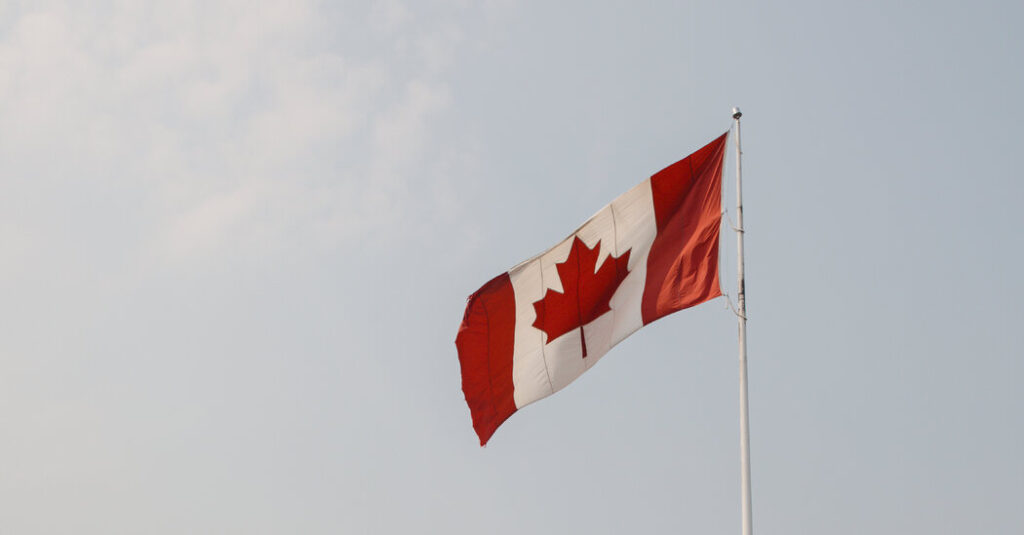
Blaming Canada used to be such a fantastical idea that it was a joke. A couple of decades ago, “South Park” imagined a campaign against Canada for fabricated offenses (in this case, children who swear) as a satirical device whose obvious impossibility was meant to underscore the pathetic human tendency to point fingers at someone — anyone — else for our own failings.
Yet here we are, with the actual president of the United States, well into his second term, blaming Canada for pretty much everything. The “South Park” movie culminates in a war between Canada and the United States. For now, in the real world, the battlefield is economic, with President Trump threatening to impose tariffs on some $20 billion of Canadian exports, ranging from hockey sticks to cement. The official pretext is unfair Canadian treatment of U.S. booze, dairy and cars.
That’s just the most recent rationale. Earlier in July, Canada’s cited crime was being ravaged by the dangerous fires in our own boreal forest. Before that, Canada was considered a national security threat, and therefore subject to tariffs on our steel, aluminum, car parts and cars.
What makes this new attack on Canada truly absurd is that it runs counter to the United States’ own economic interests. American workers can, with some justification, complain about China’s self-aggrandizing trade policies, and it’s true that the downward pressure on wages in competing countries could lower labor and environmental standards.
But America’s trade relationship with its northern neighbor is very strong, and mutually beneficial. The Trump White House knows that, because commerce between the two countries is governed by a trade agreement negotiated during the first Trump administration and lauded by the president himself as “the best trade deal ever.” Even politicians who were lifelong critics of free trade and opponents of Mr. Trump’s backed the United States-Mexico-Canada Agreement. In fact, the U.S.M.C.A. was the first and only trade deal Sherrod Brown, the trade skeptic and former senator from Ohio (now running again), ever supported.
Mr. Brown was right to do so. The United States runs a slight trade deficit with Canada in overall trade in goods and services, and a large surplus if you exclude energy, which America needs more, not less, of in the power-hungry age of artificial intelligence. At a time when Americans rank inflation and affordability as their top economic concerns, adding another tax on consumer goods — which is what tariffs are — is self-defeating.
Rehearsing the economic irrationality of the president’s trade war on Canada is fun, and a self-soothing behavior for America’s long-suffering northern friends, but the reality is that the economics of Mr. Trump’s tariff attacks on Canada are not really the point.
This fight isn’t about correcting the global financial imbalances that the president’s more high-minded apologists contend are the true purpose of his trade policy. Nor is it about ending the Rust Belt deaths of despair that Mr. Trump’s most articulate enablers sometimes cite as the motivation for their protectionism.
That doesn’t mean that there is no method to what can look like madness. Mr. Trump’s tariff offensive has a clear purpose: to demonstrate who is dominant and who must submit.
As a U.S. counterpart told me during the U.S.M.C.A. negotiations in 2018, we are 10 times bigger than you, so we should get our way 10 times more than you do. The laughably flimsy, constantly changing justifications for the president’s tariffs are in fact part of the point. True power is being able to do whatever you like for whatever reason you like, or for no reason at all.
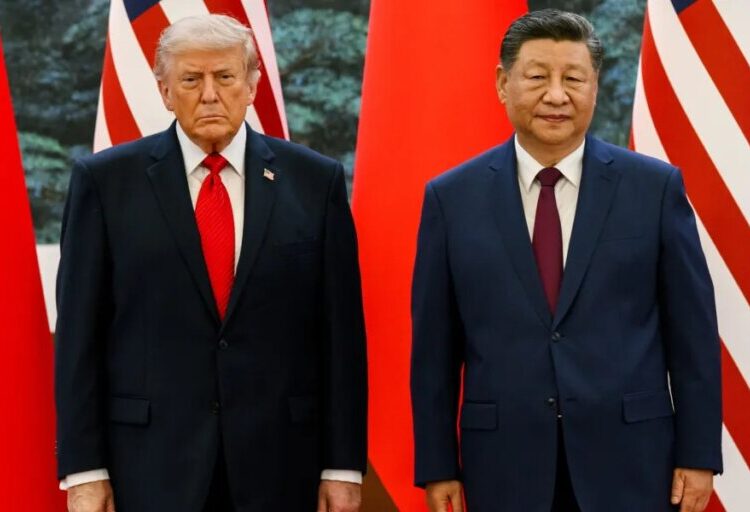
The rest of the world saw that, too, last week, when tariffs were imposed on more than 80 countries on the grounds that they were violating forced labor provisions. This from a White House that is friendlier with China than it is with its NATO allies.
You don’t need to have attended meetings in the Oval Office or have a degree in international relations to see that this is what is going on. The president has been his usual, utterly transparent self.
Since Mr. Trump was elected a second time, he has repeatedly described Canada as the 51st state and our prime minister as a governor. The tariffs would not be levied, he has pointed out over and over again, if Canada were to accept absorption. After the new measures were announced this month, Mr. Trump insisted that Canada was entirely at Washington’s mercy: “They need us to survive. Without us, there’s no way they can survive.”
As Stephen Miller, one of Trump’s top advisers, explained to CNN’s Jake Tapper at the beginning of this year, “We live in a world in which you can talk all you want about international niceties and everything else, but we live in a world — in the real world, Jake — that is governed by strength, that is governed by force, that is governed by power.”
In other words, this isn’t about wine sales or how Canada manages its forests or reviving U.S. manufacturing. It’s about whether Canada is prepared to accept a profound change in its relationship with the United States. It’s about whether Canada is willing to go from being an ally and a partner, in a relationship governed by treaties and rules, to being a vassal, subject to Washington fiat — like the Venezuela of Delcy Rodríguez, only with snowdrifts and hockey.
Nor is appeasement, which some Trump whisperers counsel, a way to avert that awful choice. Saying yes to the White House’s demands just invites more of them until full submission has been established. Giving in gracefully is a less theatrical way of arriving at the same destination.
Once you understand that, it is obvious how Canada needs to react. As we did in 2018, when we responded to the first major U.S. tariff attack with dollar-for-dollar retaliation, Canada must fight back. The only thing a bully understands is strength, and Mr. Trump is keen to establish himself as the world’s apex predator.
Self-defense works best when you do it as a team, and that is why my friend and former Liberal Party colleague Mark Carney, the Canadian prime minister, has struck such a chord around the world with his call for middle powers to act together.
That’s the right thing for the rest of us to do, and it is happening faster than Americans may realize. But the big unknown remains what happens in the United States.
Mr. Trump has made his view plain. His Washington doesn’t have allies. It has only satraps, enemies and equals — the latter a singular group that includes just China and on some days, perhaps, Russia.
That’s what makes this fight such a critical test for the United States and Americans. The countries of the world, especially America’s erstwhile allies, are watching U.S. politics almost as closely as Americans themselves are.
Inside the United States, the pressing question is whether the country will remain a democracy. That matters to the rest of us, too, of course. But even if democracy eventually prevails inside the United States, America’s old friends will wonder whether Trumpism permanently reshaped Washington’s relationship with the rest of the world.
Will a post-Trump America try to rebuild genuine partnerships with its like-minded allies, based on the idea that win-win outcomes are possible and that even superpowers need to honor their treaty commitments? Or is Mr. Trump saying out loud what most Americans have really thought of their allies all along?
The United States is — understandably — so preoccupied by its internal trauma and its war of choice in the Middle East that it is easy to imagine that these other foreign relationships are second-order questions. After all, in its 250th year, the Republic really is flirting with authoritarianism.
But it would be a grave mistake for Americans to treat their place in the world as an afterthought. Because the irony is that Washington is abusing its allies at precisely the moment when it needs them the most. As the war with Iran is demonstrating, even the United States is weaker when it goes it alone. The United States will need friends even more if it hopes to hold its own against China.
In 1944, when the United States began to construct the Pax Americana in earnest and to invest in the postwar recovery of its allies, Washington accounted for close to half of the world’s gross domestic product. Today it is still the single biggest economy, but its share has fallen to just over a quarter. China’s is roughly 17 percent. But add NATO partners, along with Japan, South Korea, Australia and New Zealand, and Team Democracy is back to well over half of the global economy, accounting for as much as 60 percent.
Yet for a lot of its longtime members, that list of like-minded democracies doesn’t feel like much of an alliance anymore. A Pew survey published this month showed that in most of the 36 surveyed countries, China was viewed more favorably than the United States. That included Canada, where 33 percent of respondents saw America favorably, compared with 44 percent for China. People in France, Germany and Britain took a similar view.
At one level, that’s nonsense. China has an authoritarian communist government that imprisons and executes dissidents and ethnic minorities and ruthlessly punishes foreign partners deemed to be stepping out of line, as it did with Canada a few years ago, imprisoning two innocent Canadians in response to our decision to honor our extradition treaty with the United States in an unrelated case.
But given Mr. Trump’s choice to play by China’s rules and force smaller countries to suffer or to submit, the poll result shouldn’t be much of a surprise. Superpowers, even the most benign, are always resented. That means that America’s allies have all long harbored a latent strain of anti-Americanism. Those Pax Americana skeptics are gloating right now, wagging their fingers at the Atlanticists and telling them they told us so.
Would-be future American leaders who recognize the value of allies and think all will be forgiven when the White House has a new occupant need to appreciate the depth of the damage being done by its current resident. They can limit the harm and create the option for the United States to make a different choice in the future by speaking out now.
If they don’t, the rest of the world will be right to think that all Americans actually agree with the current bully in chief. The only winners from that outcome will be the world’s despots.
Or, as the great Canadian songwriter and poet Leonard Cohen presciently put it, “You aren’t going to like what comes after America.”
Chrystia Freeland, a former deputy prime minister, minister of foreign affairs and minister of finance of Canada, is an unpaid economic adviser to President Volodymyr Zelensky of Ukraine and the author of the forthcoming book, “Unreliable Boyfriend: an Insider’s View of Dealing With a Chaotic Superpower, Plutocrats and Other Complicated People.”
The Times is committed to publishing a diversity of letters to the editor. We’d like to hear what you think about this or any of our articles. Here are some tips. And here’s our email: [email protected].
Follow the New York Times Opinion section on Facebook, Instagram, TikTok, Bluesky, WhatsApp and Threads.
The post ‘You Aren’t Going to Like What Comes After America’ appeared first on New York Times.