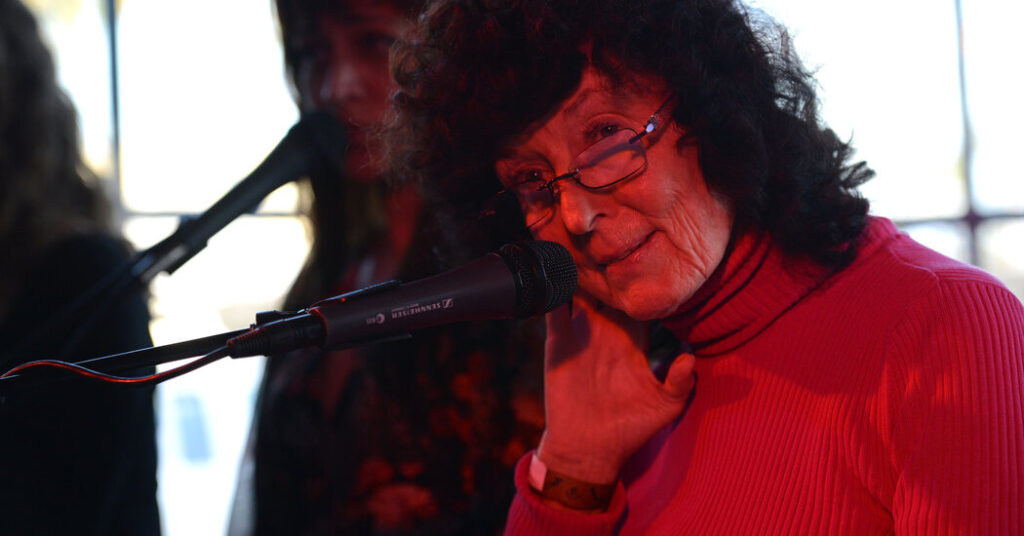
Linda Perhacs, the revered singer-songwriter whose 1970 album “Parallelograms” influenced generations of folk artists, has been reported missing.
In a statement shared with The New York Times, Perhacs’s former manager, Laurel Stearns, said that friends and collaborators of the musician, 82, had been unable to reach her ever since she was discharged from an assisted living facility eight months ago. Stearns later added that the facility was in Northridge, Calif.
Fernando Perdomo, a producer who has worked with Perhacs, said that on Monday he filed a report regarding her whereabouts with adult protection services in Los Angeles County, which includes Northridge.
According to Stearns, Perhacs was released from her care facility, where she was being treated for dementia, under the supervision of a legal guardian. But, Stearns said, that person has been “unresponsive.” Stearns’s statement did not disclose the name of the guardian.
“According to individuals close to Perhacs, she was discharged from a residential care facility approximately eight months ago under the supervision of her legal guardian,” the statement from Stearns said. “Since that time, numerous friends and longtime collaborators report they have been unable to establish direct contact with her. Repeated attempts to communicate with her guardian have also, they say, gone unanswered.”
“Our main prerogative at this time is it to spread awareness in hopes of finding Linda safe and comfortable,” Sterns added in an email.
Perhacs was working as a dental hygienist in Los Angeles in the late 1960s, and experimenting with songwriting on the side, when one of her patients, Leonard Rosenman, a composer whose credits included music for “East of Eden,” “Rebel Without a Cause” and other movies, helped her land recording sessions with elite musicians.
“Parallelograms” received little commercial attention when it was first released but enjoyed a resurgence in the late 1990s and early 2000s, after its rediscovery and subsequent reissues.
Her song “If You Were My Man” appears in Daft Punk’s sci-fi film “Electroma” (2006), though it was not until 2014 that Perhacs released her sophomore album, “The Soul of All Natural Things,” more than 40 years after “Parallelograms.” Jon Pareles, writing in The Times, said the album proved that “her aura of mystical innocence” remained intact. She released a third album in 2017.
On Monday, Stearns and three other people who have collaborated with Perhacs posted a request for information about the musician’s whereabouts on social media. “Please help us locate Linda to ensure her wellbeing,” they wrote.
Perdomo, who worked as a co-producer on Perhacs’s last two albums, posted a video to social media on Monday in which he describes an attempt to contact the musician six weeks ago. He says he learned that Perhacs had been moved out of the facility by her “next of kin,” whom Perdomo says he has since been unable to contact.
In an email, Perdomo clarified that by “next of kin” he was referring to Perhacs’s legal guardian.
“Her next of kin’s number, which we had, which we used to have contact with him, he’s not answering phone calls,” Perdomo says in the video, “and I think he might have blocked us.”
The post Linda Perhacs, Experimental Folk Singer, Is Reported Missing appeared first on New York Times.