For a decade, Indian Prime Minister Narendra Modi’s political dominance has rested on two hard-as-cement assumptions. First, that he is close to invincible at the polls. And second, that India’s youngest voters are politically indifferent. Over the past week, both assumptions cracked.
What began as outrage over dysfunction in India’s college exam system built into something much larger — the first sustained, youth-led movement in years to force India’s powerful central government actually to concede ground.
Here’s how student groups such as the All India Students’ Association, together with the “Cockroach” political movement — the name is derived from an insult aimed India’s youth — put the government on the defensive.
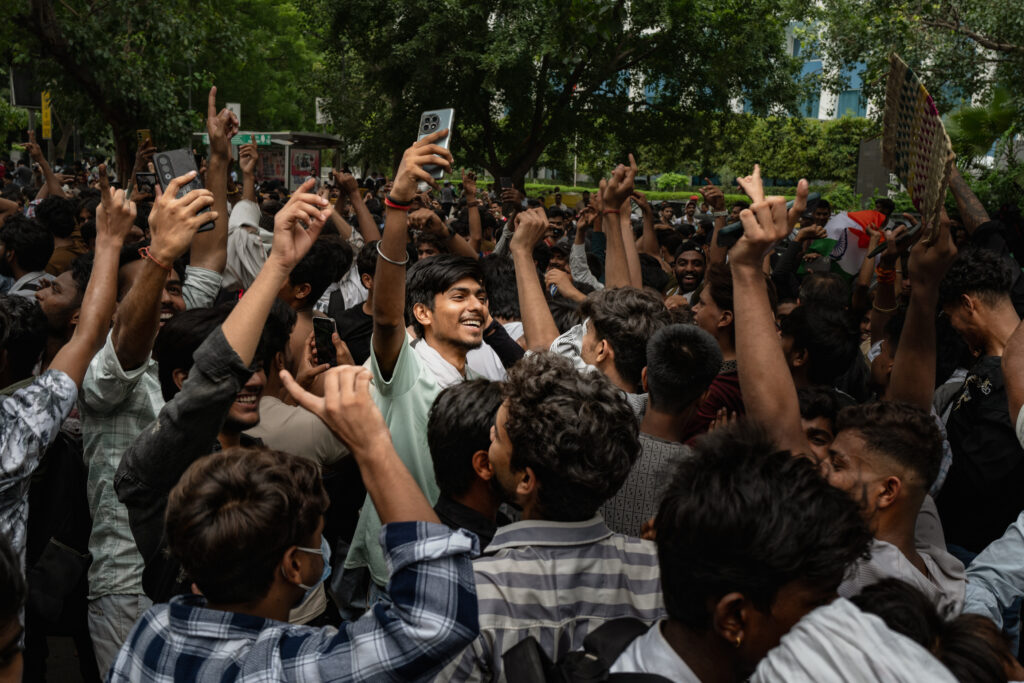
I visited the protests beginning on July 18 in New Delhi and then again in Mumbai, last Friday and Sunday. What I saw was young men and women, most in their early 20s, who had walked barefoot from villages and towns with little more than bananas or peanuts in their bags. Determined to make themselves heard, they slept along roads and packed into trains and buses.
Events escalated dramatically on July 20. Students marched toward Parliament on the first day of the “monsoon” session, and Delhi police responded brutally, employing pellet guns, tasers, tear gas and even batons laced with nails. Scores of protesters were hurt. One student remains in intensive care at a Delhi hospital. Opposition leader Rahul Gandhi, part of a group protesting the crackdown the next, was dragged into custody by police. In the northern state of Bihar, police unleashed water cannons, and later in the week one officer was even caught on video firing an AK-47 rifle — a weapon of war — toward the demonstrators. (No one was hit.)
Such scenes are stunning in Modi’s India. For 12 years, this government has seemed to elevate itself beyond the reach of dissent. It has been assisted in this by a mainstream media that has increasingly become an arm of the government. But these Generation Z protesters found a bug in this self-reinforcing system: In viral posts on platforms such as Instagram and X, they communicated directly to the public as citizen journalists documenting the brutality used against them.
By that evening, much of the country, including some ardent Modi supporters, had taken to social media themselves to express their dismay at the scenes on their screens. This included famous figures from movies and sports who rarely take a public position critical of the Modi government. Yet here they stood in solidarity with the protesters.
The snowball kept rolling. The country’s streets filled with people draping themselves in national flags and singing patriotic songs. They rallied around Hindi slogans aimed directly at the prime minister: One was “jab-jab Modi darta hai, police ko aage karta hai” (“Each time Modi is scared, he takes refuge in the police”). Another cited the sudden resignation of Modi’s education minister: “Dharmendra Pradhan toh jhanki hai, Modi-Amit Shah baaki hai” (“Dharmendra Pradhan is only the beginning; Modi and Amit Shah are next”). Shah, the home minister, is considered the second most powerful man in India. Memes characterizing Modi’s actions as cowardice became material for T-shirts, placards and Instagram reels.
In an unprecedented move, Modi soon released two midnight messages on Instagram promising solutions to the problems facing Gen Z. But still the young protesters did not budge.
There have been rare instances of Indian youth criticizing Modi by name before. But the critical mass that formed last week was something new. No previous protests — not the citizenship protests of 2019 nor the farmers protests of 2020-21 — managed to turn Modi himself into a subject of derision and satire the way these young protesters did.
But. With a leader such as savvy and entrenched as Modi, there is always a but.
On Sunday, as victory rallies celebrating Pradhan’s resignation took place across India, authorities began arresting students. Reports then emerged Monday that notices were sent to social media platforms seeking the removal of posts critical of the prime minister. The same day, the outgoing education minister was praised in Parliament. That suggests an inexorable return to the status quo could be beginning, but I don’t think so. The events of the past week have altered something fundamental.
For years, Indian politics has been defined by the assumption that young voters would either support Modi’s Hindu nationalist Bharatiya Janata Party or remain disengaged. Many commentators dismissed Gen Z as politically apathetic, as consumed by influencers and algorithms — as “cockroaches.” These protests have shattered that stereotype forever.
So the arrests may succeed in intimidating protesters. Social media companies may comply with takedown requests. Modi still commands enormous institutional power, and his party remains electorally formidable. None of that has changed. But the projection of Modi’s unflinching authority has been seen through. And governments rarely recover the aura of invincibility once it has been publicly punctured.
The post India’s Gen Z just made Modi blink appeared first on Washington Post.