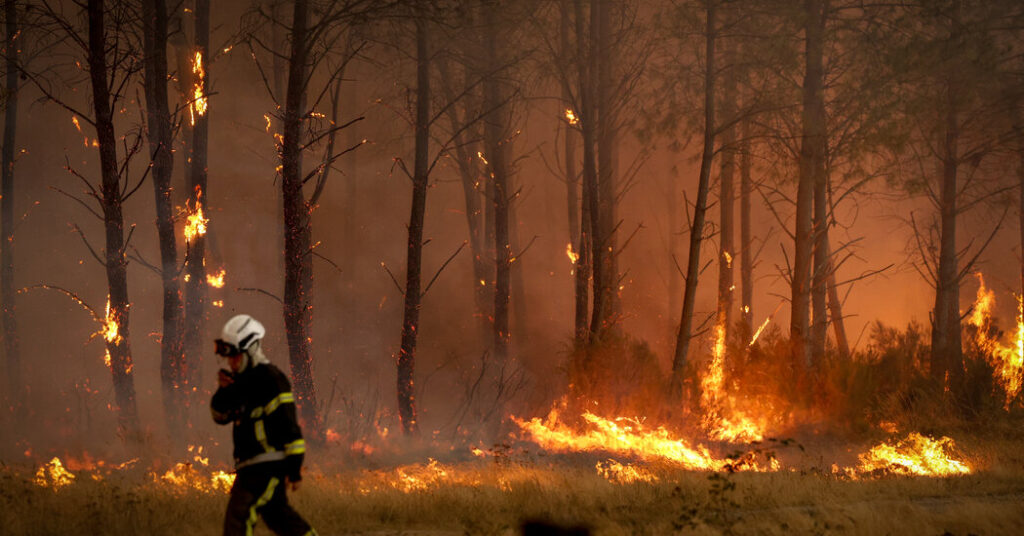
Guillaume Bos described how he watched on Friday as a fire swept through his village in the Gironde region, the area hardest hit by the wildfires raging in southwestern France. Around his home, he said, “everything is burned as far as the eye can see.”
“It’s a real disaster,” said Mr. Bos, 36, a business manager and forest owner who lives in Le Temple, a village with around 600 residents some 18 miles west of Bordeaux. Blazes have been raging for days, fueled by unusually hot and dry conditions and evading the efforts of firefighters to contain them.
Mr. Bos said he had received an order to leave on Friday afternoon, but, like others in France, he chose to stay with farmers and forest owners to try to fight the flames. His wife and son evacuated.
“When your wife and son leave, and you don’t know how things are going to turn out — yeah, it’s not easy,” he said.
Using tractors and trailers loaded with water tanks, Mr. Bos said that he and his friends had managed to save most of the houses at the heart of the village, but about six were destroyed, along with most of the surrounding pine forest. Though the worst is now over, he said they were spraying water all around Le Temple to keep the fire from reigniting.
“It’s a round-the-clock effort,” he said.
Nina Rosazza, 42, has been relentlessly helping firefighters since a fire broke out near her home in Andernos-Les-Bains a few days ago. She and her husband got a trailer, a water tank and a motor pump to help contain the fire. About 100 people with 50 trucks joined them.
“Lots of tradespeople, shop owners — anyone who could get the necessary equipment — came to join us,” she said. They have focused on smaller fires, clearing the way for firefighters to battle the more intense blazes.
“We’re not heroes, but we’re trying to do our part to put an end to this, because it’s a massacre,” she said.
Alexandre Bidau, 33, is a construction worker who lives in the town of Pessac on the western outskirts of Bordeaux, France’s sixth-biggest city and a center of the renowned winemaking region that has so far escaped the blazes. He said he had volunteered to help firefighters on Sunday.
With his brother and his cousin, Mr. Bidau borrowed a water tank with a capacity of over 1,000 liters, or about 264 gallons, and headed to his friend’s house, which was about to be engulfed by flames. They managed to save it and were then directed by firefighters to carry out various reconnaissance and water-spraying missions.
“It was very sad; it really broke my heart to see all these burning woods, that scorched vegetation,” Mr. Bidau said. “But I also feel a sense of satisfaction from helping people save their homes and assisting firefighters.”
At some point, Mr. Bidau said he found himself surrounded by dozens of other volunteers from the construction industry. “The mutual aid we saw was truly exceptional,” he said. “I’m still pretty blown away by that movement.”
Mr. Bidau, who spoke on the phone on Monday from the hospital where his wife was about to give birth, said he went back home when she called him to say her labor pain was intensifying. He said several members of his family had already been severely affected by the fire: One of his aunts lost her house, and his brother and his mother had to evacuate.
Now, with more extreme heat forecast for the coming days, Mr. Bidau worries that he and his family may be forced to flee in the hours or days ahead.
“I hope they’ll be able to keep it under control today,” Mr. Bidau said.
In Le Temple, Mr. Bos described how he had also helped save a friend’s house from the blazes that have burned through over 100,000 acres in the Gironde region and displaced more than 200,000 people, one of the largest peacetime evacuations in the country’s history.
“It was Friday night; the firefighters were elsewhere, and we were really left on our own,” he said. A friend had called in tears, worried that his house would burn down. Mr. Bos and his neighbors rushed there and managed to put out the flames.
“In the heat of the moment, with the adrenaline pumping, you don’t think, you just go for it,” said Mr. Bos, who said he also witnessed incredible solidarity among residents.
“But now, the adrenaline is wearing off, and the reality is painful,” Mr. Bos said. “There are people who depend entirely on the forest for their livelihood.”
The post In France’s Evacuation Zones, Some Residents Stay to Help Save Homes appeared first on New York Times.