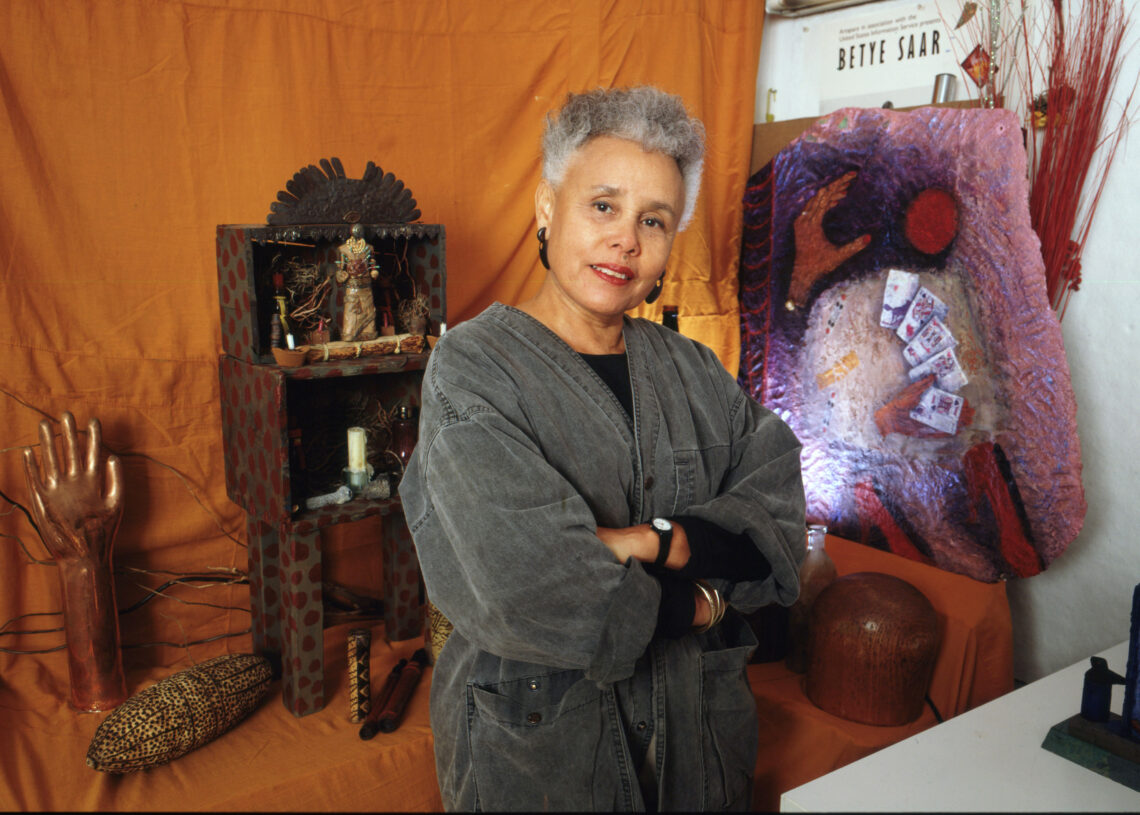
Betye Saar, who scoured flea markets for ordinary items — clocks and window frames, plastic dolls, miniature ships and masks — from which she crafted works of art that explored and exploded images of Black women in America, died Sunday in Los Angeles. She was 99 and would have celebrated her 100th birthday on Thursday.
Her death was announced by Roberts Projects, the Los Angeles gallery that represented her.
Ms. Saar, a lifelong Californian, was 93 when she became an art world star in 2019. That year, the Museum of Modern Art in New York and the Los Angeles County Museum of Art mounted simultaneous exhibitions of her work. Reviewing the Los Angeles show in The Washington Post, art critic Sebastian Smee wrote that her “modestly scaled assemblages address racism and female labor with excoriating intensity and moody finesse. But they also vibrate with spiritual yearning.”
By then, she had been an artist for more than 50 years. In interviews, Ms. Saar described the assassination of the Rev. Martin Luther King Jr. in 1968 as the event that politicized her and gave her work purpose. “I was a mother with young children,” she told the New York Times. “I couldn’t walk in protest, but I did have a weapon, and that was art.”
She began collecting likenesses of Aunt Jemima, Uncle Tom, Little Black Sambo and other caricatures that she described as “Black derogatory images.” She incorporated them into collages and assemblages, transforming the scavenged items into statements of political and social protest.
The most famous of those works was “The Liberation of Aunt Jemima” (1972), in which she depicted the apron-wearing “mammy” with one hand holding a broom and the other a gun.
“It’s like they abolished slavery but they kept Black people in the kitchen as Mammy jars,” Ms. Saar told the Los Angeles Times. “I had this Aunt Jemima, and I wanted to put a rifle and a grenade under her skirts. I wanted to empower her. I wanted to make her a warrior.”
Ms. Saar worked in a variety of media, but her assemblages — collections of objects she found on the street or at swap meets — attracted the most notice. She was inspired by a 1967 visit to the Pasadena Art Museum (now the Norton Simon Museum), where she saw assembled works by a master of the form, Joseph Cornell. Ms. Saar said she recalled thinking: “Hey, I can do that. I’ve got all this fantastic stuff.”
Some of her pieces told stories, and some didn’t. “I prefer it when they don’t tell a story so the viewer can invent their own,” she told the New York Times. Some assemblages displayed materials that belonged to Ms. Saar’s female ancestors, who were African American, Irish and American Indian. Others referenced events in her life. In “Black Girl’s Window” (1969), a Halloween skeleton, alluding to her father’s death when she was 5, accompanies Ms. Saar’s self-portrait, among other images.
Still others were overtly political. In his review of the Los Angeles exhibition, Smee focused on an assemblage called “The Edge of Ethics,” from 2010.
A dark green birdcage contains an armless black figurine chained to a glass bottle and standing on outsize bird’s feet. Smee called the work “a masterpiece,” and he observed that “it makes a bald statement about slavery and incarceration.” He added, “It is more succinct, more poignant and more pressingly urgent than a roomful of research papers, a month of Sunday sermons, a year of news reports.”
Ms. Saar’s work often referred to such religious traditions as shamanism and voodoo, as well as astrology, palmistry, phrenology and tarot. In a 1977 documentary about Ms. Saar, Los Angeles-based artist John Outterbridge, remarking on her interest in ancient beliefs, said, “She could be a daughter to one of the pharaohs.”
Betye Irene Brown was born in Los Angeles on July 30, 1926. Around the time of her father’s death, her family moved in with relatives in Pasadena. She spent summers with her paternal grandparents in the Watts neighborhood of Los Angeles, where she watched the construction of Simon Rodia’s Watts Towers, a major work of architectural sculpture.
Ms. Saar said Rodia, an Italian immigrant, influenced her by his use of broken dishes, seashells, rusty tools, even corn cobs that he pressed into cement, creating an art of assemblage and presaging her own eclecticism.
At the University of California at Los Angeles, she majored in interior design. “Being from a minority family,” she told the Los Angeles Times, “I never thought about being an artist. But I could tell people how to buy curtains.”
After graduating in 1949, she created a greeting card line and founded an enamelware business. She started graduate school in graphic design, but an encounter with printmaking changed her trajectory. The form was “liberating,” she told the Los Angeles Times. “It gave me the freedom to experiment.” She began creating color etchings, ink drawings and intaglio prints.
In 1952, while in graduate school, she married Richard Saar, a ceramicist. They soon had three daughters: Tracye Saar-Cavanaugh, now a writer, and Alison and Lezley Saar, both artists. In 1962, the family moved to L.A.’s bohemian Laurel Canyon, where Ms. Saar continued to live after she and her husband divorced.
In addition to her daughters, survivors include six grandchildren.
During a 1970 trip to Chicago, Ms. Saar studied the African artifacts in the basement of the Field Museum. From then on, many of her works incorporated objects and artworks from Africa.
In 1974, she received a grant from the National Endowment for the Arts. It made her feel “like an artist for the first time,” she said. “Before I was just making stuff.” A year later, she was the subject of a small exhibition at the Whitney Museum of American Art in New York.
Although she mostly avoided art world disputes, Ms. Saar led a letter-writing campaign in 1997 to protest the awarding of a MacArthur “genius grant” to Kara Walker, an African American artist whose silhouetted images included depictions of enslaved people as participants in debauchery with their masters.
In an interview for the PBS series “I’ll Make Me a World,” Ms. Saar called Walker’s work “sort of revolting and negative and a form of betrayal to the slaves, particularly women and children, and that it was basically for the amusement and the investment of the White art establishment.”
She subsequently explained to the International Review of African American Art: “Here we are at the end of the millennium seeing work that is very sexist and derogatory. … The trend today is to be as nasty as you want to be: TV, Rodman, rap. … There is no personal integrity. … Aunt Jemima is back with a vengeance.”
But mostly, when she had something to say, Ms. Saar did so through her art. In her later years, her assemblages sometimes grew into room-size installations. “I’m basically a recycler,” she told the New York Times. “I’m a person who walks looking down, because you can find lots of great things on the ground.”
The post Betye Saar, artist who shattered stereotypes of Black women, dies at 99 appeared first on Washington Post.