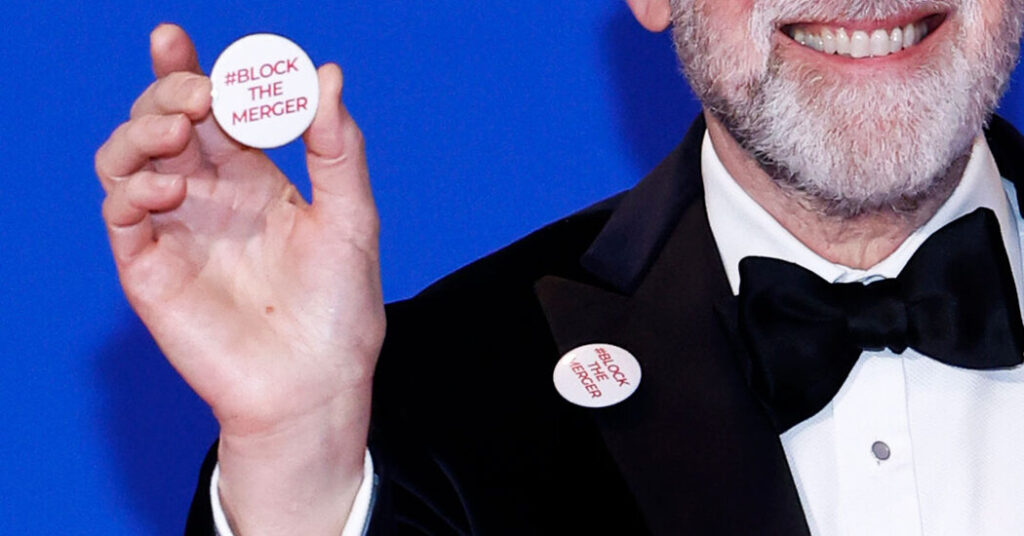
In April, the attorney Norm Eisen was on his way into the Supreme Court as part of the legal team fighting to preserve birthright citizenship when he got a text from the actor Mark Ruffalo.
Along with several others in the entertainment industry, Ruffalo was searching for some way to stop the pending merger between Paramount and Warner Bros., which would leave the MAGA suck-up David Ellison in charge of two of the big five major movie studios, as well as HBO Max and CNN. After acquiring Paramount, CBS’s parent company, in 2025, Ellison delighted Donald Trump by installing the anti-woke editor Bari Weiss atop the network, throwing “60 Minutes” and other programs into crisis. Variety wrote that his rising empire “skews alpha male,” raising fears that he’d “entwine the studio’s content more closely with MAGA messaging.” Ellison’s willingness to cater to the president — he threw a party in Trump’s honor in April — is almost certainly why Trump’s Justice Department approved Ellison’s bid for Warner Bros., reportedly overruling career officials who worried it would violate antitrust law.
Should the merger go forward, many in Hollywood worried the new media behemoth would greenlight fewer TV shows and films, especially those that displeased Ellison’s Republican allies. CNN might become an ersatz Fox News. “Any kind of documentaries that are holding power to account will never make it to the marketplace,” Ruffalo told me.
No one was quite sure how the consolidation could be thwarted. In Hollywood, said Ruffalo, the mood was both fatalist and opportunistic. When Trump stormed back into office, he seemed, for a moment, like a cultural as well as a political conqueror, ushering in a much-discussed vibe shift. When his corrupt Justice Department greenlit the merger, Ellison’s success seemed inevitable. Besides, many in the industry were deeply wary of Warner Bros.’ other suitor, Netflix, which they feared would put fewer movies in theaters. With Ellison about to become one of the most powerful men in movies, many seemed reluctant to cross him. “Most of Hollywood, I hate to say it, they just laid down,” Ruffalo told me.
Eisen, a lawyer who’s emerged as a sort of attorney general for the anti-Trump resistance, thought there was a path to stopping the merger, and saw an imperative to try. “Classically, one of the things that you see in a backsliding democracy is the autocrat’s favored cronies seizing oligarchal control of the media,” he said. That’s how things had played out in Russia, Turkey and Hungary, and now it seemed that the same dynamic was coming to America. What happened next, however, demonstrates the importance of not surrendering to authoritarianism prematurely.
In a phone call on the Supreme Court steps, Eisen drafted an open letter denouncing the merger and celebrating reports that state attorneys general were scrutinizing it, tacitly encouraging them to take Paramount to court. Some leading Hollywood figures, including J.J. Abrams, Damon Lindelof and Ben Stiller, signed on. A Times guest essay that Ruffalo helped write said, “Despite appearances, the end of this story hasn’t been written.” He was right: This month, buoyed by a growing movement, 12 Democratic attorneys general sued to stop Ellison’s Warner Brothers takeover, arguing that it violated antitrust law.
“Historically, it’s unusual for the states to take the lead on antitrust enforcement actions,” reported Variety. But the case was strong enough that last week, a California judge issued a temporary restraining order putting the merger on hold. And on Friday, Paramount, which had hoped to close the deal this month, agreed to postpone the merger until next June or the end of the trial, whichever comes first.
“I think it’s seismic,” the media reporter Oliver Darcy, founder of the influential newsletter Status, said of the delay. “And it certainly puts into question whether this deal will cross the finish line.”
Obviously, Ellison could still prevail. But at the very least, the delay is likely to cost him a lot of money. When Paramount was competing with Netflix to take over Warner Bros., it sweetened its offer with a so-called ticking fee, in which Paramount agreed to pay Warner Bros. shareholders about $7 million a day if the deal isn’t closed by Sept. 30. Should the deal drag on until next June, Paramount could be out almost $2 billion.
The lawsuit could also put pressure on Paramount to settle, perhaps by spinning off CNN and making guarantees that would protect jobs in Hollywood. In an interview with Status, Rob Bonta, California’s attorney general, said it wouldn’t be enough for Ellison to just give up control of CNN, but that such a move would “definitely have value.”
The mere possibility that the deal could be defeated, said Ruffalo, has strengthened resistance in Hollywood. After Paramount announced its pause, SAG-AFTRA, the union that represents actors, broadcasters and recording artists, finally voted to oppose the merger. There’s a growing understanding, said Ruffalo, that if you let yourself be cowed by MAGA, “you’re doomed. If you fight, at least you have a fighting chance. And they’re losing their grip on power. They’re losing their grip on their narrative.” As Trump looks ever less indomitable, so does his dream of remaking American culture in his image.
That’s the lesson for Eisen, too: that Trump is beatable if you take a page from his playbook and flood the zone with opposition. In Trump’s second term, Eisen’s 60-person outfit, Democracy Defenders, has been involved in some of the most consequential legal battles against Trump: protecting birthright citizenship, ending Trump’s “weaponization” slush fund, blocking the Justice Department’s attempt to subpoena election officials in Georgia, and stripping Trump’s name off the Kennedy Center.
“They’re all about the defense of our democracy,” said Eisen. “And in some ways, the Paramount/Warner Bros. case is as important as any of them.”
The Times is committed to publishing a diversity of letters to the editor. We’d like to hear what you think about this or any of our articles. Here are some tips. And here’s our email: [email protected].
Follow the New York Times Opinion section on Facebook, Instagram, TikTok, Bluesky, WhatsApp and Threads.
The post A Setback for the MAGA Media Takeover appeared first on New York Times.