Elon Musk’s latest prediction that “money won’t matter” within a decade drew swift online mockery — but a closer look at how fellow tech billionaire Vinod Khosla responded reveals a more sobering warning buried beneath his apparent agreement.
In a wide-ranging interview with The Economist, Musk told editor-in-chief Zanny Minton Beddoes that AI and robotics will produce such an abundance of goods and services by 2036 that money will become irrelevant. His logic: “What do you want money for? You want money for goods and services” — and once robots and AI generate more of both than any human could consume, currency loses its purpose. Musk went further, predicting deflation, not inflation, would become the era’s defining economic challenge.
Musk made similar remarks on the People by WTF podcast months earlier, saying “money disappears as a concept” once AI and robotics can satisfy all human needs without wages acting as “a database for labor allocation.”
What changed this time was the venue and the pile-on. Gizmodo characterized Musk as melting down over “perfectly normal questions” about his worldview, calling his answers frequently incoherent. On Reddit, one widely upvoted thread set off a round of debate ranging from Musk’s track record of predictions to the future of capitalism.
Khosla enters — with a catch
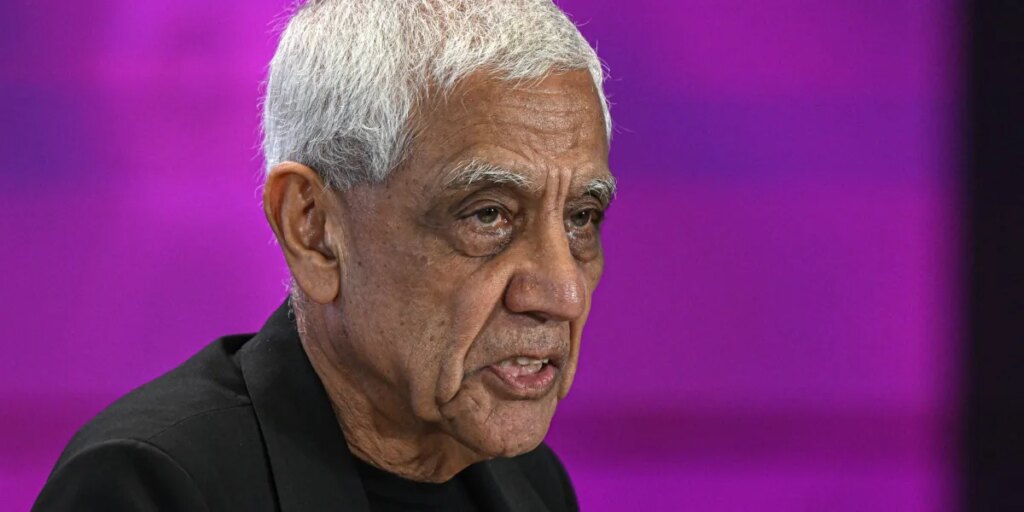
Vinod Khosla, the veteran Silicon Valley investor and Khosla Ventures founder, didn’t join the pile-on. Instead, he posted on Xthat he’d “modify” Musk’s prediction by adding a crucial qualifier: money won’t matter in 2036 “only if the politics permits this great abundance.” He linked the post to his own 2024 essay, “AI: Dystopia or Utopia?” published on his firm’s website.
Khosla wasn’t endorsing Musk’s timeline so much as using it as a springboard to make a very different argument, namely that the technology enabling abundance and the political will to distribute its benefits fairly are two entirely separate problems, and solving the first guarantees nothing about the second.
Reaction to Khosla’s post split along similarly predictable lines. One reply called the whole abundance premise “beyond ridiculous,” arguing that police, firefighters, doctors, and nurses won’t simply work “for free.” Another commenter offered a backhanded validation, noting that “Elon is often right in the end, but usually about 10-15 years early on his predictions.”
The dystopia hiding in the fine print
Khosla’s essay warns that “AI could create a world where a small elite thrives while the rest face economic instability, especially in a democracy that drifts without” active policy intervention. He argues AI is categorically different from prior technological revolutions like the microprocessor or the internet, because those tools amplified what humans could do with existing brainpower, while AI actually substitutes for brainpower itself.
That distinction is what makes mass abundance technically plausible, in Khosla’s telling: AI could eventually replace most jobs in healthcare, law, retail, and beyond, with productivity gains theoretically capable of supporting comfortable living standards for everyone.
Khosla has been predicting this for over a decade. A Substack analysis of his writing notes that as early as 2014, “he issued a warning shot, arguing that AI would drive unprecedented abundance alongside a massive gap between the rich and the poor.” His proposed fix, per Fortune’s earlier coverage, is a universal basic income “to ensure people can live well even as jobs disappear”.
Crucially, Khosla’s essay stops well short of predicting governments will actually adopt such fixes. He warns wage compression, job displacement, and deflation could just as easily deepen inequality as eliminate it, with the outcome depending “upon the policy approach of our elected officials and their willingness to tackle the severe redistribution problem pure capitalism may create.”
Separately, at Stanford’s FIS event, Khosla warned of “a five-year burst of productivity and cost cutting before a deflationary decade reshapes the global economy” — a rockier near-term path than Musk’s smooth abundance narrative implies.
Neither man is short on incentive to talk up AI’s transformative potential as both have deep financial stakes in the technology delivering on its promise. But Khosla’s caveat suggests that even among AI’s most bullish investors, the real debate isn’t whether the technology can produce abundance. It’s whether the political system will let that abundance reach anyone beyond the people who own the robots.
For this story, Fortune journalists used generative AI as a research tool. An editor verified the accuracy of the information before publishing.
The post Elon Musk’s vision of a post-money future got mocked. Vinod Khosla warns it could become a dystopia instead appeared first on Fortune.