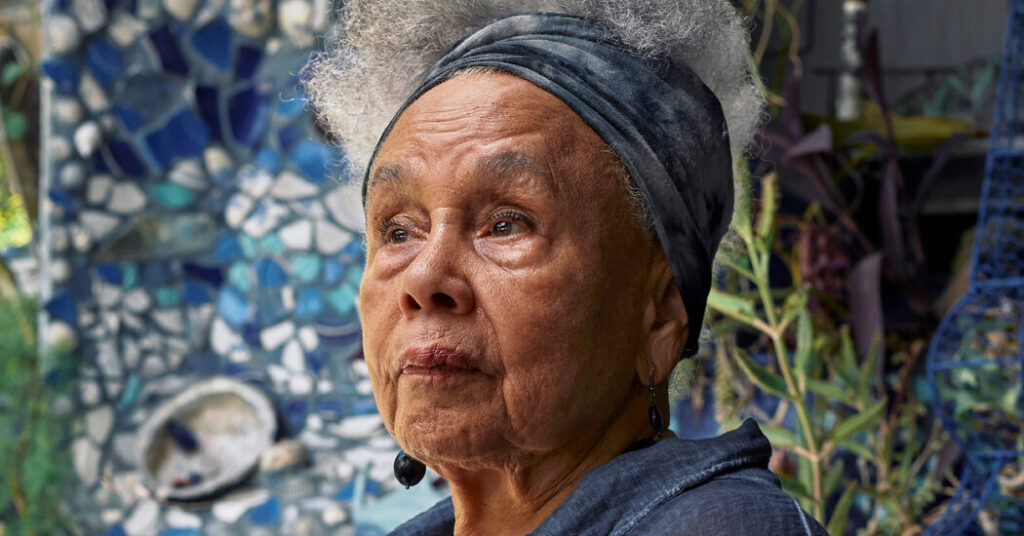
Betye Saar, the groundbreaking California assemblage artist who confronted stereotypes about Black women through her dreamy memento boxes as well as her arresting images of Aunt Jemima armed with rifles and other weapons, died on Sunday at her home in Los Angeles. She was 99.
Hannah Gottlieb-Graham, a publicist for Roberts Projects in Los Angeles, the gallery that represented Ms. Saar, confirmed the death.
Assemblage refers to sculpture made from found objects, and Ms. Saar was a leading practitioner in California starting in the 1960s and ’70s, along with George Herms, Edward and Nancy Kienholz, John Outterbridge and Noah Purifoy.
More than her male counterparts, Ms. Saar was known for incorporating into her work delicate fabrics associated with domestic life, strong images of the Black female body and a heavy dose of spirituality. Her most celebrated pieces from the 1970s served to confront and complicate stereotypes of Black people that were embodied in minstrel characters or figures of Black “mammies,” the women hired to care for white children.
One way that Ms. Saar transformed these derogatory figures, which were easy to find at the time in the form of collectibles, was by arming them. In her acclaimed 1972 assemblage “The Liberation of Aunt Jemima,” inspired in part by her rage after the assassination of the Rev. Dr. Martin Luther King Jr., she supplied a plastic figurine of the character made famous on pancake boxes with a broom, rifle and grenade. The work incorporates emblems of the Black Power movement, from a swath of kente cloth to the image of a raised fist.
In her book “South of Pico” (2017), about Black artists in Los Angeles in the ’60s and ’70s, the art historian Kellie Jones described Ms. Saar’s Aunt Jemima as “incredibly strident, promoting the threat of violence.” Angela Davis described it as the spark that lit the Black women’s revolution.
“I had this Aunt Jemima, and I wanted to put a rifle and a grenade under her skirts,” Ms. Saar told The Los Angeles Times in 2016. “I wanted to empower her. I wanted to make her a warrior.”
Betye Irene Brown was born on July 30, 1926, in Watts, Calif., shortly after the town was annexed by Los Angeles. She was the oldest of three children of Jefferson Maze Brown and Beatrice Lillian Parson, both of mixed heritage: African, Native American and Irish on her mother’s side, and African and Choctaw on her father’s. Mr. Brown died when she was 5, and Betye grew up in Pasadena with her mother.
In a 2011 oral history for the Getty Research Institute, Ms. Saar described her upbringing as middle class and not entirely segregated. The public pool and parks were, she recalled, but theaters and streetcars were not.
Her mother was a seamstress, and Ms. Saar grew up making things — at art classes at school and on her own, often creating gifts for friends and family. She spent her last two years of high school studying ceramics, illustration, watercolors and art history at Pasadena Junior (now City) College.
In 1949, she graduated from the University of California, Los Angeles, where she majored in design, and found work designing jewelry, home goods and greeting cards before starting her career as a printmaker.
Ms. Saar credited her interest in assemblage to two influences. One was the slowly growing “Watts Towers,” which she liked to visit as a girl with her grandmother. The Italian immigrant Simon Rodia spent decades building these soaring structures by hand, embedding in concrete an array of broken glass, tile, ceramics and more.
“I was fascinated by how he used bottle caps and corn cobs and broken plates — trash, essentially — to make art, to make something beautiful,” she told The New York Times in 2024. In the Getty oral history, she compared the towers to “strange castles” from the fairy tales that she loved as a girl.
The other eye-opener, she said, was a major exhibition at the Pasadena Art Museum in 1967 of the work of Joseph Cornell, with its array of surrealist-tinged, memento-laden boxes, featuring poetic assortments of marbles, letters, feathers and more. She remembered each box being as dramatically spot-lit as a precious gem.
The Cornell show inspired her to set out to create what she often called her own “magical little worlds.”
Living in the hippie enclave of Laurel Canyon, she began collecting objects from local yard sales, thrift stores, flea markets and more; later she would add items purchased during travels to Nigeria, Senegal, Mexico, Haiti, Brazil and elsewhere.
Ladies’ gloves and brooches, faded family photographs and embroidered handkerchiefs were recurring objects in her work. Images of hands and celestial bodies were also favorites, reflecting her interests in palmistry, astrology and tarot-card reading. When a beloved great-aunt, Hattie Parsons Haynes Keyes, died in the early 1970s, Ms. Saar inherited a trunk filled with personal effects — letters, photographs, handkerchiefs, trinkets — that she began to use, too.
“I’ve always felt that old objects hold a power,” she said in 2024. “They’ve survived, and they have a sense of the previous owner. They have a spirit.”
By the 1970s, Ms. Saar had also begun using actual window frames to contain and organize her artworks, first layering her own prints and drawings in the frames before adding other objects.
One of her most important windowpane assemblages, “Black Girl’s Window” (1969), features in its upper section stars, moons and a lion representing the artist’s astrological sign, Leo, floating above a daguerreotype of the artist’s grandmother. The lower pane shows a dark silhouette of a girl’s face and hands pressed against the window, as if she is some sort of mystic seer gazing across a spiritual divide.
The work has often been read as an expression of a young Black woman’s ancestral yearning and spiritual longing — what the art historian Richard J. Powell has called Ms. Saar’s “version of a crystal ball.”
By the late 1990s, Ms. Saar began revisiting some of her pathbreaking themes and images in new work. For starters, she brought back Aunt Jemima with “newer weapons and a tougher attitude,” as she wrote in a 1998 catalog introduction. One innovation at this time was her use of vintage washboards as her canvas — a symbolic material for exploring the plight, past and present, of Black women.
Ms. Saar exhibited throughout her lifetime. But it was only when she reached her 80s and 90s that she received the international museum attention and scholarship needed to secure her place in the canon. She was awarded several lifetime achievement awards, including one from the International Sculpture Center in New York in 2018.
Carol S. Eliel, the Los Angeles County Museum of Art curator who organized the 2019 exhibition “Betye Saar: Call and Response,” said in an interview in 2018 that Ms. Saar was “not nearly as well known as she deserves, likely because she is Black, a woman and working in Los Angeles — three strikes against her in the art world until all too recently.”
From 1952 to 1970, Ms. Saar was married to the ceramist Richard Saar, who died in 2004. They had three daughters. Their youngest, Tracye, became a writer, while Alison and Lezley became prominent visual artists in Los Angeles in their own rights, showing work with their mother on occasion.
They survive her, along with six grandchildren.
Since 2016, her gallerist, Ms. Roberts, has worked closely with Ms. Saar on a definitive volume of her work, known in the field as a catalogue raisonné.
“I still want to make art,” Ms. Saar told The Times in 2024. “Sometimes in the morning when I wake up, it’s hard to get out of bed, hard to get back into my body and get it to move. But I do it. Not everyone has a reason to get out of bed, something they love to do and that gives their life meaning. I am so lucky that I have that as part of my life.”
Ash Wu contributed reporting.
The post Betye Saar, Artist Who Upended Black Stereotypes, Dies at 99 appeared first on New York Times.